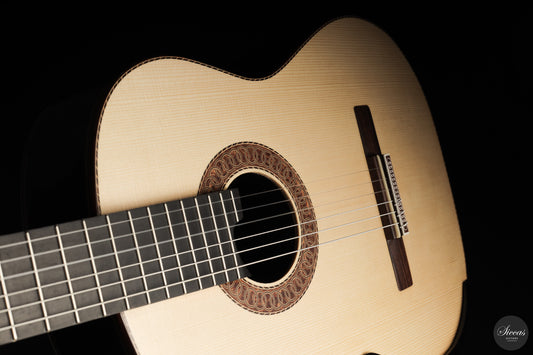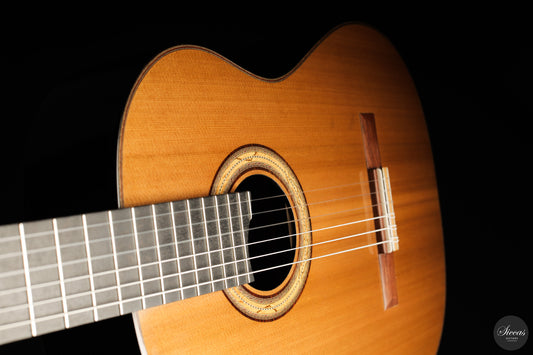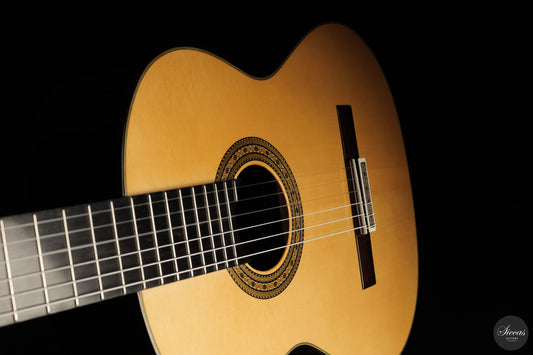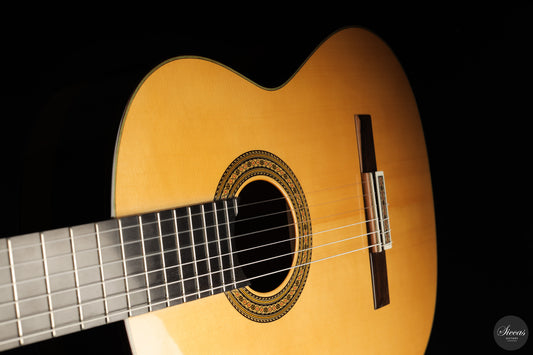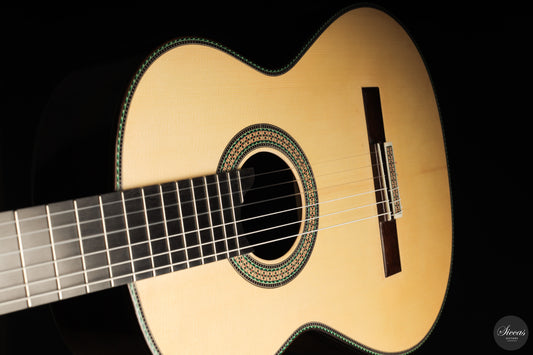

Andreas Kraus builds classical guitars in Berlin, both in the traditional Spanish manner with a solid top and as double tops with a Nomex core. His workshop is in the Kunstfabrik HB55 on Herzbergstraße in the Lichtenberg district. He came to guitar making as a player. His stated aim is a guitar with a quick response, a strong and full tone and comfortable playability.
From player to maker
By his own account, Kraus has played guitar since the age of ten, in many different ensembles. At some point he wanted to know more about how the instrument is constructed, and so he built his first guitar. That project sparked a lasting passion, and he went on to build every kind of guitar he had ever wanted. His first instruments were self-taught. Later he attended workshops with several guitar makers, above all with the Berlin luthier Dennis Tolz.
Making music actively also brought him repair work. Fellow musicians, relatives and friends asked him to look at their instruments, and in this way he gathered broad experience in repairing and restoring all kinds of plucked instruments. For a while he also carried out repairs for a Berlin guitar shop. Today he works as a plucked-instrument maker, and the Berlin Chamber of Crafts is the supervisory body for his business.
Traditional guitars and double tops
Kraus began by building in the traditional way and then experimented more and more with the different concepts of traditional and modern guitar making. Both lines now exist side by side in his workshop. His double tops consist of two thin layers of wood with Nomex between them, and they can be ordered in spruce or cedar. Even with a double top he aims for a sound that stays as traditional as possible but carries more power. To get the greatest possible output from the limited energy available, he makes his tops as light as he can.
Back and sides are mainly East Indian rosewood, with other woods possible on request. Necks are made of cedro or mahogany. His classical guitars come with Barnett tuners as standard, and scale length and neck profile can be adapted to the player.
Kraus also builds steel-string guitars with spruce or cedar tops. Here too he keeps the top light and braces it with a combination of traditional X-bracing and fan bracing. The braces are scalloped to give the top more freedom of movement and to reduce mass. Steel-string models are fitted with Schaller GrandTune tuners.
Repairs and festivals
Repairs remain a second pillar of the workshop: setups, gluing cracks and broken necks, loose or torn-off bridges, fretwork, pickup installation and finish work. He examines each instrument closely and decides on the work together with its owner. Instruments can be handed in at the workshop in Lichtenberg or at his private address in Schöneberg, by appointment only. Kraus speaks German, English and Chinese.
His website lists a regular round of guitar festivals. In recent years these included the Koblenz International Guitar Festival, the festivals in Iserlohn, Berlin and Hamburg, the Aalborg Guitar Festival & Competition in Denmark and, in February 2026, the Folkwang guitar festival in Essen.
Instruments at Siccas Guitars
Siccas Guitars has his double-top guitar 2025-01. We introduced it as a double top with the soul of a traditional guitar, which matches what Kraus himself sets out to achieve with this construction. Readers who want to compare the main bracing concepts will find an overview in our guide to fan-braced, double-top and lattice guitars.