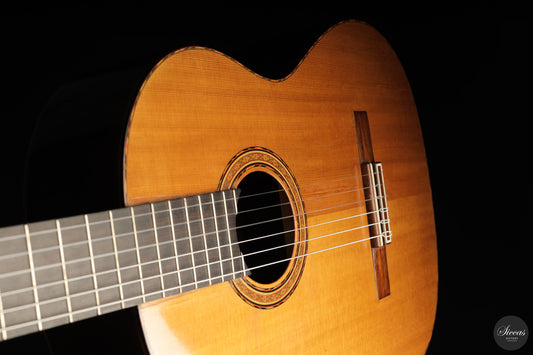
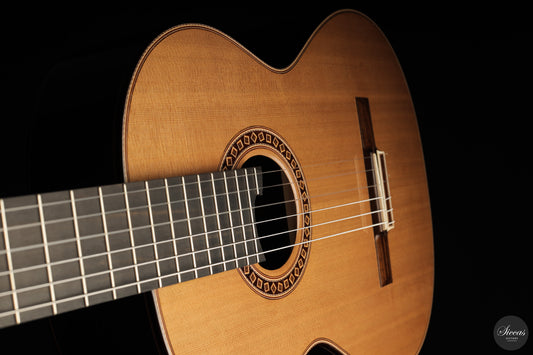
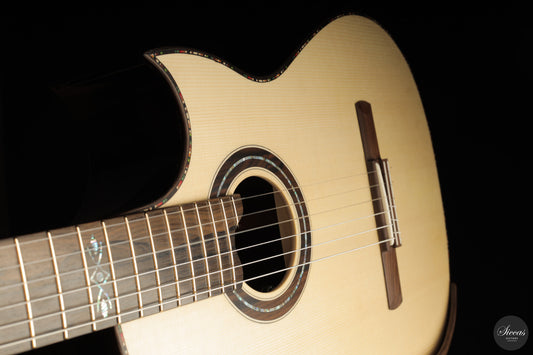
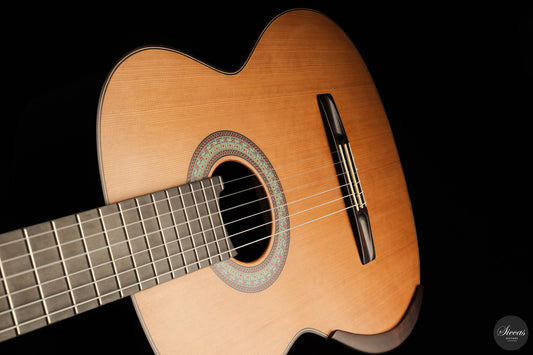
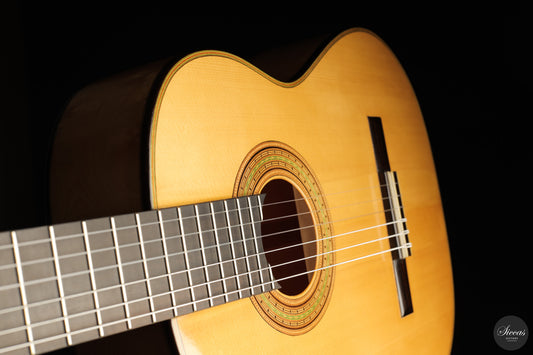
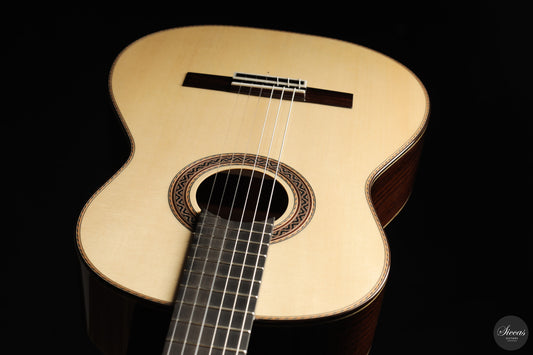
Double Top Guitars – A Revolution in Soundboard Design
Few innovations in the history of the classical guitar have reshaped the instrument's sonic possibilities as profoundly as the double top. By replacing a single solid piece of tonewood with a three-layer sandwich construction — two thin outer skins of spruce or cedar bonded around a Nomex honeycomb core — luthiers discovered a way to build a soundboard that is simultaneously lighter, more responsive, and structurally more stable than anything that came before. The result is a guitar that speaks with unusual immediacy, carries further in a concert hall, and rewards even the most delicate touch with a clarity that traditional tops can struggle to match.
Understanding what a double top actually is, where it came from, and what it means for you as a player or buyer is the aim of this guide. Whether you are considering your first concert-level instrument or looking to add a contemporary voice to your collection, the double top deserves your close attention.
What Is a Double Top? Construction Explained
The term "double top" refers to the three-layer sandwich construction of the guitar's soundboard. Two very thin sheets of tonewood — most commonly European or Canadian spruce, or western red cedar — are separated by a core of Nomex. Nomex is a honeycomb polymer originally developed for the aerospace industry, prized for its extraordinary stiffness-to-weight ratio. In guitar construction it takes the form of a thin hexagonal lattice, typically measuring between two and three millimetres in depth, which is bonded between the two wood skins using epoxy or polyurethane adhesive (water-based glues cannot be used, as they would cause the thin wood layers to warp).
The completed top assembly can weigh up to 25 percent less than a comparable solid-wood soundboard, yet it is significantly stiffer and more resistant to deformation. This means the top can be driven harder by the strings, vibrate more freely across its entire surface, and sustain notes for longer. The pockets of air trapped inside the Nomex layer also act as a buffer against the expansion and contraction caused by changes in humidity — making double top guitars considerably less susceptible to cracking than traditional solid-top instruments.
It is worth noting that "double top" describes the soundboard construction only, not a particular bracing pattern. A double top can be combined with fan bracing, lattice bracing, radial bracing, or virtually any other structural system the luthier prefers. This flexibility has allowed makers to develop a wide range of voices within the double top family. For a deeper comparison of these different approaches, the overview of fan-braced, double top and lattice classical guitars is an excellent starting point.
The Origins: Dammann, Wagner, and the Birth of a Movement
The double top was born in Germany in 1989, when luthier Matthias Dammann began experimenting with a new kind of soundboard. His earliest prototypes used two thin sheets of cedar with a core of tiny cedar strips laminated under pressure — an all-wood construction. The results were encouraging enough to continue, but the real breakthrough came when Dammann's colleague Gernot Wagner proposed replacing the wood core with Nomex. The honeycomb aerospace material offered far greater consistency and a better stiffness-to-weight ratio than anything achievable with wood alone.
Dammann incorporated the Nomex core and the modern double top as we know it took shape. Wagner built his own first double top roughly eight years after Dammann's initial experiments, also using Nomex, and went on to develop the technique into one of the most refined and admired practices in contemporary lutherie. Both men are now regarded as the founding figures of the double top movement — a story told in detail on our dedicated page about double top guitar pioneers Dammann and Wagner.
In the decades since, the double top has been adopted by luthiers across Europe, the Americas, and beyond. Today it stands alongside traditional fan-braced construction and lattice bracing as one of the three principal approaches to building the concert classical guitar. Makers from Florence to Buenos Aires, from Vienna to Tokyo, now offer double top instruments, each interpreting the fundamental design according to their own tonal ideals. To understand how the double top fits within the broader arc of instrument making, it helps to explore the full landscape of classical guitar makers active today.
The Sound of a Double Top Guitar
Players who encounter a well-made double top for the first time are often struck by a combination of qualities they have not previously heard in a single instrument: projection that fills a room effortlessly, an attack that is immediate and well-defined, a sustain that blooms long after the string is released, and a tonal balance across the registers that feels almost engineered rather than discovered. All of these characteristics flow directly from the physics of the construction.
Because the soundboard is lighter, it responds to smaller inputs — meaning pianissimo passages speak clearly and without strain. Because it is stiffer, it couples energy from the strings into the body of the guitar more efficiently, driving greater volume without requiring the player to dig in. The Nomex core damps certain high-frequency resonances, which gives the double top its characteristic warmth and reduces the harshness that can appear in lattice-braced instruments pushed to their limits.
In tonal character, double tops tend to occupy a middle ground between traditional fan-braced guitars — warm, complex, sometimes slightly intimate in projection — and full lattice instruments, which can be extremely loud but occasionally lack the woody depth of older designs. The double top offers concert-level volume alongside a tonal palette that remains accessible and musical. It is particularly well suited to the modern concert repertoire, where projection and clarity of line are at a premium, but it is equally at home in chamber settings and recording studios.
That said, no two double tops sound alike. The choice of spruce versus cedar for the outer skins, the depth and density of the Nomex layer, the bracing pattern, the back and sides materials, and the individual character of the luthier's voicing all contribute to the final result. A cedar-topped double top from one maker may be rich and immediate; a spruce-topped instrument from another may be crystalline and singing. This diversity is one of the great pleasures of the form.
Double Top vs. Traditional and Lattice Guitars: How to Choose
If you are deciding between a double top, a traditional fan-braced guitar, and a lattice instrument, the most useful guide is your own playing context and tonal priorities.
Traditional fan-braced guitars — the lineage running from Antonio de Torres through Ignacio Fleta and Daniel Friederich — remain the benchmark for complexity and harmonic depth. They reward a refined right-hand technique and excel in intimate settings. If your playing leans toward the Romantic and early twentieth-century repertoire and you prize nuance and colour above all else, a fine traditional instrument may still be the right choice.
Lattice guitars, pioneered by Greg Smallman in Australia from the late 1970s onward, offer maximum volume and sustain, often at the cost of a slightly drier, more percussive tone. They are the choice of players who perform in large venues without amplification and need every decibel the instrument can produce.
Double tops thread a course between these poles. They are the instrument of choice for players who need concert-level projection but do not want to sacrifice the warmth and tonal complexity of a more traditional construction. Many leading soloists — including those who perform with Manuel Barrueco and David Russell — have made double tops their primary concert instruments precisely because they do not force a compromise between power and beauty.
From a practical standpoint, double tops also offer better humidity resilience than solid-top instruments, which matters considerably for touring musicians or players who live in climates with pronounced seasonal variation. The Nomex core helps stabilise the top against the stresses of changing conditions, reducing the risk of cracks and making the instrument somewhat easier to care for over the long term.
What to Look for When Buying a Double Top Guitar
When evaluating double top guitars, begin with the soundboard materials. European spruce tends to produce a brighter, more articulate tone with excellent headroom that develops further with playing time. Cedar responds quickly and warmly from the outset, making it a popular choice for players who want immediate colour and intimacy. Some makers use spruce on one face and cedar on the other, creating a hybrid response.
Pay attention to the Nomex depth and density, which the luthier will usually be able to describe. A thicker core creates a stiffer top with greater projection potential; a shallower core allows more flexibility and a warmer, more complex response. The bracing pattern layered onto the double top construction will further shape the outcome — a maker who combines a double top with lattice bracing is building toward maximum power, while fan bracing on a double top tends to preserve more of the traditional tonal profile.
Play the instrument at different dynamic levels and in different positions. Double tops should feel responsive from the quietest pianissimo to a full fortissimo — if the guitar feels congested at high volume or thin at low volume, the voicing may not be optimal. Listen for the sustain tail on single-note lines; a well-made double top will show a long, singing decay that is one of the signature pleasures of the construction.
Finally, consider the luthier's track record and their relationship with professional players. A double top guitar is a significant investment, and makers who work at the highest level — those whose instruments appear in the hands of recording and touring soloists — bring a depth of craft that is audible and palpable in the instrument. The Siccas Guitars collection includes double top instruments from many of the world's most respected contemporary makers, offering an opportunity to compare approaches and find the voice that speaks most directly to your own musicianship.