
Antonio Marchese – A New Voice in the Italian Classical Guitar Tradition
Antonio Marchese belongs to a generation of Italian luthiers who approach the classical guitar with both scholarly rigour and genuine artisanal passion. Born in 1992 in Aosta, he has built a reputation for instruments that honour the Spanish tradition while bearing a distinctly personal aesthetic — one defined by hand-assembled wooden mosaic ornamentation and the warm, luminous depth of French polish. Still in his early thirties, Marchese is already recognised as one of the most promising voices among contemporary classical guitar makers.
Formation: Milan, Voghera, and the Spanish Lineage
Marchese's training was thorough and deliberately unhurried. He enrolled at the Civica Scuola di Liuteria in Milan, one of Italy's most respected instrument-making schools, completing a six-year programme. The first four years immersed him in the construction of plucked instruments alongside the study of organology, acoustic physics, and the chemistry of woods and finishes. The final two years turned his attention to the restoration of historical instruments — a discipline that sharpens the eye and the hand in ways new construction alone cannot.
After graduating, Marchese sought practical depth by joining the workshop of master luthier Enrico Bottelli in Voghera, near Pavia. Working first as an apprentice and eventually as a collaborator, he absorbed Bottelli's deep engagement with the instruments of the Spanish tradition. That influence has never left him: it shapes every structural decision he makes, from the geometry of the top to the choice of bracing. Just as figures like Ignacio Fleta drew on the accumulated knowledge of Spanish guitar making while forging their own identity, Marchese has used the same tradition as a foundation rather than a constraint.
During his years of training he also participated in significant cultural projects that widened his perspective. He contributed as a maker and restorer to the exhibition Caravaggio e Monteverdi: sonar stromenti e figurar la musica at the Violin Museum in Cremona in 2017, and to the Le Mani Sapienti project promoted by the Fondazione Antonio Carlo Monzino — first at the Castello Sforzesco in Milan during Expo 2016, and later at LAC Lugano Arte e Cultura in Switzerland. These experiences connected his craft to a broader historical and cultural conversation about the place of the instrument in Italian artistic life.
The Workshop in Montafia: Craft at the Heart of Monferrato
In 2019, Marchese opened his own atelier in Montafia, a small village set among the hills of Monferrato in the Piedmont region. The location is not incidental: Piedmont has a long and underacknowledged history of instrument making, and working there places Marchese within a living tradition rather than apart from it. His teaching role at the Accademia Liuteria Piemontese San Filippo in Turin, which he took on after several years of teaching varnishing at the Civica Scuola di Liuteria in Milan, reinforces that commitment to passing the craft forward.
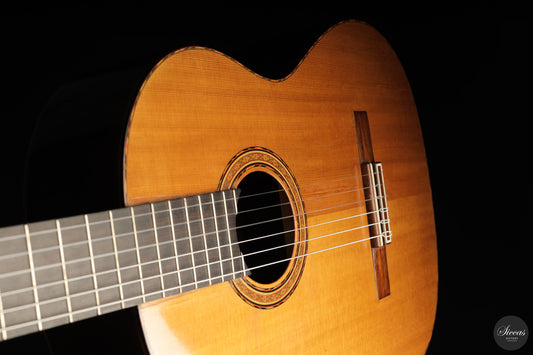
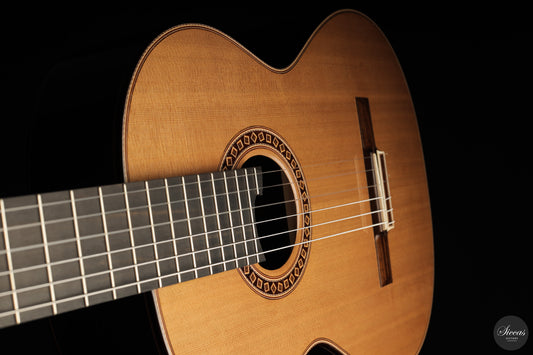
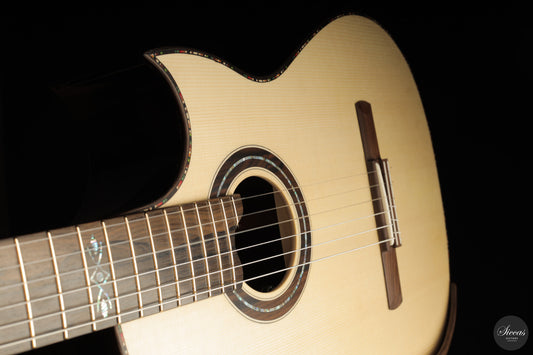
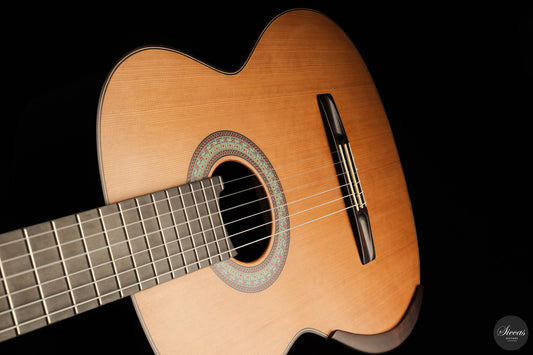
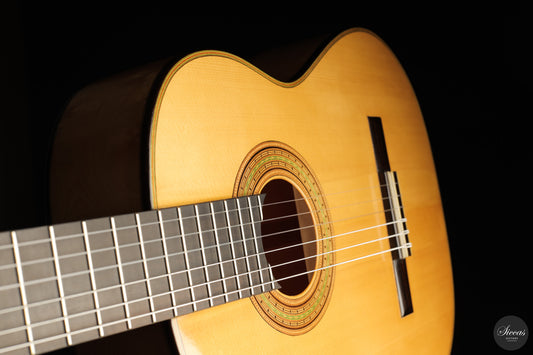
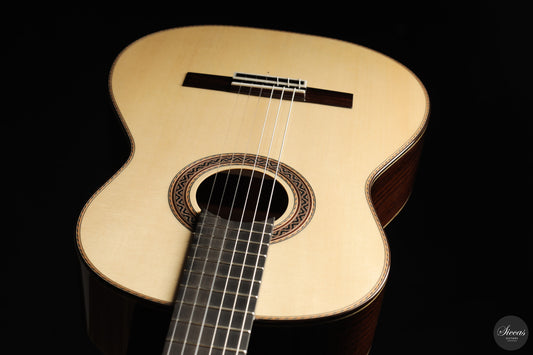
The workshop itself operates at a deliberately measured pace. Marchese builds original models alongside carefully researched historical copies, and every guitar passes through the same meticulous finishing process. His French polish — applied in the traditional shellac technique refined over many years — gives his instruments a visual warmth that complements their acoustic character. The hand-assembled wooden mosaic work on rosettes and decorative borders is entirely his own, each piece assembled from individual marquetry elements rather than prefabricated strips.
Construction Approach: Spanish Roots, Asymmetrical Intelligence
The architecture of a Marchese guitar reflects sustained study rather than simple homage. His "Garcia" model, for instance, was developed through meticulous examination of three historical Garcia instruments and an early-period Simplicio — the goal being to understand and internalise construction principles rather than replicate any single guitar. The result is an 8-fan bracing system with two closing bars and no bridge plate, executed asymmetrically: narrower, taller braces on the treble side for clarity and brilliance, wider and lower braces on the bass side for depth and resonance.
This kind of structural differentiation between the two halves of the top is a sign of a luthier thinking acoustically, not just aesthetically. The soundboards he favours — often Val di Fiemme spruce, harvested from the same Trentino forests associated with the great violin-making tradition — are graduated to between 1.6 and 1.8 mm, a thinness that demands confidence in joinery and bracing alike. Back and sides in exotic satinwood, combined with premium Gabon ebony fretboards, complete instruments that are coherent from every angle. The connection between this approach and the broader fan-braced tradition in classical guitar making is clear, yet Marchese's voice within it is distinctly his own.
His labels, too, carry a sense of historical seriousness: some instruments have been finished with labels printed on paper dating to the second half of the 18th century, a small but telling gesture toward the long continuity of this craft.
A Place in the Italian Luthiery Landscape
Italy has always produced luthiers of distinction, and the classical guitar — often seen as a Spanish domain — has found genuine champions on Italian soil. The Florentine tradition represented by makers like Andrea and Giovanni Tacchi and the collaborative spirit behind the Italica project both speak to the depth of this culture. Marchese belongs to this world, contributing from Piedmont a sensibility shaped equally by the alpine north and the Spanish south — rigorous in structure, refined in finish, and attentive to the decorative dimension of the instrument in a way that recalls the great historical makers without imitating them.
His guitars have found their way to serious players who value the combination of tonal clarity, dynamic responsiveness, and visual beauty that defines his work. At a scale of 650 mm with a 51 mm nut, his instruments are built for the professional repertoire, capable of the full dynamic and expressive range that the concert stage demands.
Browse available Antonio Marchese guitars → in the Siccas Guitars collection.