
Ashley Sanders – A Master of Lattice-Braced Concert Guitars from Australia
Ashley Sanders occupies a distinctive place among the world's finest classical guitar makers: a self-taught craftsman turned master luthier, working from a small coastal town in South Australia to produce instruments that rival those of the great European workshops. His guitars are renowned for combining exceptional projection with a rare warmth and sweetness of tone — a balance that is notoriously difficult to achieve, especially with the lattice bracing method he has made his signature. In a field where output often takes precedence, Sanders builds only a handful of instruments each year, each one the product of unhurried, meticulous attention.
From Cabinet Maker to Concert Guitar Builder
Sanders' path to lutherie began not in a guitar workshop but in the joinery trade. As a teenager, he built an electric guitar with minimal tools and virtually no prior experience — the result was playable, imperfect, and revelatory. That early experiment planted a seed that would take decades to fully flower. In the intervening years, Sanders worked as a Saturday apprentice with professional guitar repairer Nick Court, absorbing the fundamentals of guitar construction and repair before pursuing a formal cabinet making trade certificate, which he completed with distinction.
For more than two decades, he ran his own bespoke furniture business, crafting custom pieces for private clients, antique dealers, and interior designers. Working daily with mahogany, oak, Australian blackwood, and maple, he developed a deep understanding of how timber moves, responds to humidity, and behaves under tension — knowledge that would later prove invaluable at the guitar bench. He mastered finishing techniques including lacquering, oil finishing, and French polish, all of which remain central to his guitar making practice today.
The transition to full-time guitar making came gradually. Sanders observed the decline of the precious hardwood species that had sustained the furniture trade and recognized that a golden era for those timbers was drawing to a close. As that chapter ended, the guitar re-entered his life with renewed urgency, and he committed himself entirely to lutherie. His workshop is now based in Port Elliot, a quiet coastal town roughly ninety minutes south of Adelaide, where the unhurried rhythm of the place suits his methodical approach to the craft.
Construction Philosophy and the Lattice Approach
Sanders approaches guitar building as a process of continuous, careful refinement. Early in his lutherie career he worked with traditional fan bracing, then explored radial bracing, before arriving at the lattice method — the same high-performance approach associated with the pioneers of the modern concert guitar. Lattice bracing replaces the conventional wooden fan struts with a lightweight grid, typically of carbon fibre and balsa, allowing the soundboard to be made thinner and to vibrate more freely. The result is a guitar with exceptional volume and sustain, capable of filling a concert hall without sacrificing the tonal complexity that serious players demand.
What distinguishes Sanders' approach is his insistence on original design rather than imitation. He developed his own body template and has refined his bracing geometry through years of methodical experimentation, making one change at a time so that each variable can be assessed in isolation. This disciplined methodology — rare in any craft — means that every improvement is understood, not merely stumbled upon. The guitars that emerge from this process are described consistently as powerful yet sweet-voiced, a combination that is genuinely unusual and that reflects both the quality of his materials and the precision of his construction.
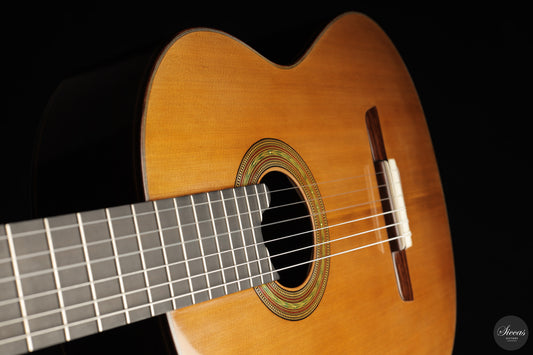
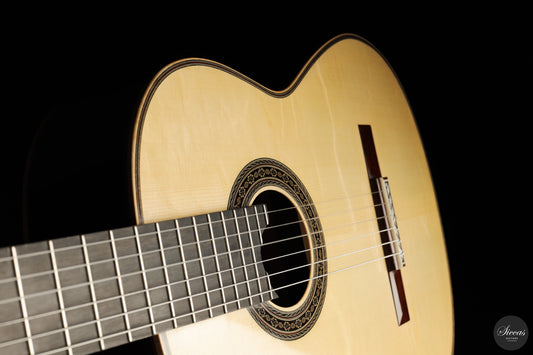
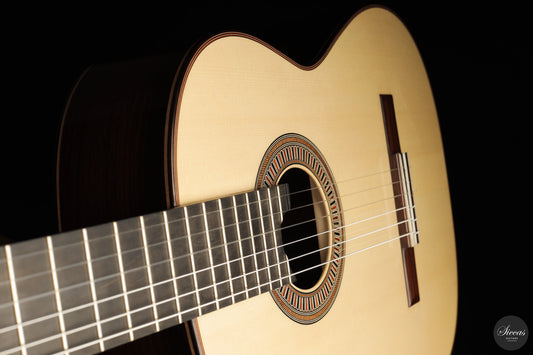
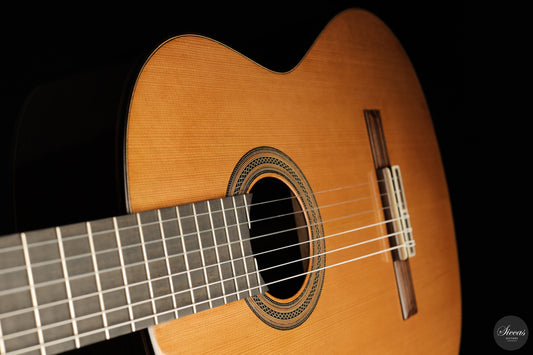
Sanders selects his tonewoods with equal care. Soundboards are cut from master-grade cedar or Swiss spruce. Bodies are built in East Indian rosewood, ziricote, pommel sapele, or Australian blackwood, the latter a nod to the native timbers of his homeland. Necks are fashioned from Fijian or Brazilian mahogany. In recent years, Sanders has also shown a commitment to sustainability, incorporating alternative tonewoods such as burl ash as fine-quality traditional species become increasingly scarce. This willingness to adapt reflects the same open-minded curiosity that led him from fan bracing through radial to lattice — a craftsman always in dialogue with his materials.
A Guitar for the Concert Stage
Sanders builds to concert standard, and his instruments have attracted the attention of professional players seeking something beyond the mainstream European market. His guitars are scaled at 650 mm, the conventional concert length, and are voiced for the demands of the recital stage: broad dynamic range, clear separation across registers, and a sustain that supports long musical lines. The finish work, grounded in his decades of furniture-making experience, is immaculate — a reminder that the visual and tactile qualities of a fine guitar are inseparable from its acoustic character.
The small annual output — typically around three instruments — means that each guitar receives the full depth of Sanders' attention. There is no production line, no delegation, no compromise. Every decision, from the selection of the top wood to the final shaping of the headstock, is made by the same pair of hands. This intimacy of making is something Sanders regards not as a limitation but as the defining condition of his work. It places him in a lineage of solitary masters — thinkers as much as makers — whose instruments carry a singular voice. One thinks of figures such as Daniel Friederich, whose lifelong insistence on individual craftsmanship set a standard that continues to shape the field.
Recognition and the Australian Guitar Tradition
Australia has produced a small but remarkably distinguished group of classical guitar makers, and Ashley Sanders is firmly among its leading figures. His work has been represented internationally since at least 2010, when specialist dealers began recognising the quality of his instruments on the world stage. Reviews from players and collectors consistently highlight the combination of power and tonal sweetness that defines his best guitars — qualities that are directly traceable to his construction choices and his exacting standards of timber selection and finishing.
The broader tradition Sanders contributes to is one shaped by an eclectic range of influences, from the great Spanish workshops of Ignacio Fleta and José Luis Romanillos to the high-performance innovations of the late twentieth century. Sanders has absorbed these influences while forging a voice that is unmistakably his own — grounded in the Australian landscape and its native timbers, yet fully engaged with the international conversation about what a concert guitar can be. His work is a reminder that world-class lutherie is not confined to any single country or tradition, and that the finest instruments can emerge from the most unexpected places.
Browse available Ashley Sanders guitars → in the Siccas collection.