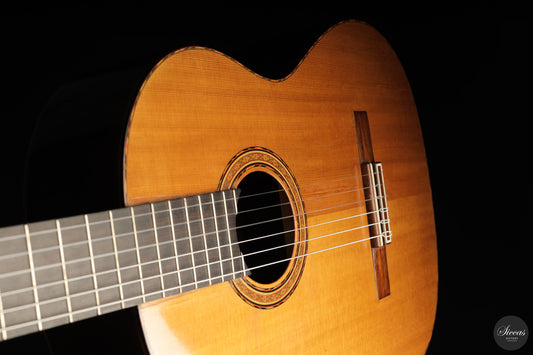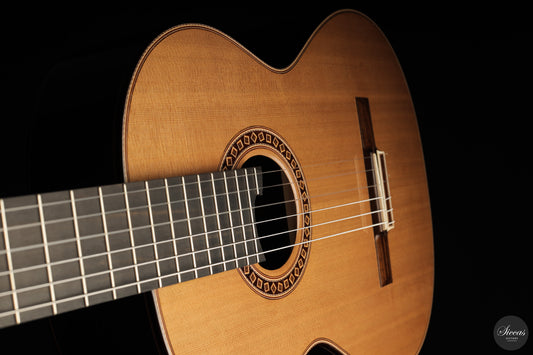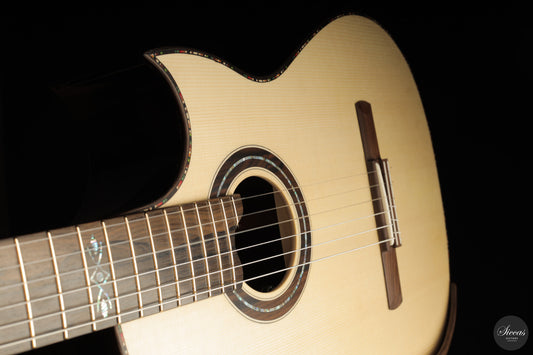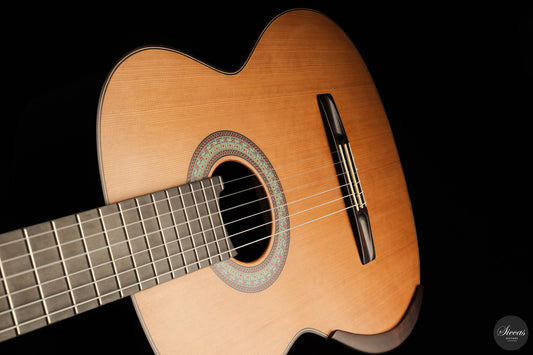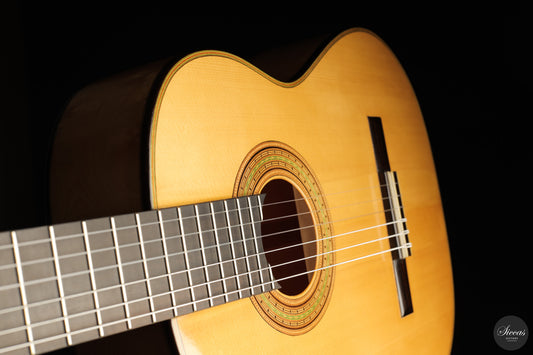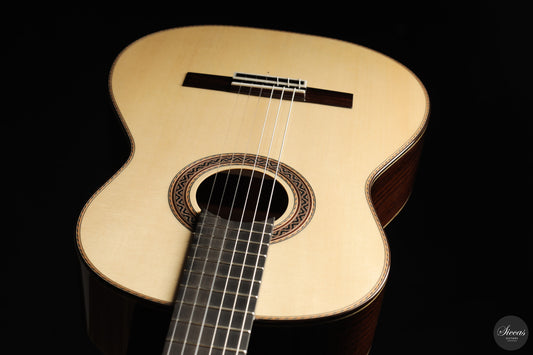

Chiara Frisio is one of Italy's most compelling emerging luthiers — a Milanese maker whose workshop brings together the rigour of historical instrument building and the warmth of the traditional classical guitar. Trained at one of Europe's finest lutherie schools and shaped by years of hands-on mentorship, Frisio works across a remarkably broad range: from fan-braced concert guitars to six-course Renaissance lutes and rare baroque mandolins. Her instruments have attracted growing attention among discerning players, and her classical guitars are available through Siccas Guitars, the world's leading classical guitar dealer.
Biography & Training
Chiara Frisio was born and raised in Milan, in a home filled with music. Her mother taught piano at the local conservatory, giving Frisio an early and natural exposure to musical culture. She began playing the violin at the age of six and continued for several years before gravitating towards the guitar and electric bass — instruments whose physicality and tactile immediacy suited her temperament more closely.
The turning point came during high school, when Frisio found herself repairing her own bass guitar. That encounter with the instrument from the inside — its structure, its voice, its vulnerability — fascinated her completely. After graduating from school, she enrolled in the four-year lutherie programme at the Civica Scuola di Liuteria di Milano, one of the most respected institutions of its kind in Europe. There, under teachers including Roberto de Miranda, Silvia Zanchi, Ivan Bruna, and Bob van de Kerckhove, she absorbed both the technical and historical dimensions of instrument making across many traditions of plucked instruments.
A defining moment arrived in her third year of study, when she built a copy of a six-course mandolin by the Milanese maker Giuseppe Presbler. The project ignited a lasting passion for early mandolin forms and historical lutherie that would run alongside her guitar work throughout her career.
After graduating as Maestro Liutaio, Frisio spent several years in the workshop of the respected Milanese luthier Lorenzo Lippi, where she deepened her expertise in Embergher mandolins, bresciano mandolins, and Neapolitan baroque mandolins. She also collaborated with Maestro Federico Gabrielli on early mandolin projects, further broadening her command of historical forms. This post-graduate period transformed her from a skilled student into a fully rounded professional maker.
Construction Philosophy
Frisio's classical guitars are built using traditional Spanish construction methods, drawing primary inspiration from the work of Hermann Hauser. Her instruments feature a seven-strut fan brace and an underbridge plate — a combination that lends the guitars a tonal profile described as rich, warm, and balanced across all registers, full of harmonics and expressive depth. For Frisio, the acoustic result is inseparable from the physical experience of playing: she pays close attention to setup, neck measurements, and neck shaping, ensuring that every instrument is not only beautiful in sound but genuinely comfortable to play over the course of a career.
This dual focus — on voice and on the player's body — reflects an understanding of the guitar as a long-term companion rather than a static object. Her instruments are built to grow with the musician who plays them, becoming more responsive and revealing with time. Understanding the relationship between structural choices and acoustic outcomes is central to her approach; readers interested in how different bracing systems affect the sound of a classical guitar will find useful context in the overview of fan-braced, double-top, and lattice guitars.
Beyond the guitar, Frisio's construction practice encompasses lutes and a wide range of historical mandolins. Her Renaissance lutes are built after historical models — including the eight-course Hieber pattern — using spruce tops with flamed maple back and sides and traditional wax soundboard finishes. These instruments sit within a centuries-old continuum of Milanese lutherie that stretches back to the great makers of the early modern period. Italy has a particularly distinguished legacy in this area, as explored in the article on Italica and the Italian master luthier tradition.
Signature Models
Frisio numbers her classical guitars sequentially, each one a hand-built individual rather than a production model. Her concert guitars are typically built with a spruce top and Indian rosewood back and sides, finished in French polish, with a 650 mm scale length and Gotoh machine heads. The instruments are light in weight — around 1,550 to 1,650 grams — a characteristic that contributes to their responsiveness and tonal openness. Each guitar is tuned and measured for its air body frequency, a detail that speaks to Frisio's precise and methodical approach to acoustics.
Her Renaissance lutes — built after the eight-course Hieber model — use spruce tops paired with flamed maple ribs, finished in wax rather than lacquer to preserve the natural resonance of the soundboard. At around 750 grams, these are delicate instruments whose every structural choice is governed by historical practice and acoustic sensitivity. Frisio's breadth as a maker — spanning concert guitars, lutes, and early mandolins — places her in a tradition of broad-based Italian lutherie well worth understanding. The work of other distinguished Italian makers is celebrated in the profile of Andrea and Giovanni Tacchi.
Notable Players
As a relatively young maker, Frisio is in the process of building the community of players who carry her instruments onto the concert stage. Her guitars have been acquired by professional and advanced players who value the combination of tonal warmth, playability, and the individuality of a hand-built Italian instrument. The growing catalogue of her work available through Siccas Guitars has introduced her instruments to a global audience of serious classical guitarists. The question of how concert guitarists choose and use their instruments is one explored in depth in the article on how concert guitarists practice.
Legacy
Chiara Frisio represents a generation of Italian luthiers who have emerged from rigorous formal training and deep workshop apprenticeships to develop genuinely individual voices. Her ability to move fluently between the classical guitar and the early instrument world — building Hauser-inspired concert guitars alongside Renaissance lutes and baroque mandolins — gives her work an unusual breadth and historical awareness. Her Milan workshop, open by appointment on the Via Vetta d'Italia, is the centre of a practice that is still young but already marked by seriousness of purpose and refinement of craft. The great makers who have defined the classical guitar's sonic tradition — figures explored in the overview of classical guitar makers — provide the larger context within which Frisio's work is finding its place.
Browse available Chiara Frisio guitars → in the Siccas Guitars collection.