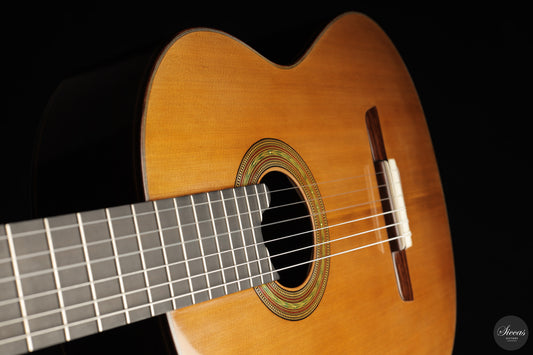
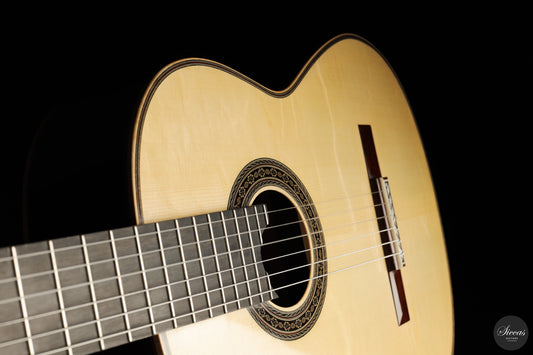
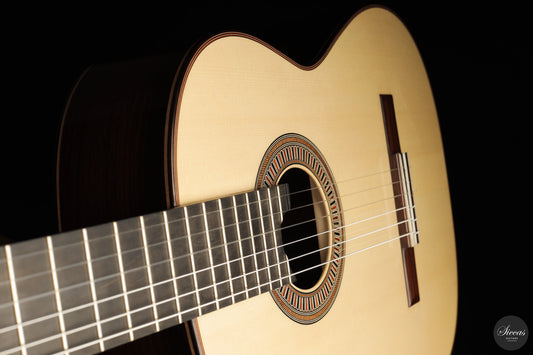
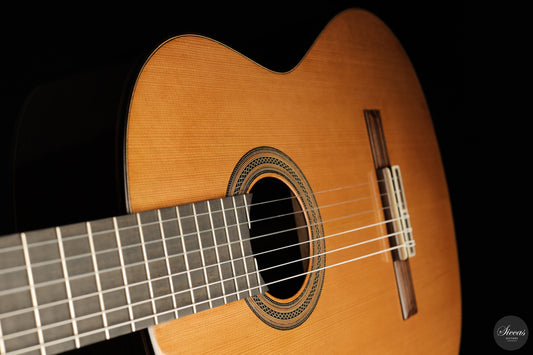
Christopher Dean stands among the most respected classical guitar makers to emerge from Britain in the modern era. Working from his workshop in Kingham, Oxfordshire — in the heart of the Cotswolds — Dean has been crafting concert-level instruments since 1985, building a reputation that extends far beyond the United Kingdom. His guitars are known for their refined aesthetics, powerful yet balanced tone, long sustain, and unmistakable clarity. The Eden-Stell Guitar duo, one of the many celebrated ensembles to have played his instruments, describes them as possessing "clarity, warmth, projection, and a myriad of possible sounds," calling Dean "a true craftsman — one of the best guitar builders in the world." That kind of testimony, coming from players who have access to instruments by any maker on earth, speaks volumes about the standing Dean has earned over four decades of dedicated work.
Biography & Training
Born in 1958 in Lincoln, England, Christopher Dean showed an early aptitude for both art and making things with his hands. As a teenager he also began learning the guitar, and these interests converged when he built his first classical guitar on his parents' kitchen table — a formative moment that would set the course of his life. Having considered a career in agriculture, he made the decisive turn toward lutherie by applying for a place at the London College of Furniture, where he studied Musical Instrument Technology with a specialisation in modern fretted instruments. The course proved formative in more ways than one: study visits brought him into contact with two giants of British and Spanish lutherie, José Luis Romanillos and Paul Fischer, whose influence would shape his subsequent development.
After graduating, Dean spent a year making furniture in New Zealand before returning to England to work as Paul Fischer's assistant. Those two years at Fischer's side gave him a thorough grounding in both the craft of guitar making and the practical realities of running a workshop. In October 1985, he set up his own independent workshop and has worked exclusively on his own instruments ever since — with the occasional exception of restoration work on guitars by historical masters such as Santos Hernández and Hermann Hauser. That willingness to engage with the great instruments of the past reflects the depth of his engagement with the tradition he has inherited.
Construction Philosophy
Dean describes himself, with characteristic modesty, as "a refiner of an art, not an innovator." This is not a lack of ambition; it is a considered commitment to the long tradition of classical guitar making, one in which incremental refinement and deep listening to the instrument are valued above novelty. His design priorities are disarmingly direct: he aims for "good volume, clarity and a good balance across its range, and a guitar with character." The emphasis on character is telling — he is passionate about the transformation from inert wood into a living instrument with its own personality, and he aims for a guitar that looks and sounds intuitively right in all its proportions.
Dean builds fan-braced concert guitars, working within the tradition established by the great Spanish masters and refined by makers like Daniel Friederich. He also produces lattice-braced instruments, with his lattice constructed entirely from wood — no carbon fibre — which he believes preserves a more organic tonal response. For finishing, he uses French polish with shellac exclusively, occasionally applying oil finishes to soundboards. He is convinced that synthetic finishes can inhibit the natural vibration of a well-made guitar, and that shellac not only frees the wood to resonate fully but also permits easier repairs in the future. This long-term thinking — building instruments that will be playable and serviceable for generations — is characteristic of his approach.
For those curious about how fan bracing compares with other structural approaches, the guide on fan-braced, double top and lattice guitars offers useful context.
Tonewoods & Signature Models
Dean's choice of tonewoods reflects both deep knowledge and pragmatic flexibility. He works extensively with European spruce for soundboards, valuing its clarity and dynamic range. For the back and sides, he uses Indian rosewood and — where available and CITES-compliant — Rio rosewood (Brazilian rosewood, Jacaranda). He notes a meaningful difference between the two: Rio provides "slightly more instant reflection and projection," while Indian rosewood is "possibly warmer." The neck is typically South American mahogany or cedrela, and the fingerboard ebony. He has also produced a number of shorter-scale guitars — many built to 640 mm — specifically designed for players with smaller hands, without any compromise in volume or tonal quality. This attentiveness to the practical needs of real players is a thread that runs through everything he does.
Dean numbers his instruments sequentially, a practice that reflects both his pride in each guitar and his commitment to transparency with buyers. Instruments in the Siccas Guitars collection, such as his No. 508 from 2022, illustrate the consistency and refinement that define his output across different periods of his career.
Notable Players
Dean's guitars have found their way into the hands of a wide range of professional musicians. The Eden-Stell Guitar duo — Chris Eden and Graham Stell, one of the most acclaimed guitar duos in the world — have been among his most celebrated advocates. Concert guitarist Tillman Hopstock, Eleftheria Kotzia, and Simon Dinnigan (members of the Vida Quartet) have also played his instruments. The breadth of this roster, spanning solo performers, duos, and chamber ensembles, points to the versatility of Dean's guitars: instruments that speak convincingly in a variety of musical contexts and respond equally well to different playing styles and repertoires.
Legacy
Christopher Dean has been building guitars from his Cotswolds workshop for over four decades. In that time, he has established himself as one of the defining voices in British lutherie — an maker who has consistently placed craft, integrity, and musical intelligence above trend or fashion. His decision to work slowly and carefully, focusing on a small number of instruments per year, has ensured that every guitar that leaves his workshop meets the highest possible standard. He has also undertaken the restoration of instruments by Santos Hernández and Hermann Hauser, situating his own work within a lineage that stretches back to the founding figures of the modern classical guitar. For players and collectors seeking an instrument that combines the best of the British tradition with an uncompromisingly musical sensibility, a Dean guitar represents one of the finest choices available today.
Browse available Christopher Dean guitars → in the Siccas Guitars collection.