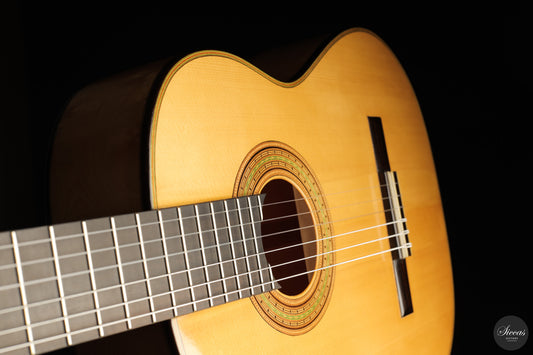
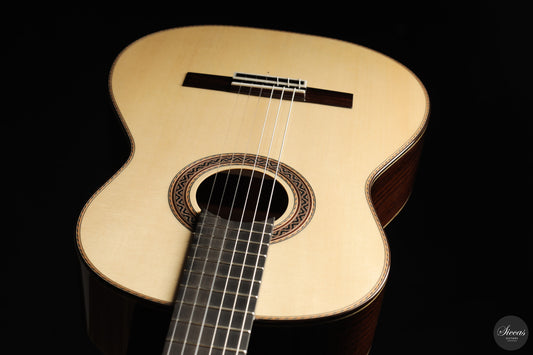
Few names in contemporary classical guitar making carry the weight of Gernot Wagner. Based in Frankfurt, Germany, Wagner is widely recognised as one of the co-inventors of the double-top soundboard — a construction method that has fundamentally reshaped what players and audiences expect from a concert guitar. Over more than four decades at the bench, he has combined rigorous craft training with an experimentalist's curiosity, producing instruments that have found their way into the hands of internationally acclaimed soloists and onto the stages of major concert halls worldwide. His work sits at the very centre of the conversation about classical guitar makers who have genuinely changed the instrument.
Biography and Training
Gernot Wagner was born in 1956 and grew up in Frankfurt. His path into lutherie was shaped by a deep personal love for the guitar — he has described wanting to build instruments he himself would love to listen to and play. In 1984 he left Frankfurt to establish a workshop in Eastern Bavaria, putting distance between himself and city life in order to focus entirely on the craft. It was there, in relative quiet, that his approach to guitar making began to crystallise.
His formal training came at the renowned Instrumentenbauschule in Mittenwald — Germany's most prestigious school for musical instrument makers — where he earned the title of Master Guitar Maker. The Mittenwald school grounds its students in the full arc of European instrument-making tradition, and Wagner absorbed those foundations thoroughly. He emerged as a craftsman with an unusually strong grasp of acoustical principles alongside the technical disciplines of woodworking and finishing. In 1988, before the double-top had even been developed, he won the Grand Prix at the Paris/ORTF International Guitar Maker Competition, an early signal that his instruments were already operating at an exceptional level.
Construction Philosophy
Wagner's defining contribution to lutherie is the composite double-top soundboard, developed together with fellow German maker Matthias Dammann in the late 1980s. The innovation centres on a Nomex honeycomb core — the same lightweight cellular material used in aerospace engineering — sandwiched between two extremely thin layers of tonewood, typically cedar or spruce. The resulting soundboard is dramatically lighter than a conventional top while remaining highly rigid across its surface. This combination of low mass and high stiffness is acoustically significant: it allows the top to respond to the player's touch with exceptional speed and sensitivity, producing a sound characterised by greater projection, longer sustain, and a complex, multi-layered tonal palette.
Wagner and Dammann arrived at the Nomex sandwich construction through genuine experimentation rather than theoretical prediction, refining the thicknesses, materials, and bracing configurations over many years of trial and careful listening. Their collaboration is explored in depth in the Siccas Guitars article on double-top guitar pioneers. Wagner has continued refining his methods for over three decades, and today his instruments represent some of the most evolved expressions of the double-top concept. He has also built lattice-braced guitars, and his 1992 lattice model stands as evidence of his willingness to explore multiple structural approaches to the problem of acoustic performance. For players wanting to understand the broader context of these construction families, the guide to fan-braced, double-top and lattice guitars provides useful orientation.
Beyond the soundboard, Wagner pays close attention to every element of the instrument — neck geometry, body depth, scale length, and the selection and treatment of tonewoods. His workshop output is deliberately limited, allowing him to give each guitar the degree of individual attention that distinguishes a hand-built concert instrument from a production model. He does not seek volume; he seeks quality and consistency at the highest level.
Signature Models and Instruments
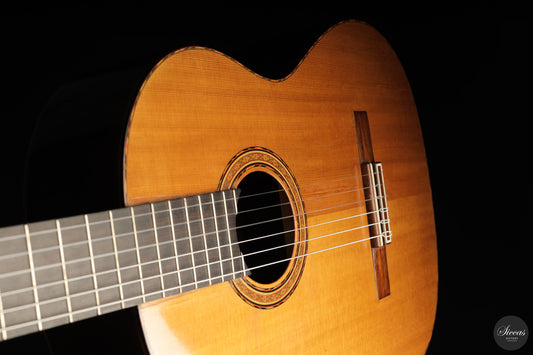
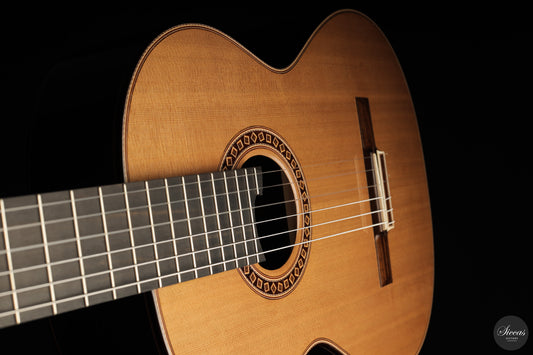
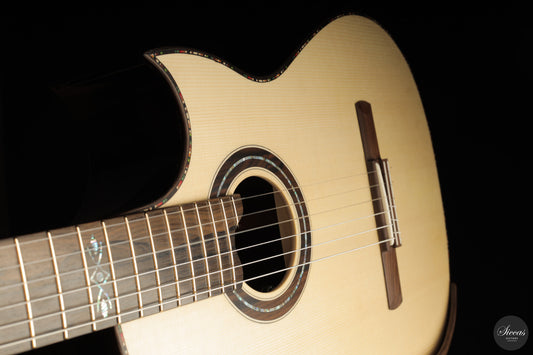
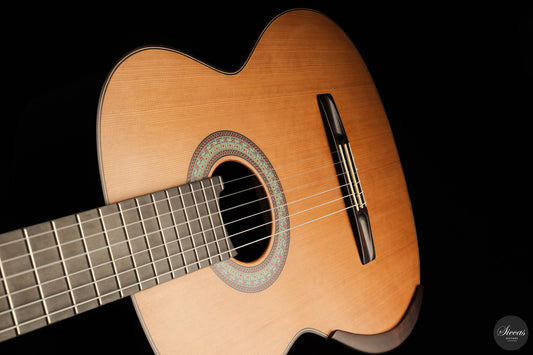
Wagner's catalogue includes both double-top and lattice-braced models, and he has worked with cedar, spruce, and various back and side combinations over the years. His double-top guitars are perhaps the instruments most associated with his name — instruments that offer the warmth and colour of traditional construction alongside the projection and dynamic range that the composite soundboard enables. Players often describe his guitars as having an unusual immediacy of response: the note speaks quickly and blooms fully, with a singing quality in the upper register that is particularly well suited to concert performance.
His instruments are also notable for their elegant aesthetic. Wagner brings a careful attention to detail in binding, rosette design, and finish that reflects a complete vision of the guitar as both a functional and a visual object. While his guitars are built first and foremost to be played, they are also unmistakably beautiful. This dual commitment — to sound and to appearance — places him alongside makers like Daniel Friederich and José Luis Romanillos who understood the guitar as a complete artistic statement.
Notable Players
Among the professional soloists who have played Wagner guitars, Jason Vieaux — the Grammy Award-winning American guitarist — is perhaps the most widely known. Vieaux's association with Wagner instruments brought significant international attention to the maker's work, and a former Vieaux guitar (a double-top model) has circulated among collectors and players as a benchmark instrument. Bill Kanengiser, a founding member of the Los Angeles Guitar Quartet, has also played Wagner guitars, as has the Duo Melis. The fact that players of this calibre have chosen Wagner instruments for both recording and concert performance speaks clearly to the reliability and musical depth of his work.
Wagner's guitars have appeared on recordings and in live performance across Europe, North America, and beyond, making them among the most internationally travelled instruments of any contemporary German maker. The consistent praise from performers centres on the same qualities: tonal richness, dynamic sensitivity, and a projection that fills a hall without effort.
Legacy and Teaching
Gernot Wagner's legacy extends well beyond the instruments he has built. Through his involvement with the Lutherie Academy and his comprehensive online course on composite double-top construction, he has shared the technical and conceptual foundations of his approach with a new generation of makers around the world. This willingness to teach openly — to explain not just the what but the why of his methods — is relatively unusual in a field where knowledge has historically been guarded closely, and it has helped the double-top technique spread far beyond his own workshop.
The double-top guitar is now made by luthiers on every continent, and while many variations and interpretations have emerged, Wagner's original collaboration with Dammann remains the point of origin that all subsequent makers reference. His contribution to the double-top guitar tradition is foundational in a way that few individual makers can claim for any single innovation. Alongside the historical giants of the instrument — figures such as Robert Bouchet — Wagner has earned a permanent place in the history of classical guitar making, not through imitation of the past but through genuine invention.
Browse available Gernot Wagner guitars → in the Siccas Guitars collection.