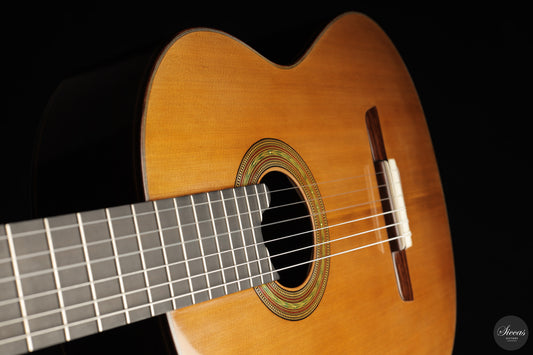
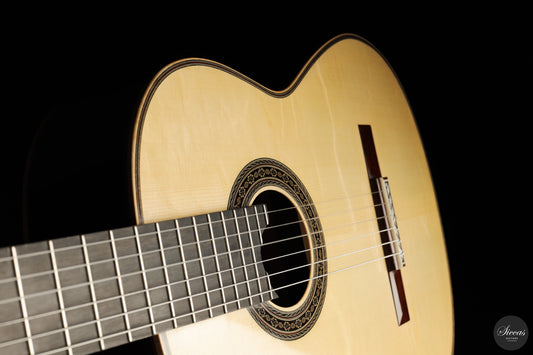
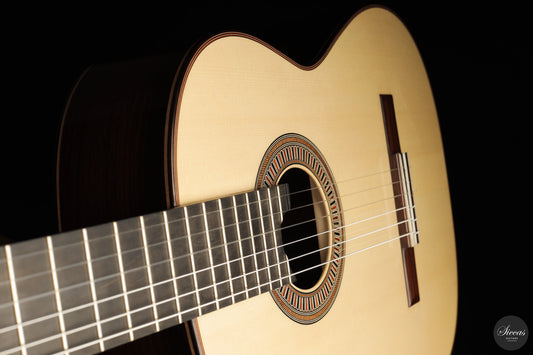
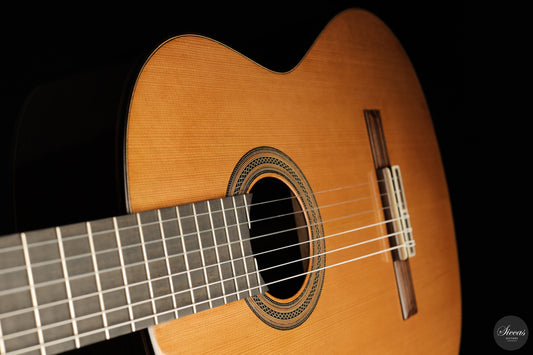
Zbigniew Gnatek occupies a rare position in the world of contemporary classical guitar making: a Polish-born, Sydney-based luthier who has spent nearly three decades synthesising the refined aesthetic sensibility of the European tradition with the acoustically adventurous spirit of the Australian school. Since he began building guitars in 1995, Gnatek has steadily earned an international reputation for instruments that are simultaneously technically sophisticated and deeply musical — guitars that concert soloists trust on stage alongside full orchestras, yet which retain the intimate sensitivity required for solo recitals. His work is not merely a hybrid of two traditions; it is a considered, original voice in the ongoing conversation about what the concert classical guitar can be.
Biography and Training
Gnatek's path to lutherie is unusual and illuminating. Rather than coming to guitar making through a purely craft-focused apprenticeship, he arrived with a dual academic formation that sets him apart from most of his peers. He studied classical guitar performance in both Europe and Australia, ultimately completing a Bachelor of Music Performance at the Sydney Conservatorium of Music — one of the most respected music institutions in the Southern Hemisphere. This period gave him not only a professional performer's understanding of what a guitar must do under the hands of a soloist, but also an intimate familiarity with the repertoire and the acoustic demands of the concert hall.
Alongside his musical studies, Gnatek pursued a degree in Audio Engineering, grounding his understanding of instrument acoustics in the physics of sound as well as in empirical listening. This combination — performer's ear, engineer's analytical mind, and craftsman's hands — became the intellectual foundation of his lutherie. He settled in Sydney, which placed him at the heart of the vibrant Australian luthiery scene, a community that since the 1980s has been at the forefront of developing the lattice-braced classical guitar. Working within and alongside that tradition, Gnatek began to develop his own distinctive approach from the mid-1990s onward.
Construction Philosophy
The most immediately striking aspect of Gnatek's guitars is the way they subvert expectations about what an Australian lattice guitar sounds like. The lattice-braced classical guitar as it emerged from Australia tends toward a bold, projecting sound with a particular darkness in the bass registers and a degree of sustain that traditional fan-braced instruments cannot match. Gnatek uses lattice bracing as his structural foundation, but the result is tonally far removed from the heavier end of the Australian school. His instruments are notably lighter in construction, and the tonal character that emerges is one of striking clarity and balance: deep, resonant basses paired with crystal-clear, bright trebles, creating a string separation that performers describe as exceptional.
This balance between projection and sensitivity is the central challenge of the modern concert guitar, and Gnatek addresses it through careful attention to the interaction between the top, the lattice structure, and the overall geometry of the instrument. His guitars are built to carry through an orchestral texture while remaining responsive enough for the softest pianissimo in a solo passage. The doubled sides and back construction he employs further contributes to the resonance and projection of the instrument, adding both structural rigidity and acoustic depth without adding undue weight.
The visual and constructional finish of Gnatek's guitars reflects the European artisanal tradition he absorbed during his training — a tradition that prizes quiet precision and understated elegance over ostentation. In this sense his instruments occupy a thoughtful middle ground: structurally they belong to the modern Australian school of innovation; aesthetically and tonally they speak a language closer to the refined European concert guitar. Players who want the projection and dynamic range of a lattice instrument without sacrificing the warmth and nuance associated with European lutherie find in a Gnatek guitar a compelling answer.
Signature Characteristics and Models
Gnatek builds exclusively to concert standard, producing a relatively small number of instruments each year as befits a workshop committed to hand craftsmanship of the highest level. Each guitar is individually voiced and adjusted, meaning that no two instruments are acoustically identical even when built to the same specification. His choice of tonewoods reflects both availability and his own tonal priorities: spruce and cedar tops are both used, with the selection calibrated to the desired character of each individual build. Back and sides typically feature premium tonewoods selected for acoustic and aesthetic quality.
A consistent feature across Gnatek's output is the exceptional playability of his instruments. As a trained performer himself, he pays close attention to neck geometry, string action, and the feel of the instrument under the left hand — aspects that distinguish a truly professional instrument from one that merely sounds impressive in isolation. This performer-centred approach to construction is something he shares with the great European masters of the twentieth century, from Daniel Friederich to Robert Bouchet, for whom the physical relationship between player and instrument was as important as the acoustic result. Gnatek has also built instruments in reduced string lengths, including 64 cm scale models that extend the accessibility of his concert instruments to players with smaller hands or specific technical requirements.
Notable Players
The roster of concert guitarists who have chosen Gnatek instruments speaks to the international reach of his reputation. Among the performers associated with his guitars are Costas Cotsilis (Greece), Rafael Aguirre Minarro (Spain), Artyom Dervoed (Russia), Alen Garagic (Bosnia and Herzegovina), Pedro Rodrigues (Portugal), Guilherme Vinces (Brazil), and Krzysztof Pelech (Poland). This list spans multiple continents and encompasses guitarists working at the highest levels of the international concert circuit, confirming that Gnatek's instruments perform reliably across a wide range of musical styles, climates, and performance contexts. The international diversity of his clientele also reflects the universal appeal of an instrument that does not privilege one national school of playing over another — a quality that flows directly from Gnatek's own bicultural formation.
Legacy and Place in Contemporary Lutherie
Zbigniew Gnatek is part of a remarkable generation of luthiers working outside Europe who have enriched the classical guitar world by bringing new technical ideas into dialogue with the accumulated knowledge of centuries of European craft. The wider landscape of classical guitar making has been transformed in the last four decades by innovations in bracing and construction that began largely in Australia, and Gnatek is among the most thoughtful and refined voices within that movement. His guitars do not simply adopt Australian lattice technology wholesale; they integrate it with a musical sensitivity and a finish quality that are unmistakably European in spirit.
For players seeking an instrument of the very highest quality — one that combines projection, tonal balance, playability, and visual refinement — a Gnatek guitar represents a compelling choice. His three decades of building, his academic grounding in both music and acoustics, and the consistent praise of the international performers who play his instruments all testify to a luthier who has found his own original voice in one of the most competitive and demanding fields in instrument making. To hold and play a Gnatek guitar is to encounter the product of a genuinely integrated vision: European in feeling, Australian in structure, and entirely its own.
Browse available Zbigniew Gnatek guitars → in the Siccas Guitars collection.