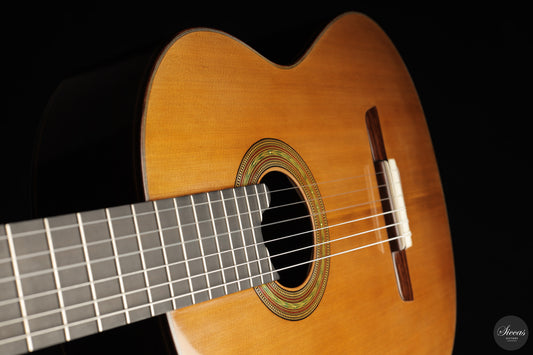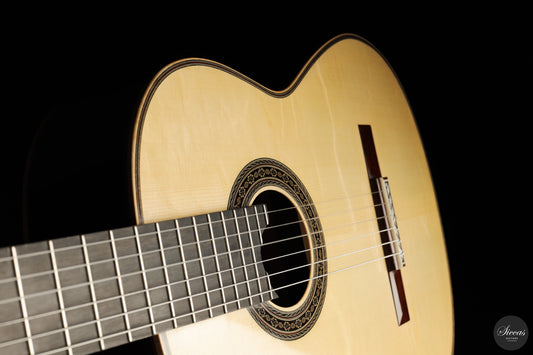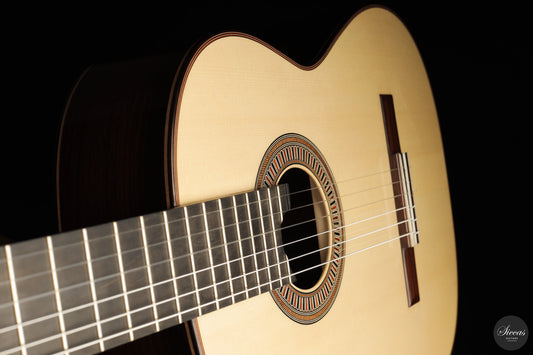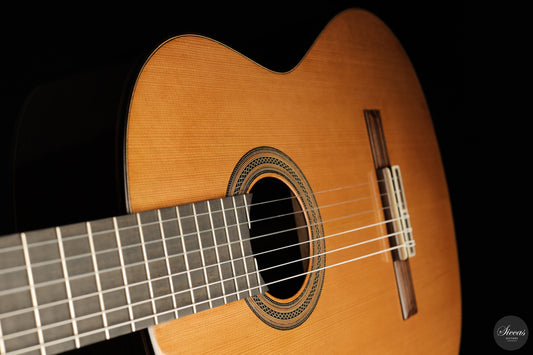

Gropp Guitars is one of Germany's most distinguished classical guitar workshops, a family enterprise rooted in more than a century of unbroken lutherie tradition. Based in Markneukirchen-Breitenfeld in the Vogtland region of Saxony, the workshop is today run by father and son Armin and Mario Gropp, who together represent a lineage of craftsmanship stretching back to the founding of the business by Kurt Gropp. Their instruments are sought by concert guitarists across Europe, Asia, the Americas and beyond — a testament to a philosophy that honours the best of the German building tradition while never standing still in the pursuit of tonal refinement and playability.
Biography & Training
The Gropp story begins in Markneukirchen, a town in the Saxon Vogtland whose 350-year history of musical instrument making earned it recognition as UNESCO Intangible Cultural Heritage in 2014. It is a place that has shaped luthiers of world renown — among them C. F. Martin, who emigrated from here to found one of the great guitar dynasties of the United States, and Richard Jacob Weissgerber, whose name is still closely associated with the finest German classical guitar making of the early twentieth century.
Armin Gropp was born in 1941 and entered the trade early, beginning as a violin-maker in 1955. By 1959 he had turned his attention to guitars, and from 1968 onward he devoted himself exclusively to classical instruments. In 1969 he began producing guitars under his own name. His path was shaped not only by the Vogtland guild tradition but also by years of teaching at the Markneukirchen University of Music and Instrument Making, where he worked from 1993 to 2013. In 2016 he was awarded the Golden Master Craftsman's Diploma, one of the highest honours in the German skilled-trades system, in recognition of a career spanning nearly seven decades.
His son Mario Gropp was born in 1967 and began making guitars in 1983, completing his early training at the Sandner workshop in nearby Erlbach. From 1990 onward, Mario has worked alongside his father and under the Gropp name, developing his own voice as a builder while remaining deeply grounded in the workshop's accumulated knowledge. Critically, Mario has invested years in the study of guitar playing itself — a discipline that gives him an unusually direct understanding of what performing guitarists need from their instruments in terms of action, response, and balance across the strings.
Construction Philosophy
The guiding principle at the Gropp workshop is the union of tradition and innovation. On the traditional side, the builders draw consciously on the legacy of Richard Jacob Weissgerber and the distinct school of German lutherie that flourished in Markneukirchen, a lineage that blends Spanish construction methods with elements of the eighteenth- and nineteenth-century Viennese style associated with makers such as Stauffer. This gives Gropp instruments a tonal character that is recognisably German — clear, balanced, and firm — while retaining the warmth that players associate with the best Spanish-school guitars. Those interested in exploring how different bracing traditions shape sound will find useful background in the guide to fan-braced, double-top and lattice guitars.
On the innovation side, the Gropps have developed proprietary interior construction techniques aimed at enhancing the volume, dynamic range, and projection of their concert models — qualities essential for instruments intended for the large modern concert hall. One particularly refined detail is a tuning compensation built into the bridge: the scale length is proportionally adjusted according to string thickness, resulting in markedly improved intonation across the full range of the instrument. The neck-to-head joint is executed as a dovetail, providing structural stability at one of the most mechanically critical points of any guitar. Scale lengths across the model range span from 580 mm to 660 mm, accommodating players of different hand sizes and stylistic preferences.
The workshop maintains a wood inventory aged up to eighty years, drawing on eleven different species for backs and sides — including curly maple, walnut, padouk and exotic ebony — alongside spruce and cedar for soundboards. This breadth of tonal palette allows the Gropps to tailor each instrument's character to the needs of the individual player. Every guitar is built entirely by hand, and collaboration with professional guitarists worldwide has been a defining feature of the workshop's development, ensuring that refinements in the workshop translate directly into improvements on the concert stage.
Signature Models
The Gropp range is organised around three distinct lines. The Concert model represents the workshop's highest level, built by Mario Gropp to the full specification of a professional concert instrument. The Artist model is crafted by Armin Gropp and offers the accumulated wisdom of his long career in a refined, responsive package. The Spezial line, also from Mario's bench, provides players with a carefully considered alternative that maintains the workshop's quality standards while exploring different tonal directions.
Among the most celebrated individual guitars to have come from the Gropp workshop is the "Weissgerber" model, which pays explicit homage to the great Markneukirchen builder Richard Jacob Weissgerber. The instrument features a dovetail joint at the heel, an open headstock, an oval rosette, a V-joint where the neck meets the head, and single Weissgerber tuners by Rubner — a coherent ensemble of historical details executed with contemporary precision. The result is a sound described as a unique blend of warm, played-in Spanish character with a firm, clear Germanic quality. The "La Onda" model, by contrast, represents a more forward-looking direction, incorporating the workshop's innovative interior construction and offering players a powerful, projecting voice suited to demanding concert repertoire. A 2022 example of the La Onda is among the instruments held by Siccas Guitars.
The Gropps also produce meticulous historical replicas, including reproductions of the iconic Antonio Torres 1877 guitar — a tradition that places their work in dialogue with the broadest sweep of classical guitar history. For those interested in the makers who shaped the modern instrument, profiles of Ignacio Fleta and José Luis Romanillos offer illuminating comparisons, as does the wider overview of classical guitar makers.
Notable Players
The roster of guitarists who have chosen Gropp instruments spans many countries and generations. Among the most prominent is the China Guitar Quartet — comprising Yameng Wang, Meng Su, Shanshan Chen, and Jie Li — whose adoption of Gropp guitars brought the workshop to the attention of audiences far beyond Europe. Professor Zhi Chen of Beijing and Professor Antonio Grande of Naples have also associated their names with the Gropp workshop, lending academic and artistic weight to the brand's standing in the international classical guitar community. Further afield, artists including Napoleão Costa-Lima (Brazil), Roberto Limón (Mexico), Miriam Fernández (Argentina/Switzerland), Martin Ackerman (Argentina/France), and Mauricio Carrasco (Chile/Australia) demonstrate the genuinely global reach of these instruments. European players in the Gropp family include Ahmed El-Salamouny (Munich), Thomas Riedel (Magdeburg), and Professor Raffaele Carpino (Caserta), among many others. The diversity of this community — spanning conservatoire professors, competition winners, and chamber soloists across four continents — reflects both the universal tonal appeal of the instruments and the workshop's sustained commitment to building relationships with performing musicians.
Legacy
In a world where guitar making has become increasingly globalised, the Gropp workshop stands as a living embodiment of a regional tradition that is simultaneously ancient and dynamic. The town of Markneukirchen has been making musical instruments for three and a half centuries, and the Gropp family has been part of that story for a hundred years. Armin Gropp's Golden Master Craftsman's Diploma, the UNESCO recognition of Vogtland instrument making, and the workshop's membership of the Markneukirchen Guild of Musical Instrument Crafts all speak to an institution that is valued not only for the instruments it produces but for what it represents in the cultural life of German craftsmanship.
Mario Gropp's generation brings fresh energy and technical ambition to that heritage, developing new interior construction techniques and working in close dialogue with today's concert guitarists to push the instruments toward greater projection and dynamic versatility. The Gropp workshop does not seek to replicate the approaches of the great Spanish masters — the French tradition pioneered by Daniel Friederich or the Andalusian workshops — but to offer something distinctively German: precise, considered, deeply rooted, and quietly ambitious. For players in search of an instrument that carries genuine history without being imprisoned by it, a Gropp guitar represents one of the most compelling propositions in contemporary lutherie.
Browse available Gropp guitars → in the Siccas Guitars collection.