
Heikki Rousu – A Quiet Force in Scandinavian Guitar Making
In the world of classical guitar making, Heikki Rousu occupies a distinctive and quietly influential position. A Swedish luthier of Finnish heritage, Rousu has been building instruments since 1990 and has produced well over 400 guitars, lutes, and related string instruments for musicians across Sweden and internationally. What sets him apart is not only the tonal refinement of his six-string classical guitars but also his dedication to the extended-range instruments — particularly the 10- and 11-string alto guitar — that place him among the most prolific and skilled makers in that demanding niche today.
Background and Training
Heikki Rousu began his journey as a luthier in 1990, working from a workshop in Sweden where he has remained active ever since. His path into guitar making appears to have developed organically from a deep engagement with music and craftsmanship, though the specific details of his formal training remain. What is clear from his output is a thorough command of Spanish lutherie tradition — the foundational methods established by Antonio de Torres and carried forward by makers like Daniel Friederich — combined with a distinctly Scandinavian sensibility for precision and understated elegance.
Over more than three decades of work, Rousu has built not only classical guitars but also steel-string guitars, lutes, mandolins, mandolas, bouzoukis, bass guitars, gypsy-style guitars, and lute guitars — a breadth of output that speaks to both his technical versatility and his curiosity as a craftsman. He was featured in a 2014 interview in the Swedish publication Gitarr och Luta (Guitar and Lute), one of the leading specialist periodicals in the Nordic region, reflecting the esteem in which he is held within Scandinavian musical circles.
Construction Philosophy and Signature Techniques
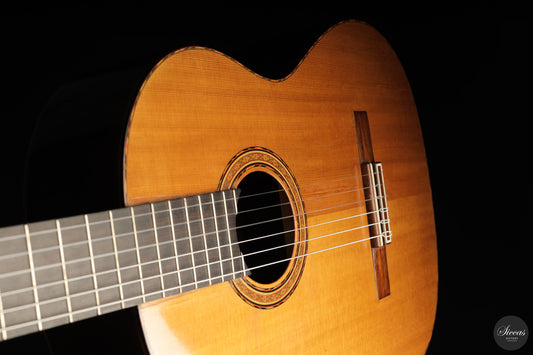
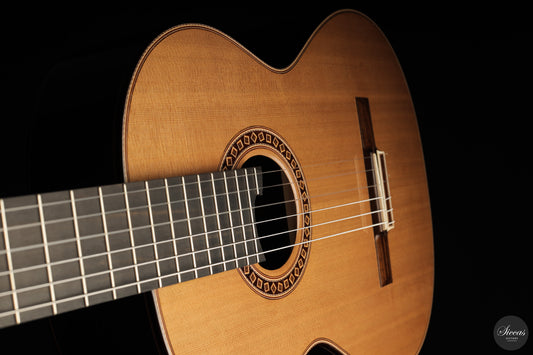
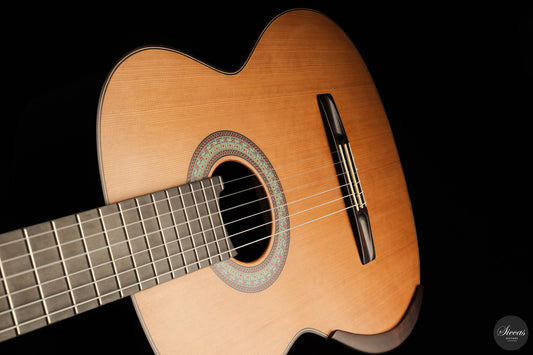
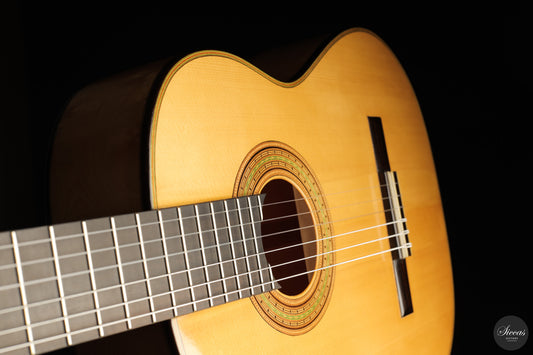
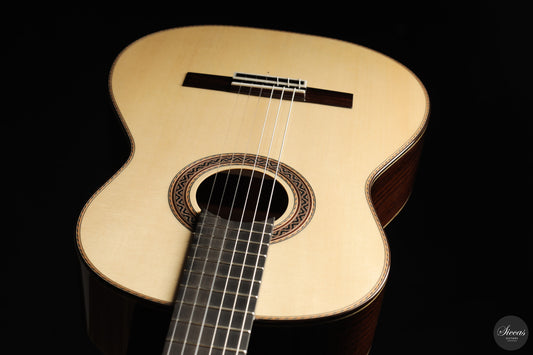
Rousu's classical guitars are rooted in the fan-bracing tradition, employing the structural logic developed by Torres and refined by generations of Spanish and French luthiers. For his standard instruments, he favors traditional fan bracing that prioritizes tonal balance — warm, resonant basses paired with clear, singing trebles — over extreme projection or modern sound amplification. His choice of tonewoods reflects the same considered approach: aged European spruce and western red cedar for soundboards, Indian rosewood and Madagascar rosewood for back and sides, with South American mahogany or cedar for necks and ebony for fingerboards.
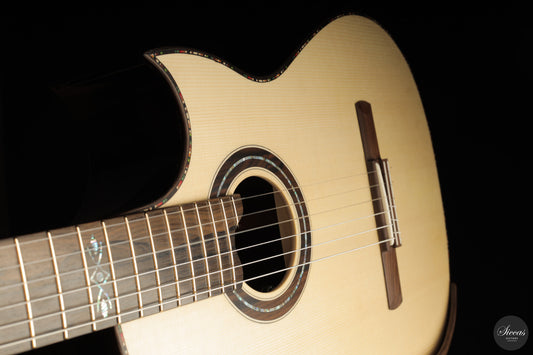
All of his instruments receive a hand-applied French polish finish in shellac, a choice that keeps the soundboard acoustically open and responsive. This technique, requiring patience and skill that few contemporary builders maintain, is one of the markers of Rousu's commitment to traditional methods. At the same time, he is not doctrinaire: he also works with doubletop and lattice bracing for players who prefer the lighter response and greater projection those approaches offer, and some of his instruments feature True Temperament fretboards — a modern Swedish innovation in tempered intonation — for players who prioritize harmonic accuracy across all positions.
The Alto Guitar and the Bolin Legacy
Among the many instruments Rousu builds, it is his multi-string alto guitars — particularly the 11-string model — that have attracted the greatest international attention and for which he has become especially celebrated. The 11-string alto guitar was conceived by the Swedish luthier Georg Bolin in the 1960s as an instrument that could bring lute repertoire into the hands of classical guitarists, using a technique and body position familiar to guitar players while providing the extended bass range of the lute. The instrument was popularised in concert by the Swedish guitarists Per-Olof Johnson and Göran Söllscher, who recorded and performed widely on Bolin instruments and established the 11-string as a serious concert instrument rather than a curiosity.
Rousu has taken up this legacy with conviction. His 11-string alto guitars are built to demanding specifications: a treble scale of 570–580 mm, an extended bass scale of 760–780 mm, fan bracing or lattice construction, and hardware from respected makers such as Schertler and Rubner. The instruments are strung with classical guitar strings supplemented by heavier bass strings tuned to extend the range down through the lowest lute courses. The result is an instrument of considerable expressive range — rich in the bass registers where lute music lives, but clear and responsive in the upper strings where melody sings. He has also built 13-string guitars for players requiring still greater range. You can explore the broader tradition of classical guitar makers who have pushed the boundaries of the instrument's design.
Notable Players and International Reach
Rousu's instruments have found their way into the hands of concert guitarists, educators, and advanced players across Europe and beyond. The guitarist Andreas Koch has been documented performing on Rousu's 11-string instruments, bringing the maker's work to wider audiences through recordings and performances. His guitars are stocked by specialist dealers in Germany and Sweden, and have appeared at Siccas Guitars among the finest contemporary classical instruments available on the market — a measure of their standing among discerning players and collectors.
The international interest in his extended-range instruments reflects a growing curiosity among guitarists about the sonic and expressive possibilities that instruments beyond the standard six strings can offer. Rousu's position as one of the most consistent and experienced builders working in this space — alongside the broader tradition of innovative lutherie explored by makers like the double-top pioneers — means that demand for his work continues to grow even as he maintains his small-scale, artisanal production of around ten to twelve instruments per year.
Legacy and Ongoing Work
After more than thirty-five years at the workbench, Heikki Rousu stands as one of Sweden's most accomplished and respected luthiers. His work bridges the classical Spanish tradition and the distinctive Nordic instrument-building culture that produced Georg Bolin and gave the world the alto guitar. He builds slowly, carefully, and with consistent artistic integrity — producing instruments that reward advanced players while remaining, by the standards of bespoke lutherie, unusually accessible.
Each instrument that leaves his workshop carries a serial number, and with approaching 500 guitars completed, the body of work represents a sustained artistic achievement of considerable scope. For players seeking a guitar that combines traditional values — warm tone, French polish, hand-fitted mechanics — with the option of extended range or innovative fretboard technology, Rousu's instruments offer a compelling and distinctive choice. His ongoing collaboration with True Temperament and his continued exploration of multi-string design suggest that this is a luthier still very much in creative development, with the best of his work perhaps still ahead. You can read more about the broader field in our overview of the master luthiers who have shaped the modern classical guitar.
Browse available Heikki Rousu guitars → in the Siccas Guitars collection.