
Hermanos Camps – A Spanish Guitar Dynasty from Girona
Few guitar workshops can claim a family tradition spanning more than three generations, yet Hermanos Camps of Catalonia, Spain has done exactly that. Founded in 1945 and now operating from Girona, the workshop has spent over seven decades refining an approach to guitar building that holds fast to the principles of the great Spanish masters while embracing carefully chosen modern innovations. The result is an instrument that balances tradition, playability, and tonal richness — qualities that have made Hermanos Camps one of the most respected mid-to-professional-tier workshops in Spain today.
From Banyoles to Girona – The Origins of the Workshop
The story of Hermanos Camps begins with Juan Camps Coll, who established his guitar-making workshop in Banyoles, in the Catalan province of Girona, in 1945. Juan was a self-taught craftsman driven by an entrepreneurial curiosity and a restless desire to experiment. Throughout his working life he tested a remarkable range of building systems, adhesives, varnishes, and tonewoods — not in pursuit of novelty for its own sake, but in service of a very clear ambition: to build a guitar that offered the finest possible acoustic quality at a price accessible to serious musicians who might otherwise be priced out of a truly fine instrument.
This democratic impulse — the conviction that exceptional craftsmanship should not be the exclusive preserve of the wealthy — shaped the workshop's identity from its very first days. Juan's approach drew inspiration from the lineage of great Spanish luthiers, above all Antonio de Torres, the nineteenth-century master whose design innovations effectively created the modern classical guitar and whose influence can be traced through virtually every significant workshop that followed, including those of Ignacio Fleta and Daniel Friederich.
When Juan's sons Javier and Jordi Camps came of age, they had grown up immersed in the sounds, smells, and rhythms of their father's workshop. Both pursued a thorough technical and musical education before formally joining the business in 1989. Their arrival marked a natural transition: the workshop moved to Girona, where it continues to operate today, and the name Hermanos Camps — the Camps Brothers — came to define a new chapter in the family's history.
Construction Philosophy – Tradition Shaped by Careful Innovation
At the heart of the Hermanos Camps approach is a commitment to handcraft rooted in centuries of Spanish tradition. Every guitar that leaves the Girona workshop is built according to methods that trace their lineage directly to the classical Spanish school — fan bracing, a traditional solera construction process, and a meticulous attention to the acoustic properties of each piece of wood selected. The brothers place particular emphasis on the careful choice of tonewoods, favouring aged, well-seasoned cedar and spruce tops paired with solid back and sides in tonewoods such as rosewood and maple.
Yet Javier and Jordi have never been content to simply reproduce the past. Drawing on their father's experimental spirit, they have integrated a number of thoughtfully chosen modern elements into their instruments. These include a truss rod inside the neck for long-term stability — a feature not found in strictly traditional Spanish guitars — an exclusive amplification system that uses six independent saddle elements on the bridge for more even string-to-string amplified response, and experimental varnishes that protect the instrument while allowing the top to breathe and vibrate freely. For players working in studio or live performance contexts who need reliable amplification without sacrificing acoustic quality, these innovations offer a practical advantage. Understanding how construction choices like bracing pattern affect tonal character is explored in more depth in our guide to fan-braced, double-top, and lattice guitars.
Signature Models – A Range Built for Every Stage of the Journey
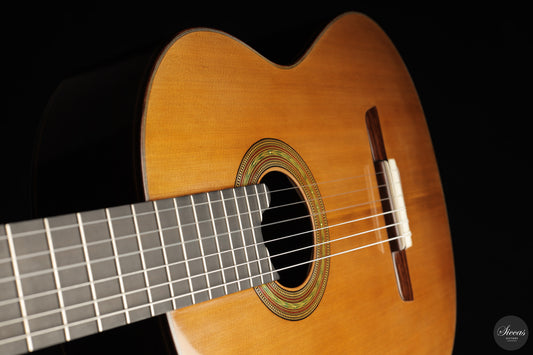
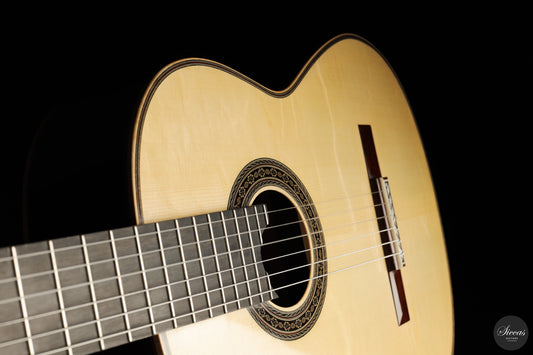
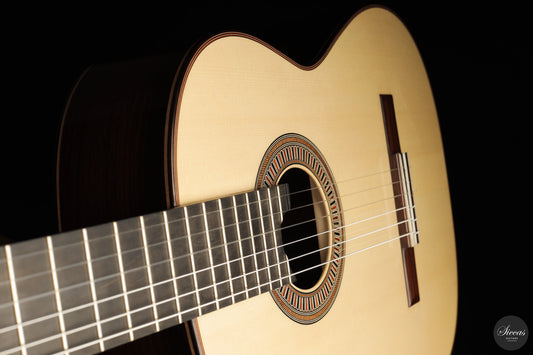
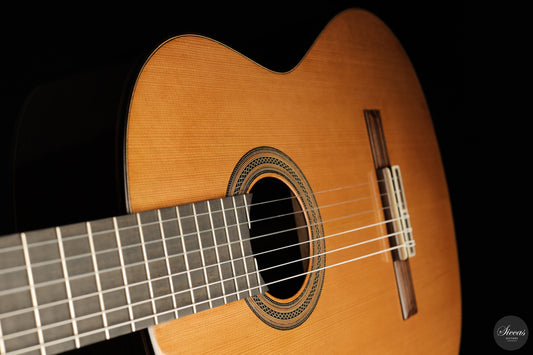
The Hermanos Camps catalogue spans a carefully considered range of instruments designed to serve players from the advanced student level through to the concert stage. Among their classical guitar models, several names have become particularly well known in the Siccas Guitars collection. The La Gravis, available in both cedar and spruce top variants, is built for the serious player who demands projection and warmth in equal measure. The La Optima and La Victrix represent the upper reaches of the Camps classical range, with all-solid construction and the kind of tonal complexity and dynamic range that concert performance demands. The La Sapienti and La Liberalis models offer a slightly more accessible entry point without compromising on the hallmark Camps tonal clarity.
Alongside their classical offering, Hermanos Camps have long been respected makers of flamenco guitars. Their Primera series — including the Primera Blanca in spruce and cypress for the traditional bright, percussive flamenco voice, and the Primera Negra in rosewood — has earned a strong following among professional flamenco players across Spain and beyond. A particular mark of distinction in this area is the workshop's long-standing collaboration with Manuel Granados, a highly regarded concert flamenco guitarist and internationally recognized pedagogue. Granados certified and lent his name to a specific line of Camps flamenco models, a partnership that speaks to the esteem in which the brothers are held within the flamenco community.
The Camps Legacy in Context
To understand what makes the Hermanos Camps workshop distinctive among the broader landscape of classical guitar makers, it helps to consider what the brothers have achieved over more than three decades of building together. In a world of boutique one-at-a-time luthiers working at very small production volumes, Camps occupies an important and sometimes underappreciated position: a workshop that maintains genuine handcraft quality while producing enough instruments each year to keep prices within reach of the working musician. This is not a trivial achievement. It requires the kind of deep, almost intuitive command of material and process that only comes from years of accumulated experience, and it demands a workshop culture in which quality is not negotiable regardless of the volume being produced.
The comparison with other celebrated family workshops is instructive. Just as the Romanillos family in Spain built a reputation on the integrity of handcraft and an unswerving commitment to tonal excellence, the Camps brothers have built theirs on a combination of those same values alongside a practical generosity of spirit — a determination that fine instruments should be available to as many players as possible. With over seventy-five years of history behind the family name and a workshop that shows no sign of slowing, Hermanos Camps remain one of the most compelling arguments for the enduring vitality of the Spanish guitar-making tradition.
Browse available Hermanos Camps guitars → in the Siccas Guitars collection.