Jean Marquet – Belgian Luthier of Rare Distinction
Jean Marquet is one of Belgium's most accomplished classical guitar makers — a luthier whose instruments have earned the attention of concert musicians worldwide for their rare combination of tonal richness, immediacy of response, and meticulous construction. Based in Antwerp, Marquet has built a reputation that places him firmly among the finest working luthiers in Europe today. His journey into lutherie is as compelling as the guitars he produces: it began not with a family trade or a formal music career, but with a single instrument that changed everything.
From Antwerp to the Workshop – A Maker's Origin
Jean Marquet came to guitar making through a moment of pure curiosity. After acquiring a classical guitar by Japanese maker Ryoji Matsuoka, he found himself captivated not only by the sound, but by the craft itself — by the question of how such an object could be conceived and built by human hands. That question set him on a path toward formal training. He enrolled at the CMB (Center for Musical Instrument Building) in Puurs, Belgium, an institution with a distinguished history of producing world-class luthiers. There he studied under Karel Dedain and Walter Verreydt, immersing himself in the disciplines of tonewoods, acoustics, joinery, and finishing. Upon completing his studies in 2019, Marquet was awarded the Gouden Bootschaaf — the Golden Fingerplane — a prize recognising the highest quality of work among graduating students. The recognition was fitting: his instruments already demonstrated a maturity and precision that belied his years as a maker.
The influence of master luthier Walter Verreydt has remained central to Marquet's development, as has his close relationship with Gerhard Oldiges, the German luthier and tonewoods specialist whose carefully selected spruce tops have found their way into some of Marquet's most celebrated instruments. These formative relationships shaped not only his technical vocabulary but his philosophy: that a guitar must be conceived as a whole, with every element — top, back, bracing, finish — working in concert toward a unified sonic and aesthetic ideal. Those seeking to understand the broader tradition in which Marquet works will find useful context in the Classical Guitar Makers overview, which traces the lineage of makers who have shaped the modern concert instrument.
Four Models, One Vision
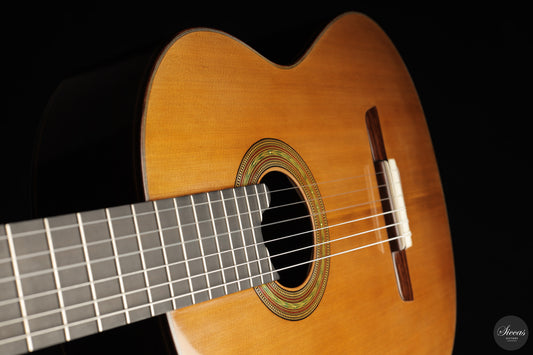
Marquet's output is organised around four distinct series, each addressing a different set of musical and aesthetic priorities. The Modèle Traditionnel is the cornerstone of his work — a guitar built for tonal complexity and interpretive nuance, offering the kind of rich, layered sound that rewards patient, expressive playing. Its character is warm and full-bodied, with carefully voiced basses and singing trebles that invite long, sustained phrases.
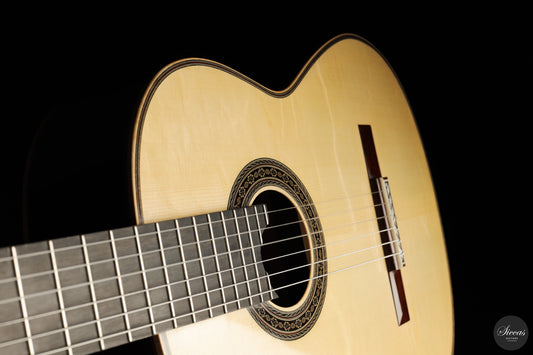
The Modèle Contemporain takes a different approach, prioritising clarity, immediacy, and a more forward-sounding projection. With a scale of 640 mm and a construction philosophy oriented toward quick response, this model suits players who demand precision and definition across all registers. A representative example — the Contemporain No. 29 — features a meticulously tuned spruce top sourced from Gerhard Oldiges in 2001, Indian rosewood back and sides, and a French polish finish. Its air body frequency is set at F#/G, and it weighs just 1,460 grams, giving it a lightness and directness that translates immediately into the player's hands. Trebles are clear and singing, the midrange richly coloured, and sustain even and long across the neck.
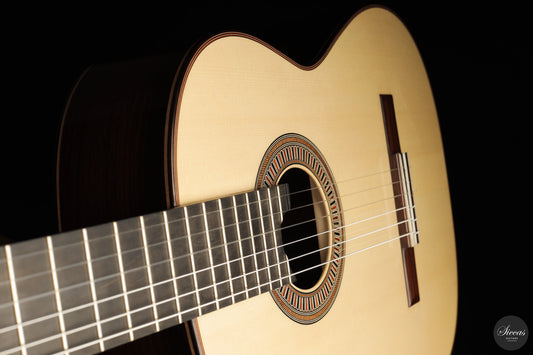
The Série Historique draws on specific historical models from the classical guitar's past. His 2023 instrument inspired by the 1937 German Hauser tradition — featuring a hazel spruce top and Indian rosewood back and sides at a 650 mm scale — demonstrates the depth of research underpinning Marquet's approach. Rather than copying historical instruments, he uses them as a structural and tonal starting point, adapting their logic to contemporary standards of playability and projection. The result is a guitar with impressive bass response, crystal-clear trebles, and an abundance of overtones that create a full-bodied, resonant character.
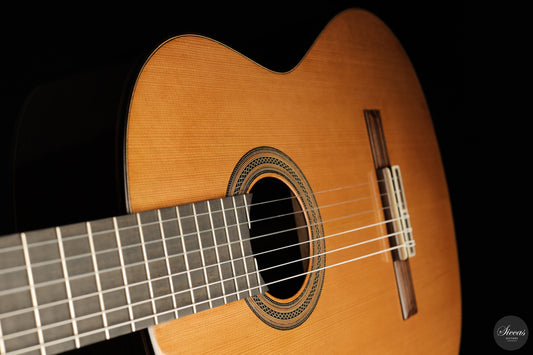
The Série Cathédrale rounds out the range, though details of this model speak to Marquet's interest in expanding the expressive possibilities of the classical guitar into new sonic territory. Across all four series, what unites his instruments is an unwavering commitment to quality — from the selection of tonewoods to the precision of the bracing, the levelness of the frets, and the care of the French polish finish.
Lutherie in Community – The Antwerpen Guitar Builder's Expo
Jean Marquet's contribution to the world of classical guitar extends beyond his own workshop. He is the organiser of the Guitar Builder's Expo at the Antwerpen Gitaar Festival, a showcase that brings together some of the finest luthiers from across Europe and beyond. In this role, Marquet has positioned himself not only as a maker but as an advocate for the craft — someone who understands that lutherie thrives when knowledge is shared, standards are held in common, and makers engage with the broader musical community. The expo has become an important platform for emerging and established luthiers alike, reflecting the same generosity of spirit that characterises his approach to teaching and mentorship.
This communal orientation is something Marquet shares with other great European makers. The tradition of workshop-to-workshop exchange and close mentorship relationships runs through the history of the classical guitar — from the Parisian ateliers that produced figures like Robert Bouchet and Daniel Friederich, to the Spanish workshops where Ignacio Fleta developed his distinctive approach. Marquet belongs to this continuum — a maker who is deeply rooted in tradition while remaining entirely of the present.
Sought After by Concert Musicians Worldwide
Though Jean Marquet's career is still relatively young by the standards of master lutherie, his instruments are already sought after by professional concert guitarists across Europe and beyond. The combination of acoustic performance, visual elegance, and carefully considered ergonomics has made his guitars credible choices at the highest levels of performance. Players drawn to his Contemporain models value their precision and forward clarity; those who gravitate toward the Traditionnel or Historique series are rewarded with instruments that reveal new dimensions the longer they are played.
His guitars feature Kris Barnett or Scheller tuning machines, Knobloch strings, and cases by Hiscox — a selection that reflects the same attention to quality found in every other aspect of his work. The French polish finish, applied by hand, gives each instrument a warmth and transparency that synthetic finishes cannot replicate, allowing the wood to breathe and the sound to develop fully over time.
For players who understand that the classical guitar's expressive potential depends entirely on the maker's skill, Jean Marquet represents a compelling choice — an instrument built by a luthier who thinks deeply, works precisely, and brings genuine musicality to every decision in the workshop. His place within the broader world of classical guitar construction traditions is already secure, and his best work may well be ahead of him.
Browse available Jean Marquet guitars → in the Siccas Guitars collection.