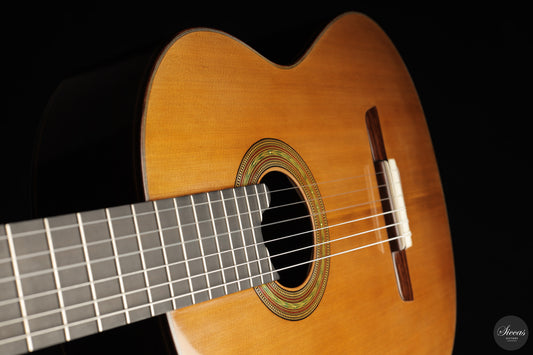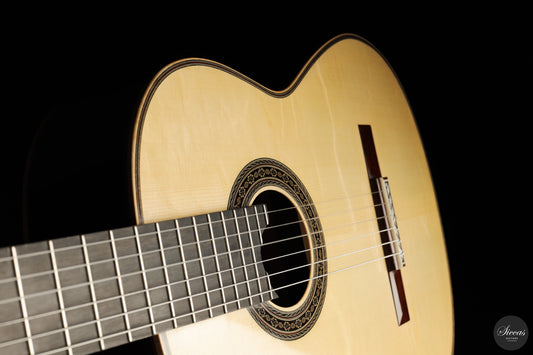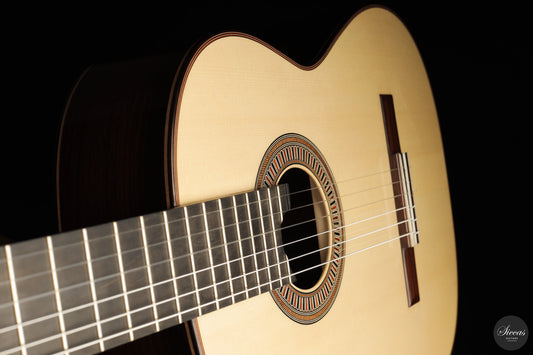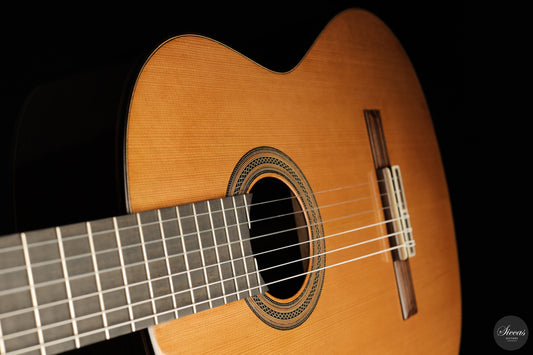

Jesús Bellido – Keeper of the Granada Tradition
Few luthiers embody the continuity of Spanish guitar making as naturally as Jesús Bellido. Born in Granada in 1966 into one of the city's most celebrated guitar-making families, he grew up surrounded by tools, tonewoods, and the accumulated wisdom of generations. His instruments stand today as living proof that the Granada school — rooted in Antonio de Torres and refined across more than a century — remains a vital force in the world of the classical guitar.
A Family Legacy in Granada
The Bellido name is inseparable from the story of guitar making in Granada. Jesús learned his craft from his father, Manuel López Bellido, an internationally recognized luthier whose own reputation placed him among the leading figures of the Granada tradition. His uncle, José López Bellido, achieved equal distinction, and the family's combined contribution to the city's guitar culture spans decades. Growing up in this environment, Jesús did not so much choose lutherie as absorb it — by the age of thirteen he was already working alongside his father in the family workshop, learning by observation, then by doing.
What makes his early development unusual is the discipline he brought to it. By the time he was seventeen, he had completed and sold guitars under his own name, an achievement that speaks to both his natural aptitude and the quality of his training. Despite this early confidence, he did not rush into full-time professional work immediately. He continued building in the family workshop while completing a Bachelor of Arts in natural sciences at the Universidad de Granada — a period that deepened his understanding of materials, acoustics, and the physical properties of wood that underpins every decision a serious luthier makes.
Establishing His Own Voice
In 1989, Jesús Bellido opened his own workshop in Granada and set about defining an independent identity as a maker. That same year, the Junta de Andalucía, backed by the National Employment Institute, appointed him professor of guitar making, tasking him with training a new generation of luthiers. He held this teaching role until 1995, when he made the decision to dedicate himself entirely to building instruments of his own. The choice was deliberate: teaching and building at the highest level are both demanding pursuits, and Bellido chose to give everything to the latter.
His position in the wider European craft world was confirmed in 2001 and 2002, when he was selected as Spain's representative expert in lutherie for conferences held in Cologne as part of the Leonardo da Vinci Project, a European Economic Community initiative aimed at preserving and transmitting traditional craft knowledge. That such a distinction came to a maker still in his mid-thirties underlines the esteem in which he was already held beyond Spain's borders.
Construction Philosophy and the Granada Approach
Jesús Bellido works within the Granada school, building traditional small-bodied classical and flamenco guitars whose proportions and aesthetic derive from the foundational work of Torres and the makers who followed him. The Granada approach prizes clarity, balance, and a natural resonance that favours the instrument's voice over any engineered amplification. Bellido adheres to this philosophy rigorously, but brings two distinct building methods to his practice: the traditional Spanish system — in which the guitar is built on a solera, with the neck and top joined from the outset — and a second approach that incorporates broader lutherie techniques adapted from European craft traditions.
The materials he selects are central to his results. His finest instruments are built from tonewoods that have been drying for fifteen years or more; in many cases the seasoning process extends beyond thirty years. This patience is not affectation — it reflects a genuine understanding that wood behaviour stabilises over time, and that the best instruments deserve the best-prepared materials. The result is a consistency of voice and structural integrity that is difficult to achieve with commercially dried timber.
Beyond his own models, Bellido has dedicated significant effort to building historically informed replicas of instruments by figures such as Antonio de Torres, Santos Hernández, Louis Panormo, José Pages, José Pernas, and Manuel de la Chica. These replicas are not merely copies; they represent a deep study of historical construction methods, and they place Bellido in a lineage of luthiers — including Ignacio Fleta and José Luis Romanillos — who treated historical instruments as both models and teachers.
The Bellido Guitar in Practice
A Jesús Bellido guitar is an instrument built for players who value responsiveness and tonal refinement over sheer volume. The small-bodied Granada form produces a singing treble, a focused midrange, and a bass that supports without overwhelming — qualities that suit solo repertoire, recording, and intimate performance alike. Players who work with Bellido instruments often note the ease of the action and the instrument's tendency to reward a refined right-hand technique with immediate, nuanced feedback.
His flamenco instruments carry the same thoughtful approach. Flamenco guitars from the Granada tradition are drier and more immediate in response than their classical counterparts, and Bellido's examples have earned respect among players who know what a historically grounded flamenca should feel and sound like. The dual classical-flamenco output is itself a mark of range: relatively few makers sustain genuine quality across both forms.
Legacy and Standing
Jesús Bellido occupies a distinctive place in contemporary Spanish lutherie. He is a maker who bridges generations — trained in an unbroken line of craft knowledge that reaches back through his father and uncle to the foundations of the Granada school — while also being a practitioner who has thought carefully about materials science, historical construction, and the demands of modern players. His time as a teacher at the behest of the Junta de Andalucía means his influence extends beyond the instruments he has built; the luthiers he trained carry his methods forward into their own workshops.
In the broader landscape of classical guitar construction, where technological innovation has drawn many makers toward lattice bracing and synthetic materials, Bellido's commitment to the traditional fan-braced form is a conscious statement. He does not reject innovation categorically — his adoption of multiple building methods shows an open and enquiring mind — but he believes that the Granada tradition, properly executed with the finest materials and genuine patience, produces instruments of the highest order. The evidence is in the guitars themselves.
Browse available Jesús Bellido guitars → in the Siccas Guitars collection.