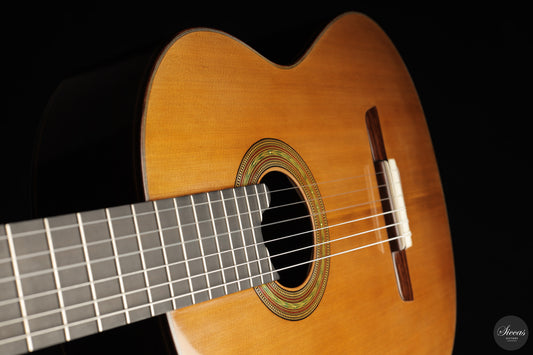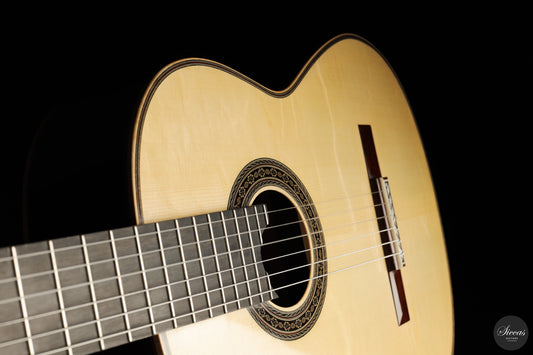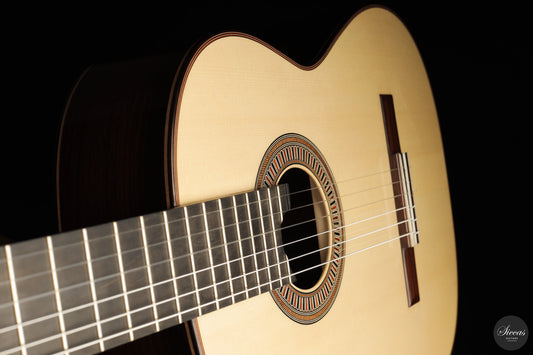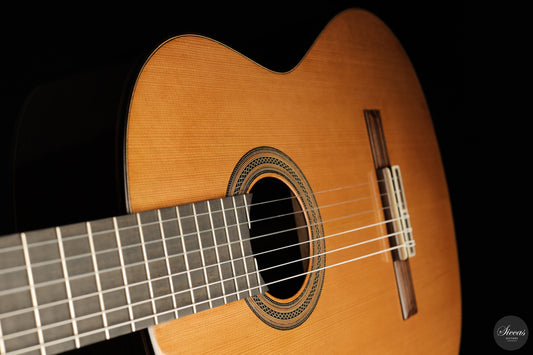

John Ray is one of the most compelling stories in contemporary classical guitar making — a Canadian from Edmonton, Alberta, who crossed the Atlantic in 1989 with little more than determination and a linguistics degree, settled in Granada, and spent the next three decades forging himself into a master of the Spanish guitar tradition. His instruments, deeply rooted in the Granada School, are known for their tonal balance, expressive depth, and the kind of refined craftsmanship that only comes from a lifetime of devotion to a single pursuit. Today, Ray's guitars are sought by concert players and discerning collectors around the world, and his name is synonymous with a living, breathing continuity of the great Andalusian luthier lineage.
Biography & Training
Born in 1965 in Edmonton, Alberta, John Ray grew up far from the world of Spanish guitar making. He studied linguistics in Montréal, graduating in 1988, and spent time afterwards working as a cook and a house painter — practical trades that, in hindsight, share more with lutherie than one might expect. A guitar teacher in Montréal planted the decisive seed, advising Ray to go to the source: Granada, Spain, the city that had given the modern classical guitar so much of its character.
On November 25, 1989, Ray arrived in Granada by bus from Madrid. He was twenty-three years old and had built almost nothing. To support himself he taught English as a second language, earning just enough to fund the slow, painstaking process of learning to build. His first guitar was constructed on his kitchen table. What he imagined might take a year or two took closer to a decade before he felt truly competent — and even then, as he readily acknowledges, there remained so much more to learn.
His early years in Granada were shaped by a constellation of generous mentors. Jonathan Hinves encouraged hands-on experimentation from the outset. Rafael Moreno shared materials and practical tips. Germán Pérez Barranco offered moral support. Above all, Antonio Marín Montero — one of Granada's most celebrated master builders — provided assistance with tools and technique at a formative stage. In 1990, Ray attended a two-week workshop in Málaga led by José Ángel Chacón, focused on repair, restoration, and construction; he subsequently spent around two years attending Chacón's weekend sessions, absorbing everything the workshop environment offered.
The most transformative relationship came in 1999, when Ray met the German luthier Rolf Eichinger. Eichinger, himself a student of Manuel Bellido and Antonio Marín, became Ray's primary mentor and gave him access to seasoned wood, specialist tools, and a frank, exacting standard of quality. Ray describes Eichinger as teaching him that "making guitars is a job that requires all of your time and all of your energy." This philosophy of total commitment became the foundation of his professional life. He is known to spend up to ten hours a day in his workshop — a discipline that connects him unmistakably to the most serious figures in the history of classical guitar making.
Construction Philosophy
Ray's approach to building is grounded in the study of historical instruments. Convinced that progress requires a thorough understanding of origins, he devoted years to analysing the great guitars of Antonio de Torres, Marcelo Barbero, Santos Hernández, and the Lorca builders. This immersion in the past was not nostalgic preservation but active learning: understanding why those instruments sounded the way they did, and how that knowledge could be applied to a modern concert guitar.
He builds using well-aged tonewoods, hot hide glue, and hand tools — saws, chisels, planes, and sandpaper form the core of his toolkit. He is selective about specialist lutherie tools, adopting them only when they genuinely improve accuracy, speed, or capability. This philosophy echoes the spirit of the great tradition he works within, one that prizes the maker's touch above mechanical shortcuts. His guitars are described by players as responsive to every nuance of performance, comfortable in the hand, and tonally balanced across the full range of the instrument.
Ray's work bridges the fan-braced Spanish tradition with a personal aesthetic shaped by decades of study, experimentation, and dialogue with the players who have played his instruments. Unlike makers who have moved toward modern carbon-fibre composites or lattice construction, Ray remains committed to the traditional Spanish method — a commitment that reflects not conservatism but deep conviction about what makes a guitar truly musical.
He also builds Torres copies, perhaps the most demanding test of a luthier's historical understanding. His 2005 copy of a Torres model was performed publicly by guitarist Javier Riba with the Cuarteto de Guitarras de Andalucía — a remarkable endorsement of its authenticity and playability. This work stands in natural dialogue with the legacy explored in depth by figures such as Ignacio Fleta and Robert Bouchet, both of whom were similarly shaped by their engagement with the Torres inheritance.
Notable Players
Over the course of his career, Ray has cultivated close relationships with the concert players who have tested and refined his instruments. Among those who have guided his development through their playing are Javier Riba, Evaristo Valenti, Carles Trepat, Victor Bravo, and Paola Requena in Spain; George Papathanasiou in Greece; and Tita Avendaño in Chile. These are not merely endorsements — Ray describes these musicians as active participants in the process of making better guitars, a collaborative dynamic that reflects the best traditions of the maker-player relationship.
Javier Riba's use of Ray's Torres copy in professional concert performance is perhaps the most visible instance of this relationship in action. The fact that a serious concert guitarist chose a Ray instrument for a demanding public programme speaks directly to the concert-level quality of his work.
The Granada School & Scholarly Contribution
Ray's contribution to classical guitar culture extends beyond the workshop. He is the editor of The Granada School of Guitar-makers, a book that documents the history and lineage of Andalusian lutherie with the authority of someone who has lived within that tradition for more than three decades. It is a rare instance of a working luthier also serving as a serious historian of his own field — comparable in spirit to the intellectual rigour that distinguished Daniel Friederich or José Luis Romanillos, both of whom combined exceptional craftsmanship with a deep engagement with guitar history and theory.
The Granada School that Ray documents and perpetuates is not a fixed canon but a living lineage — one that passes from Torres through the great twentieth-century Granada makers and onward to builders like Ray himself, who arrived as an outsider and earned his place through thirty-five years of unbroken dedication. That continuity is itself a kind of argument: that the tradition is robust enough to absorb new voices without losing its essential character.
Legacy
John Ray represents a particular kind of achievement that is rare in any craft: the outsider who becomes, through sheer commitment and humility before the masters, a genuine insider. His guitars carry the DNA of Granada — the tonal warmth, the timbral complexity, the physical ease — while bearing the unmistakable mark of a maker who has thought carefully about every decision. For players seeking an instrument that is both deeply traditional and fully alive to the demands of the concert stage, a Ray guitar offers something genuinely difficult to find elsewhere.
His story is also a reminder that the great traditions of classical guitar making are not closed to those born outside their geographic centres. What they require is not geography but devotion — the willingness to arrive on a bus in an unfamiliar city, to build a guitar on a kitchen table, and to keep working until the instrument says what it needs to say.
Browse available John Ray guitars → in the Siccas Guitars collection.