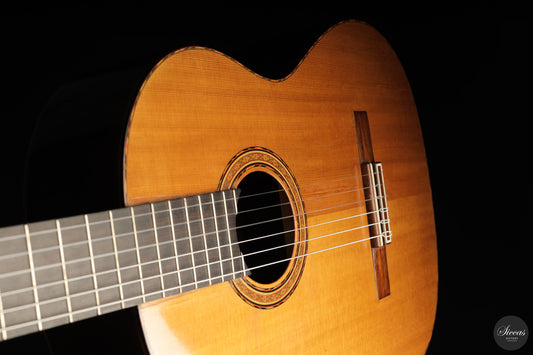
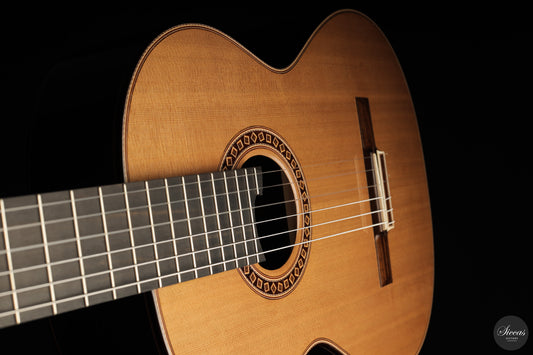
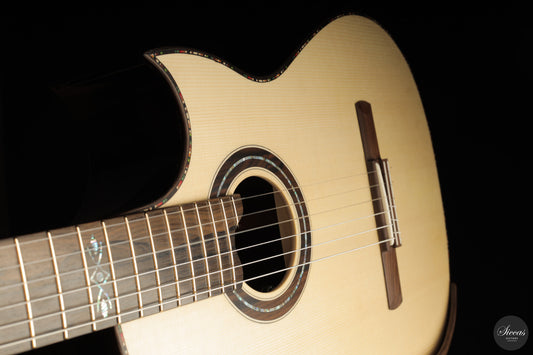
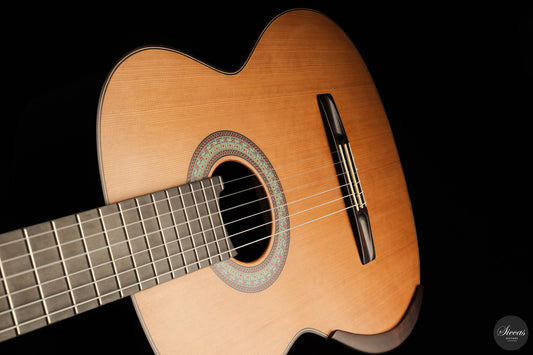
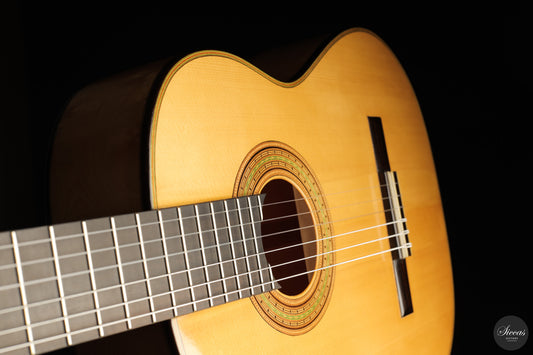
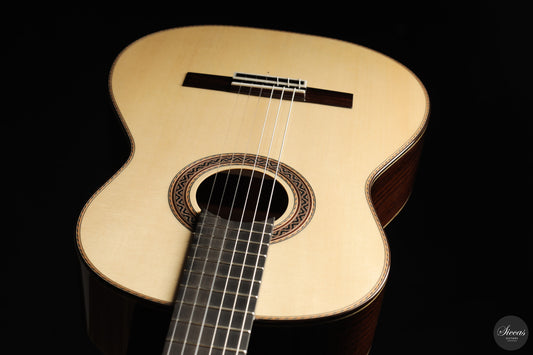
Luigi Locatto is one of Italy's most respected classical guitar makers — a luthier, guitarist, and scholar whose instruments carry the unmistakable voice of the great Spanish tradition into the concert halls of the present day. Born in Turin in 1953, Locatto has spent more than three decades building guitars of exceptional clarity, sustain, and tonal balance at his workshop in Pino Torinese, a hillside town just outside Turin in the Piedmont region. His work is rooted in a profound, hands-on study of the golden age of Spanish lutherie, and his instruments are sought after by professional soloists around the world.
Biography and Training
Locatto's path to lutherie was neither direct nor conventional — it grew organically from a life already steeped in music. He completed his classical guitar studies under the guidance of Guido Margaria, Sergio Notaro, and the celebrated pedagogue Oscar Ghiglia, graduating from the Conservatory of Alessandria. He went on to perform professionally for several years, collaborating with the RAI orchestra and the Teatro Regio in Turin, and later taught at numerous musical institutions, including the Musical Training Courses of the Municipality of Turin and the Corelli Institute of Pinerolo, where he taught for a decade.
From his youth, Locatto cultivated an interest in violin making on an amateur level. The decisive turn toward guitar construction came in 1984, when he was admitted to the workshops of José Ramírez in Madrid, where he attended a course in instrument maintenance and absorbed the working methods of one of Spain's most storied lutherie dynasties. To understand the history of that lineage, the article on José Ramírez guitar models and history offers valuable context. From the mid-1980s onward, guitar making gradually became Locatto's primary occupation, and by the 1990s it was his sole professional focus.
Construction Philosophy
Locatto describes his approach as entirely traditional, and that word carries real weight in his hands. He bases his construction on the instruments of the greatest Spanish masters of the late nineteenth and early twentieth centuries — above all on the work of Enrique García and Francisco Simplicio, whose structural logic and tonal philosophy he has studied intimately. His declared purpose is to recreate the rich palette of sound colors and the intense expressive capacity of those historical instruments without sacrificing the projection and volume that modern concert performance demands.
This is not an abstract allegiance. Locatto has carried out restoration work on original instruments by Panormo, Arias, García, Simplicio, Fleta, Santos Hernández, Domingo Esteso, Manuel Ramírez, and Julián Gómez Ramírez — a body of hands-on experience that few contemporary luthiers can match. Italian conservatories have commissioned copies from him on the strength of this expertise. The knowledge gained from opening, repairing, and reassembling these masterworks has shaped every decision he makes in his own construction: the choice of top graduation, the geometry of the fan bracing, the response of the back and sides, and the precise relationship between the components that ultimately determines how freely a guitar speaks. For a broader view of the structural approaches that define classical guitar making, the guide to fan-braced, double-top, and lattice guitars places these traditions in useful perspective.
Because of his necessarily slow and careful pace — each instrument receiving sustained personal attention — Locatto limits his output to between ten and twelve guitars per year. That deliberate restraint is itself an expression of his values: every guitar that leaves his workshop must fully satisfy his own high standards before it reaches a player's hands.
Signature Models and Materials
Locatto works predominantly within the Spanish structural tradition, building guitars that draw directly on the García and Simplicio models he has spent decades studying. His instruments typically feature spruce or cedar soundboards, chosen for their acoustic properties in relation to the specific tonal goal of each instrument, paired with traditional tonewoods for the back and sides. Several guitars in his catalogue have been built as explicit copies of — or homages to — key historical instruments: his Simplicio copies in particular have attracted considerable attention from players and scholars alike, offering a living connection to one of the great peaks of early twentieth-century classical guitar making.
His instruments are valued for a combination of qualities that is genuinely difficult to achieve simultaneously: clarity in the treble register, warmth and depth in the bass, and a tonal balance across the strings that holds together under the demands of concert repertoire. Sustain and dynamic range are consistent points of praise from players who have lived with his guitars over many years.
Notable Players
Among the professional soloists who have chosen Locatto's instruments are Lorenzo Micheli, one of Italy's most distinguished concert guitarists and recording artists, and Shin-ichi Fukuda, the acclaimed Japanese guitarist known for recordings of exceptional sensitivity and stylistic breadth. Both have made recordings on Locatto guitars — a mark of trust in an instrument that speaks to the breadth of his appeal, crossing national traditions and stylistic schools. The fact that musicians of this calibre choose his guitars for studio work underlines the consistency and reliability of his craft. Italy has produced a remarkable concentration of fine lutherie talent, and the profile of Andrea and Giovanni Tacchi illustrates how this tradition continues across generations.
Legacy
Luigi Locatto occupies a distinctive position in contemporary classical guitar making: he is simultaneously a craftsman, a scholar, a performer, and a teacher, and each of these roles informs the others in ways that are audible in his instruments. His restoration work has not only preserved important pieces of musical heritage but has fed directly into his own making, giving his guitars a historical depth that purely modern approaches cannot replicate. In an era when many makers have moved toward composite materials and radical structural experimentation — as traced in the history of double-top guitar pioneers — Locatto has chosen to go further into the past in order to understand more completely what makes a great guitar work.
With a career spanning more than three decades and an output measured in the dozens rather than the hundreds, his instruments are relatively rare on the secondary market and consistently attract serious players. His influence extends through the musicians who perform on his guitars and through the conservatory copies that allow students to encounter historical instruments in a faithful, playable form. Luigi Locatto is, in every sense, a guardian of the classical guitar's finest tradition — and a maker whose instruments reward long acquaintance.
Browse available Luigi Locatto guitars → in the Siccas Guitars collection.