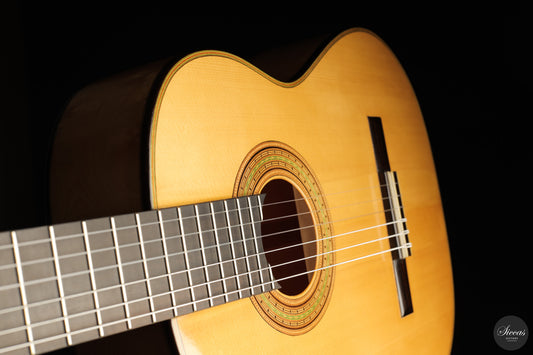
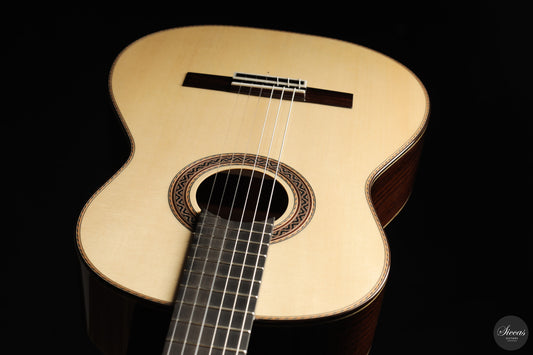
Manuel Adalid – A Spanish Master Between Tradition and Innovation
Manuel Adalid Balbuena stands among Spain's most accomplished and intellectually driven luthiers — a craftsman who grew up inside a guitar workshop, earned his mastery through decades of hands-on building, and then turned his attention to some of the most ambitious research in contemporary classical guitar construction. Born in Valencia in 1951 into a family already deeply embedded in the guitar trade, Adalid has spent his entire life asking how a great Spanish guitar can be made even better, and his answers have shaped instruments played on concert stages around the world.
A Workshop Childhood and the Path to Mastery
Adalid's formation as a luthier began before he could properly call it a vocation. His father, Manuel Adalid Lázaro, was one of the founding partners of Guitarras Francisco Esteve, established in 1957 in the Valencia region — one of Spain's most historically significant guitar-making centres. Growing up with the sounds and smells of tonewoods and French polish as natural companions, the younger Manuel spent his summers as an apprentice, learning the fundamentals of the craft from his father and from the master builder Antonio Monfort. These two figures shaped his understanding of Spanish construction at its most rigorous and classical.
Rather than moving directly into the family trade, Adalid pursued a degree in business at the University of Valencia, followed by a period running a guitar distributorship that made him one of Guitarras Esteve's most important commercial clients. This detour gave him an unusual dual perspective: he understood the market for fine guitars as thoroughly as he understood how to build them. When he was around 23 years old he returned to the Esteve workshop with complete dedication to guitar construction, completing his full apprenticeship under Monfort and his father. In October 1980, when the founding partners reached retirement age, he was appointed manager of Francisco Esteve, S.A. — a role that would transform both the company and his own career as a builder.
Leading Francisco Esteve and Earning Recognition
Under Adalid's direction, Guitarras Francisco Esteve expanded substantially. The workshop in Alboraya, a Mediterranean coastal town just outside Valencia, grew from a facility of around 2,000 m² with 30 employees to a 6,000 m² operation employing close to 50 people. This growth was not merely commercial — it reflected Adalid's ability to raise quality standards across the board while scaling production in a way that preserved the integrity of Spanish craft. The Council of Commerce and Industry of the Government of Valencia recognised his contribution by conferring on him the title of Master Craftsman (Maestro Artesano), one of the highest professional distinctions available to Spanish artisans.
His standing in the wider industry grew in parallel. He was elected Vice President of the Spanish Guild of Master Guitar Artisans and served as President of the Spanish Association of Musical Instrument Makers — positions that placed him at the heart of efforts to protect and promote Spain's guitar-making traditions. He has since been invited to deliver workshops on Spanish construction systems in Spain, France, China, and Argentina, bringing Valencian expertise to a genuinely international audience. For those interested in exploring the broader landscape of the craft, his career sits naturally within the rich history covered in our guide to classical guitar makers.
Research, Innovation, and the Private Workshop
From around 2001 onwards, Adalid embarked on what he considers his most significant personal contribution to the art: sustained research into new technologies of classical guitar construction. Over the following years he investigated double-top construction, alternative bracing patterns, the behaviour of composite and sandwich materials in soundboard design, and the acoustic consequences of double back and double side configurations. This research sits at the intersection of traditional Spanish lutherie and the kind of experimental thinking associated with double-top guitar pioneers elsewhere in Europe — and the results are audible in every concert instrument he builds.
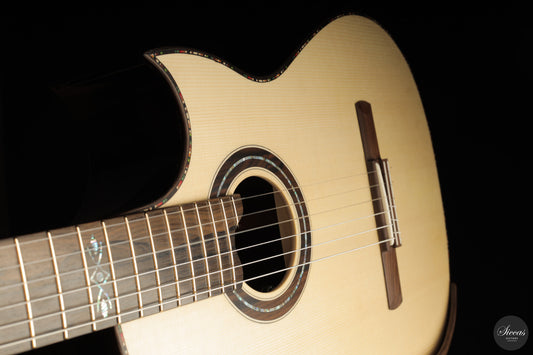
A portion of his workshop output carries the "Alboraya" label, denoting instruments designed and built entirely by Adalid himself, with only the finishing entrusted to an expert French polishing crew. These guitars represent the fullest expression of his personal vision: immaculate craftsmanship, carefully selected tonewoods, and construction principles refined through two decades of hands-on research. His approach to fan-braced, double-top and lattice construction reflects a deep curiosity about how the classical guitar's acoustic potential can be unlocked through structural innovation rather than departure from Spanish identity.
Signature Models: La Catedral, Homenaje, and the Especial Series
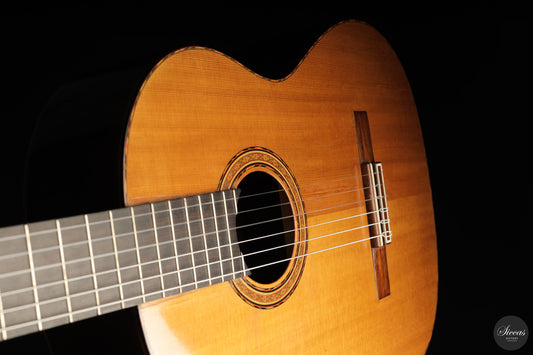
Among Adalid's concert guitar range, the La Catedral has emerged as his most celebrated model. Built with a double wooden top — typically cedar or spruce — and complemented by double back and sides, the La Catedral was designed to deliver clear, clean sound with infinite sustain and an extraordinary richness of harmonics. The tenth-anniversary edition of the model, which has become one of his most sought-after instruments, showcases his willingness to push the acoustic boundaries of double-top construction while maintaining the warmth and responsiveness that professional players demand. Instruments from this series have reached guitarists performing on concert stages across Europe, the Americas, and Asia.
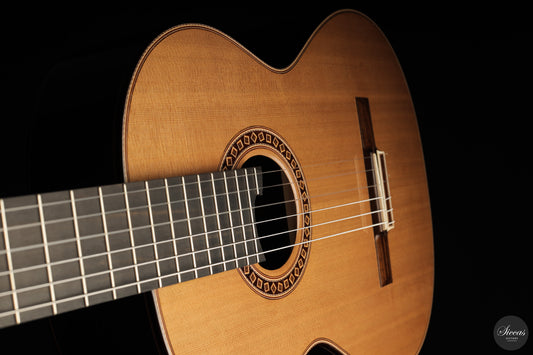
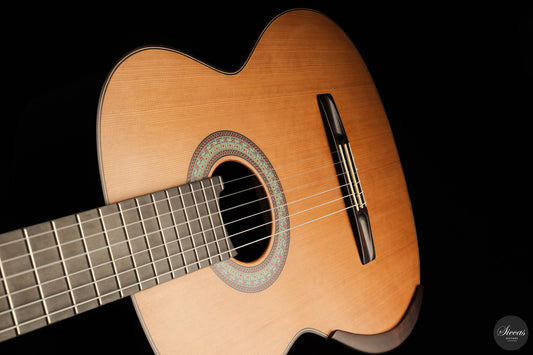
The Homenaje series — whose name means "tribute" in Spanish — occupies a similar position in his output, combining a cedar double top with tonewoods such as ziricote and reinforced cypress back and sides. The result is a guitar with thick, clear trebles, deep dark basses, and seamless blending across the register: an instrument equally at home in solo recital and chamber performance. His Especial models extend the range in a different direction, including historically informed replicas — among them a Hauser-style guitar and a Torres replica — that demonstrate the breadth of his engagement with the history of the instrument. This kind of dialogue with the past recalls the approach of masters like Daniel Friederich and Ignacio Fleta, both of whom balanced deep respect for tradition with a restless drive to improve.
Legacy and Continuing Work
Manuel Adalid's legacy is unusual in that it operates simultaneously at two scales. At the level of the industry, his long stewardship of Francisco Esteve helped preserve and disseminate Spanish guitar-making knowledge during a period when the craft faced serious commercial pressures, and his institutional roles have given him a platform to advocate for the recognition and continuity of the trade. At the level of individual instruments, his concert guitars stand as evidence of what sustained personal research can produce: tools for music-making that balance historical authenticity with genuinely modern acoustic performance.
Now in his eighth decade, Adalid continues to build at his Alboraya workshop, and the instruments he produces remain among the most distinctive coming out of Valencia's guitar-making tradition. His career connects the artisanal world of his father's generation to the research-driven lutherie of the present — a living bridge between two eras of Spanish guitar making.
Browse available Manuel Adalid guitars → in the Siccas Guitars collection.