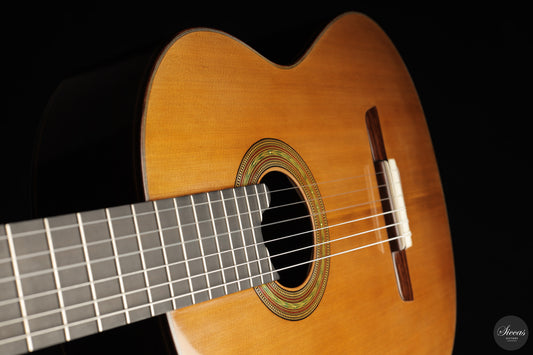
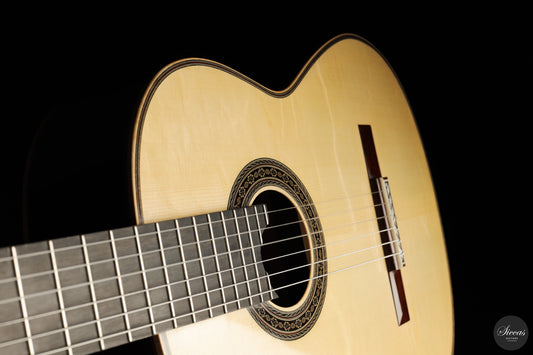
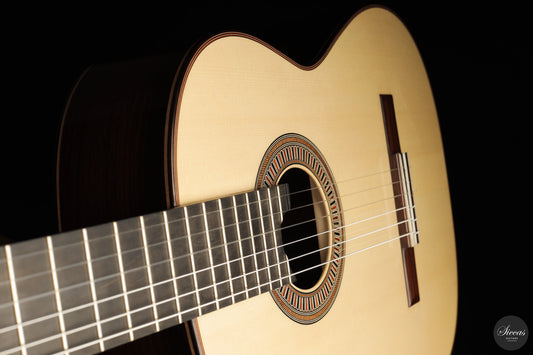
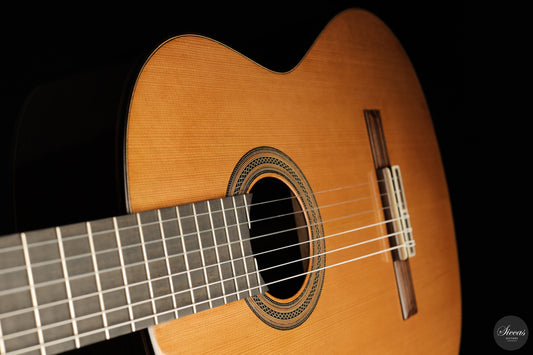
Manuel Reyes Maldonado (1934–2014) stands among the most revered flamenco guitar makers of the twentieth century. Born in Jayena, Granada, and rooted from childhood in Córdoba, Reyes spent his entire career dedicated to a single pursuit: building instruments of uncompromising character for the world's finest flamenco artists. His guitars — prized for their snappy attack, extreme clarity, and that almost impossible-to-define doughy warmth at the heart of the flamenco sound — became collector's items long before his death, and today they remain benchmarks against which all serious flamenco instruments are measured. Reyes worked without a large workshop, without apprentices in the conventional sense, and without compromise. He simply built guitars, one at a time, in Córdoba.
Biography and Training
Manuel Reyes was born on 18 July 1934 in Jayena, a small town in the province of Granada. When he was roughly ten years old his family relocated to Córdoba, where his father and brother found employment in a sawmill. It was in Córdoba that Reyes encountered his first guitar — a broken, abandoned instrument at a neighbour's house. Unsatisfied with his first attempt at repair, he resolved to build a guitar from scratch, guided by little more than intuition and determination. That early act of self-directed making would define the rest of his life.
His first formal teacher was Joaquín Sánchez Galisteo, a local luthier who taught Reyes the fundamentals of guitar construction. The deeper turning point came through the celebrated flamenco guitarist Pepe Martínez, who in the mid-1950s introduced Reyes to Marcelo Barbero, one of the great Spanish guitar makers of the era. Reyes travelled to Madrid and spent approximately a year working alongside Barbero, absorbing techniques and sensibilities that would shape his approach for the rest of his career. Barbero reportedly offered Reyes a permanent position in his Madrid workshop, but by that time there was already a waiting list of clients in Córdoba. Reyes returned to his adopted city and never looked back.
He established his own workshop in Córdoba in 1949 — a single, modest space from which he would work for the remainder of his active life, building guitars at a pace dictated by quality rather than quantity.
Construction Philosophy
Reyes was, above all, a builder of flamenco guitars, and his choices of material and method reflected a consistent and deeply held vision of what a flamenco guitar should be. He favoured spruce for the soundboard and cypress for the sides and back — cypress being the wood he most closely identified with the traditional flamenco sound, its lightness and stiffness contributing to the immediate, percussive response that distinguishes a true flamenco instrument from a classical one. Where some makers followed trends toward rosewood negras, Reyes remained loyal to the blanca tradition that cypress represents.
His finish of choice was hand-applied French polish using shellac, maintained with discipline throughout his career. All internal joints were assembled with traditional hide glue, a practice that had largely fallen out of use among most Spanish workshops by the latter half of the twentieth century. Reyes was among the last active Spanish masters to insist on it, valuing hide glue for both its tonal properties and its repairability — a join made with hide glue can be opened and re-closed without damage to the wood, a quality that matters enormously for instruments intended to last generations.
The tonal result of these choices was immediately recognisable. Players and dealers consistently describe a Reyes guitar as having extreme clarity and amplitude, a very fast response, and a characteristic warmth — described in Spanish guitar circles as a kind of "doughy" or "pasty" quality — that sits underneath the brilliance and give the instrument its soul. This combination of snappy attack and underlying creaminess is considered the hallmark Reyes sound. It is not accidental; it is the direct consequence of decades of refined choices about wood selection, bracing, and finish. His work stands comfortably alongside that of other giants of the Spanish tradition, including Ignacio Fleta and José Luis Romanillos, each of whom defined their own corner of the Spanish guitar world with equal rigour.
Signature Models and Output
Reyes never produced a named series of models in the commercial sense. Each guitar was, in effect, its own instrument — built to his exacting standards with the materials available and the specific commission in mind. What distinguished his output over the decades was not variety of model but consistency of excellence. A Reyes guitar from the early 1960s and one from the 1990s share the same fundamental DNA: spruce top, cypress body, shellac finish, and that unmistakable tonal personality.
Because he worked slowly and alone, the total number of instruments he completed over his career is limited, which is a significant reason why they are so sought after. Instruments from his earlier decades — the 1960s and 1970s — are now considered especially desirable, combining the finest examples of his developing craft with the natural ageing of the wood that deepens and opens a guitar's voice over time. These guitars occupy a different category from new instruments, however exceptional: they are historical artefacts as much as playing tools. Understanding the acoustic principles behind such instruments — including how bracing geometry and wood selection interact — is explored in depth in the guide to fan-braced, double-top and lattice guitars.
Notable Players
The roster of artists who chose Manuel Reyes guitars as their primary instruments reads like a history of modern flamenco. Vicente Amigo, one of the most celebrated flamenco guitarists of the contemporary era, is the most prominent name associated with the Reyes workshop, and his long use of these instruments did much to spread awareness of their qualities internationally. Tomatito — the Almería-born virtuoso whose career spans collaboration with Camarón de la Isla and decades of solo work — is another artist who trusted Reyes instruments on stage and in the studio. Manolo Franco, among the most respected Sevillian players of his generation, is likewise associated with the Córdoba workshop.
That the finest practitioners of flamenco guitar repeatedly chose Reyes instruments is not a marketing story. These are artists for whom the difference between a good guitar and the right guitar determines whether a performance reaches the level their music demands. The fact that so many of them arrived at Reyes' door speaks directly to the quality and the distinctiveness of what he produced.
Legacy
Manuel Reyes died on 10 November 2014 in Córdoba, leaving behind a body of work that will be studied, played and treasured for as long as flamenco exists as an art form. The continuity of the workshop was assured by his son, Manuel Agustín Reyes Flores — known as Manuel Reyes Jr. — who was born in 1969 and worked alongside his father from 1994 until the elder Reyes' death, a full twenty years of shared craft. Manuel Jr. has chosen to focus exclusively on flamenco guitars, maintaining the tradition of the blanca and keeping faith with the principles his father established.
In the wider history of the classical and flamenco guitar making tradition, the name Manuel Reyes occupies a position of rare authority. He was not a theorist or an innovator in the disruptive sense; he was a perfectionist who took a received tradition and refined it to its highest possible expression. His peers — Robert Bouchet in France, Daniel Friederich in Paris — were doing something similar for the concert classical guitar in the same decades, each finding their own path to an instrument of exceptional quality. Reyes did it for flamenco, and he did it without ever leaving Córdoba.
Browse available Manuel Reyes guitars → in the Siccas Guitars collection.