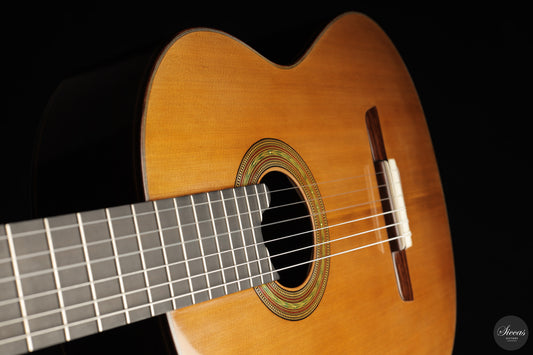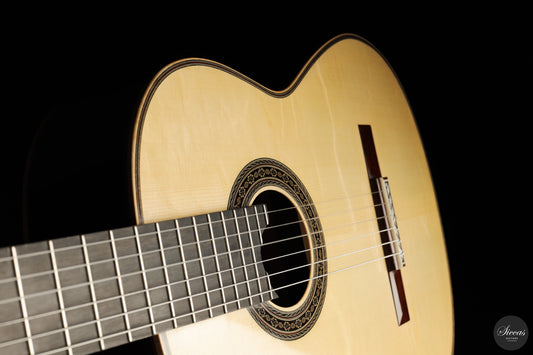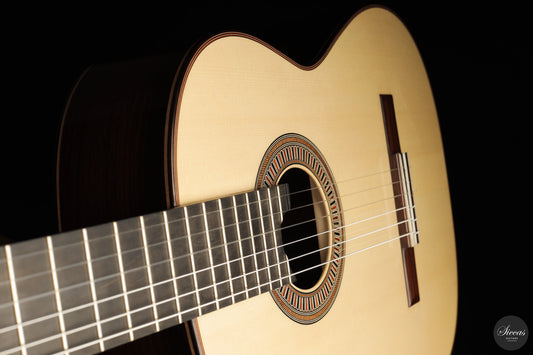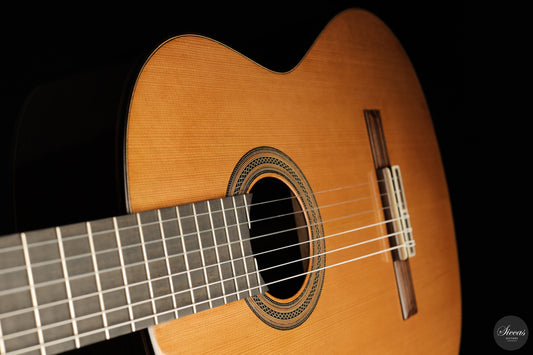

aul Fischer is widely acknowledged as Britain's foremost classical guitar maker — a craftsman whose instruments are played on concert stages around the world and whose influence on the art of lutherie extends far beyond his workshop in the Cotswolds. Born on the Isle of Man in 1941, Fischer has spent the better part of seven decades immersed in the making of fine musical instruments, building a body of work that now exceeds 1,100 guitars and plucked instruments. His name sits alongside the great European makers as a defining voice in the modern classical guitar's development, and his quiet dedication to both craft and research has earned him a reputation that is as much that of a scholar as of a builder.
Biography & Training
Fischer's journey into lutherie began in 1956 in Oxford, where he started making harpsichords and clavichords under the guidance of the eminent instrument maker Robert Goble. Goble's workshop was a rigorous school in the disciplines of fine woodworking and acoustic instrument design, and the years spent there gave Fischer a foundation that would underpin everything he built thereafter. Alongside this practical apprenticeship, Fischer pursued formal studies at the Oxford College of Art and Technology, adding a theoretical dimension to his developing craft. After a period of military service with the 11th Hussars, he returned to lutherie with a sharpened sense of purpose.
The decisive turn in Fischer's career came through a chance encounter with David Rubio, a fellow Englishman who had trained in Spain and become one of the most important guitar makers of the twentieth century. Fischer joined Rubio's workshop at Duns Tew, Oxfordshire, serving as chief instrument maker and manager. There, his skills expanded to encompass lutes and early plucked instruments alongside the modern classical guitar. Guitars produced during this period were stamped with both the Rubio label and the initials "P.F." — a quiet acknowledgement of Fischer's central role. Rubio was a mentor of rare quality, and the experience of working alongside him shaped Fischer's understanding of the Spanish tradition from the inside out. Among the wider community of classical guitar makers, few can claim such a direct line to that tradition through personal working experience.
In 1975, Fischer established his own studio, initially in Chipping Norton, Oxfordshire, where he has continued to work ever since. His workshop — known as West End Studio — sits with a panoramic view of the Cotswold Hills, and it is here that he has built the instruments that have carried his reputation worldwide. In 1983, he was awarded a Winston Churchill Travelling Fellowship, which he used to conduct research into the forests of Brazil — an endeavour that would later inform his pioneering work on alternative tonewoods.
Construction Philosophy
What distinguishes Paul Fischer as a luthier is not adherence to a single school of thought but rather a rigorously empirical approach to the questions every guitar maker must answer: what does the wood do, and how can the maker best serve the instrument's voice? Fischer has consistently argued that the soundboard is the primary driver of tone, estimating that the back and sides contribute approximately 20 to 25 percent of the overall tonal colour — a position that places the maker's skill in selecting and working the top at the very centre of the craft.
His research into alternative tonewoods became one of the defining contributions of his career. After concluding that the long-term future of Brazilian rosewood was precarious, Fischer began systematic investigations into substitute materials, selecting candidates on the basis of density, weight, and acoustic behaviour rather than appearance. His public demonstrations — in which guitars built with identical spruce soundboards and bracing patterns but different back and side woods were played side by side — showed that the tonal differences between species were far smaller than convention suggested. This work positioned Fischer among the more progressive voices in contemporary lutherie, willing to follow evidence rather than tradition. It also placed him in a broader conversation about sustainability that has grown increasingly urgent across the craft. For those interested in how structural choices shape sound, Fischer's thinking connects naturally to the wider debates explored in articles on fan-braced, double-top, and lattice guitars.
Fischer's bracing approach reflects the same systematic thinking. He made the decision to move from European spruce braces to Sitka spruce because Sitka's greater natural stiffness allowed him to reduce the physical dimensions of the bracing without sacrificing rigidity — the result being a lighter, more responsive structure that could vibrate more freely. Each instrument is individually calibrated, with thicknesses and dimensions adjusted to draw the best from the particular pieces of wood at hand rather than adhering to a fixed template. This is the mark of a maker who understands that no two pieces of timber are alike, and that genuine quality demands responsiveness to the material.
Signature Models and Range
Fischer's catalogue spans the full range of the concert classical guitar alongside a variety of historic and early plucked instruments. His concert instruments are built to the highest professional standard, intended for recording and performance at the most demanding level. The guitars are characterised by clarity of voice, even response across the full range of the instrument, and a refinement of finish that reflects decades of accumulated knowledge. Beyond the six-string concert guitar, Fischer has worked extensively with extended-range instruments, building guitars with between six and ten strings — a range that speaks to his interest in the instrument's full historical and technical potential.
His knowledge of historic instrument types, absorbed through years of working with Goble on harpsichords and with Rubio on lutes, gives his work a breadth that is rare among contemporary makers. Fischer's command of the baroque plucked instrument tradition feeds back into his understanding of the modern guitar in subtle but significant ways, informing his sense of how a vibrating body should feel and respond in the hands of a performer.
Notable Players
The list of musicians who have played Paul Fischer guitars reads as a cross-section of the classical guitar's international performing community. Jason Vieaux, the Grammy Award-winning American guitarist, has been among those associated with Fischer's instruments, as have the Assad Brothers — Sérgio and Odair Assad, whose chamber guitar duo has been one of the most celebrated in the world for four decades. Paulo Bellinati, Xuefei Yang, John Mills, Badi Assad, the Abreu Brothers, and Pepe Martínez are among the many other distinguished players who have performed on his guitars. The breadth of this roster, spanning soloists and duos, classical and crossover artists, reflects the versatility that Fischer's instruments bring to the concert stage.
Fischer's relationship with performing musicians has not been passive. Through master classes, lectures, and training opportunities offered at his studio, he has contributed directly to the education of a new generation of instrument makers, transmitting the knowledge gathered over a career of unmatched range and duration. This commitment to passing on what he has learned connects him in spirit to the great pedagogical tradition represented by makers such as José Luis Romanillos, whose own writings and teaching have been equally formative for the wider craft community. Fischer's influence can also be understood alongside that of Continental masters like Daniel Friederich, who similarly combined technical innovation with a deep respect for the classical tradition.
Legacy
Paul Fischer's legacy rests on three pillars: the instruments themselves, the research he has conducted into materials and construction, and the makers he has trained and inspired. With more than 1,100 instruments built over the course of a career spanning seven decades, his output alone would represent a remarkable achievement. But Fischer's significance goes beyond quantity. His systematic approach to tonewood research helped change the conversation in lutherie at a moment when that conversation badly needed changing, and his willingness to challenge received wisdom with empirical evidence has left a durable mark on the field.
He has served as an advisor to the Crafts Panel of the Southern Arts Association and as a Technical Advisor and Panel Member of the Crafts Council of Great Britain — formal recognitions of his standing within the broader community of British craft. The Winston Churchill Fellowship of 1983 speaks to an earlier moment of institutional acknowledgement that came well before his reputation had fully crystallised, a sign that the quality of his thinking was recognised early. Today, working from his studio in the Cotswolds with its view across the hills that have framed his life's work, Fischer continues to build guitars that performers trust on the most demanding stages in the world. His career is a demonstration of what patient, rigorous, intellectually serious lutherie can achieve over a lifetime of commitment to a single, endlessly complex craft. Those exploring the broader landscape of master-level guitar building will find his work a natural companion to the legacy of figures like Robert Bouchet and Ignacio Fleta, whose instruments similarly defined what the classical guitar could be in the hands of a dedicated craftsman.
Browse available Paul Fischer guitars → in the Siccas Guitars collection.