Raffaele Dantone – A Voice from the Dolomites
Raffaele Dantone is one of the most compelling classical guitar makers to emerge from Italy in recent years. Born in Bolzano in 1993 and working from his own workshop in the Fassa Valley in the heart of the Dolomites, he has built a reputation for instruments of exceptional tonal depth and refinement — all before reaching his early thirties. His guitars carry the warmth of the Spanish tradition alongside a distinctly personal voice shaped by the forests and mountain landscapes of northern Italy.
From Carpenter to Luthier – An Unlikely Path
Dantone's route into guitar making did not begin in a conservatory or a city workshop. He spent his early working years as a wood carpenter in the Dolomites, developing an intimate understanding of timber — how it moves, how it responds to tools, and how different species carry different acoustic potential. The forests of Trentino, with their renowned spruce, were never far away. That proximity to living wood would later inform how he selects and voices his soundboards.
The turning point came when Dantone attended a guitar-making workshop led by luthier Mirko Borghino. Building his first classical guitar during that course proved decisive. He enrolled shortly afterwards at the Civica Scuola di Liuteria di Milano, one of Italy's most respected institutions for instrument making, where he received a rigorous grounding in traditional construction methods. The Milanese school has produced a generation of outstanding Italian makers, and Dantone absorbed its demanding standards thoroughly. Italy's wider culture of lutherie — a tradition explored in detail in the story of the Italica project, where twenty Italian master luthiers joined forces — forms an important backdrop to understanding what Dantone inherited and where he departs from it.
After graduating, he deepened his practice under the mentorship of Daniele Marrabello, a Milan-based luthier of considerable standing whose own work draws on the legacy of Hermann Hauser and Antonio de Torres. With Marrabello, Dantone refined his approach to construction tolerances, graduating braces, and the relationship between top thickness and resonant frequency. This mentorship appears to have been formative: Dantone's finished instruments share a clarity of purpose that suggests thorough technical grounding rather than improvised discovery.
Construction Approach and the Dantone Sound
Dantone's guitars are rooted in the Spanish tradition. His plantilla and internal geometry draw on the Hauser lineage — a lineage that runs back through Ignacio Fleta and the great masters of the twentieth century — but the instruments do not read as copies or homage pieces. They reflect a maker who has studied the tradition closely enough to know where his own instincts diverge from it.
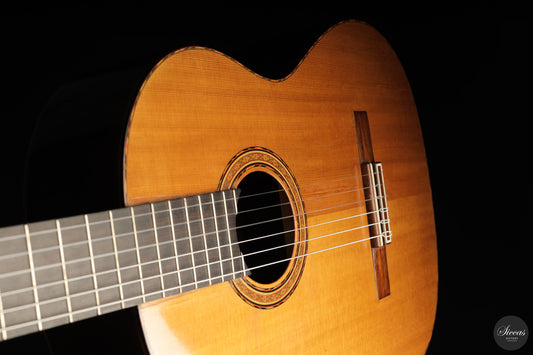
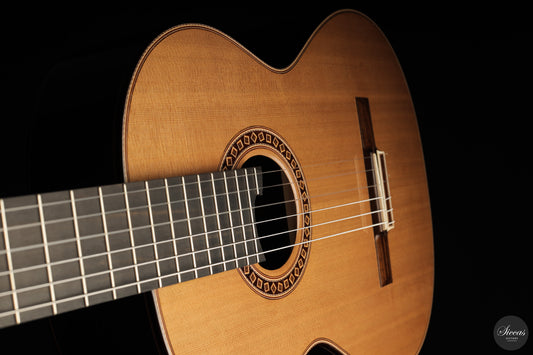
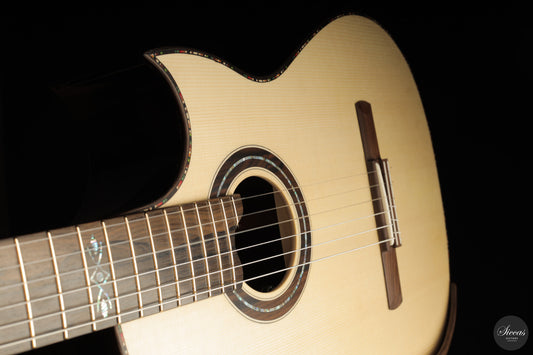
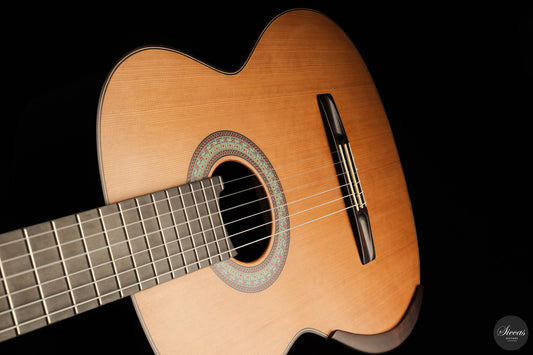
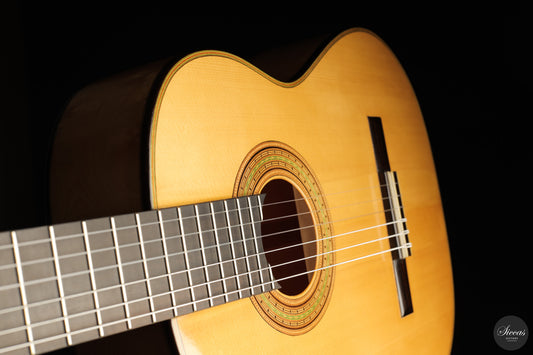
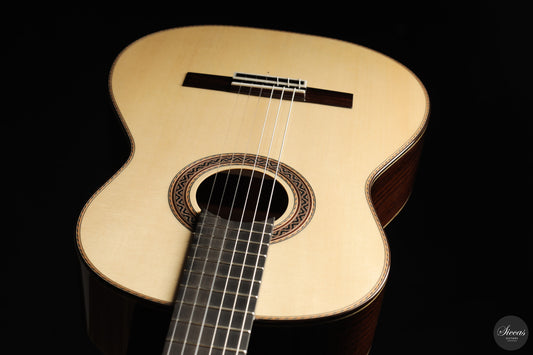
He works primarily with spruce tops, often sourced from the Trentino region where the altitude and climate produce tonewood of exceptional stiffness-to-weight ratio. Back and sides are typically Indian rosewood, though he has also explored combinations including wengé in some instruments. The bracing follows a traditional fan pattern, and Dantone pays particular attention to voicing the top — tapping and flexing the plates until the resonant frequencies align with his intended tonal target before a single brace is glued in place.
The resulting sound is characterised by deep, charismatic basses and trebles that are brilliant without being harsh. Players and critics alike describe the dynamic range as genuinely wide — these are guitars that whisper and project with equal conviction, an attribute particularly valuable in concert hall settings. Dantone's instruments also display strong colour variation across the tonal spectrum, allowing performers to shade phrases and distinguish voices within polyphonic textures. This quality — tonal versatility within a coherent overall character — is one of the benchmarks by which serious concert guitars are judged, and it places Dantone's work firmly in that conversation. Makers who have advanced the craft in comparable directions are discussed in the overview of classical guitar makers at Siccas Guitars.
Workshop in the Mountains
Dantone builds in Canazei, a small town in the Fassa Valley surrounded by the UNESCO World Heritage Dolomites. The setting is unusual for a luthier of his stature — most of his Italian contemporaries work in or near major cities — but it suits both his temperament and his relationship with tonewoods. The Dolomites have long supplied violin and guitar makers with Alpine spruce, and working in the region keeps Dantone close to the material source. The workshop itself is modest and personal, and his annual output remains deliberately limited, prioritising quality over volume in a way that recalls the working philosophy of earlier masters such as Robert Bouchet, who likewise treated each guitar as a singular object worthy of sustained attention.
His approach to the craft is unhurried. Each instrument is tuned to specific resonance frequencies before final assembly, and the finishing — binding, varnish, fret work — is executed with the care that distinguishes a handmade concert guitar from workshop production. The result is an instrument that feels as considered as it sounds.
A New Generation of Italian Makers
Dantone belongs to a cohort of young Italian luthiers who have studied rigorously, absorbed the lessons of the Spanish and German traditions, and are now producing instruments that compete at the highest level of the international market. Alongside makers such as Andrea and Giovanni Tacchi in Florence, Dantone represents a renewal of Italian classical guitar making — one that honours its roots without being confined by them. Where earlier Italian masters worked largely in isolation, this generation benefits from greater access to information, international competition feedback, and a network of peers. Dantone's willingness to be in dialogue with other builders, while maintaining a clear individual voice, is one of the things that makes his work worth following closely.
His instruments have been received with enthusiasm by professional musicians and by specialist dealers across Europe, and his waiting list reflects the esteem in which his work is held. For a maker still in the early part of his career, the consistency and seriousness of his output is remarkable. There is every reason to expect that the instruments he builds in the coming decades will confirm what his earliest guitars already suggest: that Raffaele Dantone is a name that will matter in the history of the classical guitar.
Browse available Raffaele Dantone guitars → in the Siccas Guitars collection.