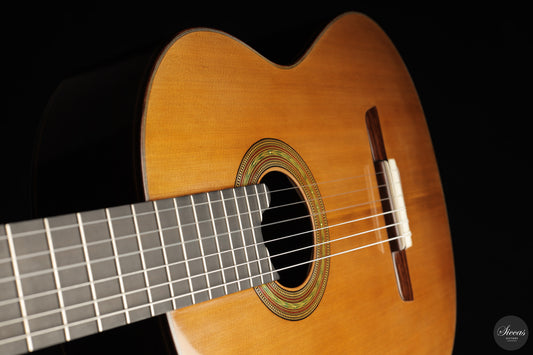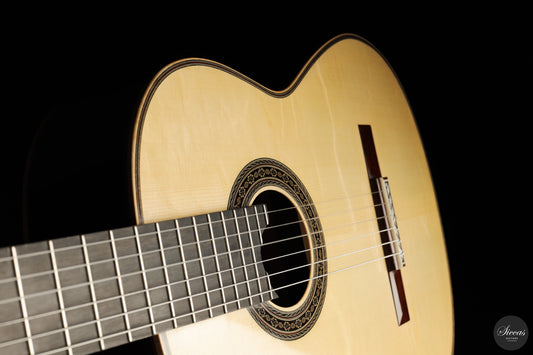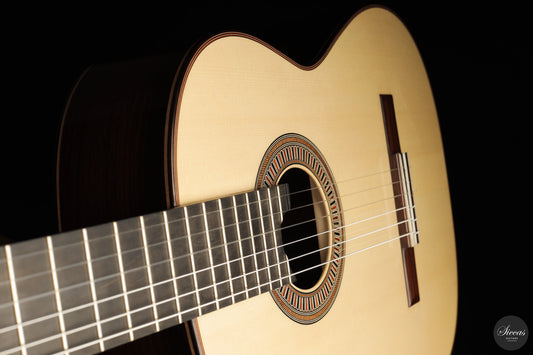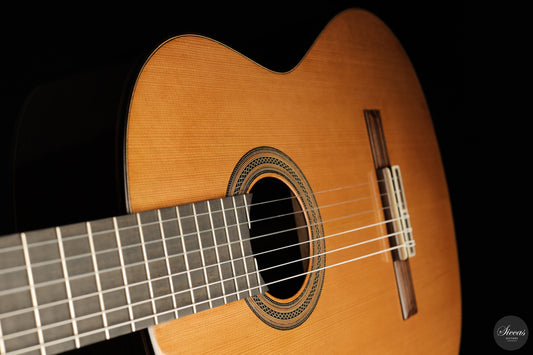

Among the great classical guitar makers of the modern era, Richard Jacob Weissgerber (1877–1960) occupies a singular position. Born in Markneukirchen, the legendary instrument-making town in the Vogtland region of Saxony, he would become widely regarded as the most creative, innovative, and certainly the most eclectic luthier of the 20th century. Whether measured by the diversity of his forms, the richness of his ornamentation, or the quality of his tonal voice, Weissgerber's output stands unmatched in breadth. His instruments are treasured today by collectors, historians, and performers alike — a testament to a craftsman who never stopped experimenting, right to the very end of his life.
Biography and Training
Richard Jacob Weissgerber was born in 1877 into a family already steeped in the craft of instrument making. His father, Carl August Jacob (1846–1918), was himself a guitar maker, and the young Richard Jacob spent his formative years surrounded by decorated instruments fresh from the workshop. His maternal grandfather, master craftsman Christian Wilhelm Seidel, provided his earliest formal training in the traditions of the Vogtland trade. This multi-generational immersion in the craft gave Weissgerber a remarkably deep foundation from the outset.
In his youth he completed a formal apprenticeship as a zither maker — a craft requiring precision in both acoustics and woodworking — before going on to assist the guitar maker Wilhelm Voigt for six years. This combination of training across related stringed instrument traditions gave him an unusually versatile technical vocabulary. In 1905, confident in his abilities and full of independent ideas, Richard Jacob founded his own guitar workshop in Markneukirchen. Early in his career he was shrewd enough to register "Weissgerber" as a protected trade name, giving the workshop a clear identity and the freedom to innovate without being hemmed in by generic regional conventions.
Construction Philosophy
Weissgerber's construction philosophy evolved dramatically over his working life, moving from the popular Viennese style of his early years toward the Spanish tradition that would define his mature work. The pivotal turning point came in 1921, when the celebrated guitarist Miguel Llobet visited Markneukirchen and played for him. In 1924 Llobet returned — this time accompanied by Andrés Segovia — and Weissgerber was able to examine their instruments at close hand: a Torres and a Manuel Ramírez guitar respectively. The encounter was transformative. The responsiveness, projection, and tonal refinement of those Spanish instruments set a new standard for what Weissgerber would aspire to build.
Further visits from players such as Emilio Pujol and Luise Walker, each arriving with their own Spanish instruments, deepened his understanding of this tradition. He absorbed the principles of Torres-influenced fan bracing, lightweight construction, and sympathetic acoustic geometry — but he never simply copied. His hallmark was the synthesis of Spanish principles with his own experimental spirit. He explored unusual body shapes, elaborate decorative schemes, and distinctive constructional variants that set his instruments apart from anything being made elsewhere. The range of his work extended from Torres-model concert guitars to vihuelas, baroque-inspired forms, and instruments with sculpted, fluted tops. His 1942 vihuela, for instance, demonstrates just how far beyond conventional guitar making his ambitions reached. Understanding this diversity is essential to appreciating Weissgerber — he was, in many respects, the opposite of the specialist, a luthier who treated the guitar family as an entire universe of possibilities. This spirit of open-ended exploration places him in the company of the great experimenters of guitar history, figures like Robert Bouchet and Daniel Friederich, who also refused to be confined by convention.
Signature Models
Weissgerber's catalogue was broader than that of virtually any other luthier of his era. His Torres-model guitars — instruments directly inspired by the proportions and bracing philosophy of Antonio de Torres — remain among his most celebrated, offering a warm, intimate tone with exceptional responsiveness under the fingers. These guitars appeared throughout his career in various configurations, from the more modestly decorated workshop models to elaborately ornamented instruments with inlaid rosettes, figured maple backs and sides, and exquisitely crafted fretboards.
Among his more unusual creations, the vihuela occupies a special place. In his 1935 catalogue Weissgerber applied the term "Vihuela" to all instruments of this historical type, deliberately connecting his work to the Renaissance traditions of the Spanish plucked string instrument. This was not mere marketing — the construction of these instruments required a thorough understanding of historical lutherie practice, and Weissgerber brought to them the same care and precision as to his concert guitars. His 1943 guitar owned by Siegfried Behrend — built with a distinctive fluted top, reportedly the first of its type that Weissgerber made — stands as another example of his willingness to push into uncharted territory. The history of the romantic and early modern guitar runs through Weissgerber's workshop in a uniquely tangible way, as he built across the full continuum from late-romantic German forms through to the modern Spanish concert instrument.
Notable Players
From early in his career, Weissgerber guitars attracted the attention and loyalty of leading professional guitarists. Heinz Teuchert, the founder of the Frankfurt School of guitar and lute playing and one of the most influential pedagogues of the German guitar world, was among those who played his instruments. Karl Scheit, the Austrian guitarist and scholar whose editions and recordings helped shape the classical guitar repertoire in the mid-20th century, was another significant figure associated with Weissgerber's work. Perhaps the most storied connection is with Siegfried Behrend, the German virtuoso and tireless advocate for the guitar as a concert instrument, whose 1943 Weissgerber — with its unusual fluted top — became one of the most celebrated examples of the maker's inventive spirit.
Beyond these named players, the broader picture confirms that Weissgerber's reputation reached far beyond Markneukirchen during his own lifetime. The visits of Llobet, Segovia, Pujol, and Walker to his workshop are evidence of an international esteem that few German makers of the period could claim. His instruments did not remain in regional circulation; they entered the hands of the leading performers of the era and were taken onto concert stages across Europe.
Legacy
Richard Jacob Weissgerber died in 1960, having completed three instruments in the final year of his life at the age of 83. That fact alone speaks to the depth of his vocation. His eldest son Martin Weissgerber (1911–1991) continued running the Weissgerber Guitar Workshop after his father's death, until its eventual closure in 1990 — a span of nearly nine decades of continuous Weissgerber guitar making in Markneukirchen.
The scholarly recognition of Weissgerber's significance has continued to grow in the decades since his death. A dedicated monograph by author Christof Hanusch — WEISSGERBER – Gitarren von / Guitars by Richard Jacob — has documented his output in depth. Several of his instruments are held in the collection of the Museum of Musical Instruments at the University of Leipzig, where they can be studied as primary documents of 20th-century lutherie. The breadth and originality of his work means that no single instrument can stand as representative; one must encounter many to begin to understand the full scope of what he achieved. For anyone interested in the intersection of German craftsmanship and the Spanish guitar tradition — or simply in instruments of exceptional quality and historical resonance — the work of Richard Jacob Weissgerber repays close attention. His place among the great masters of 20th-century guitar making is secure, and his instruments continue to find new admirers with every generation of players and collectors.
Browse available Richard Jacob Weissgerber guitars → in the Siccas Guitars collection.
The full portrait. A short overview with the key questions is in Richard Jacob "Weißgerber" — Germany's Most Inventive Guitar Maker.