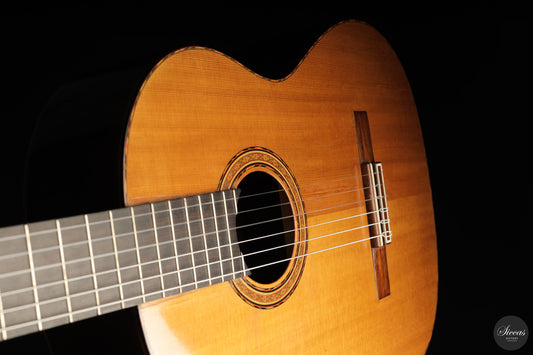
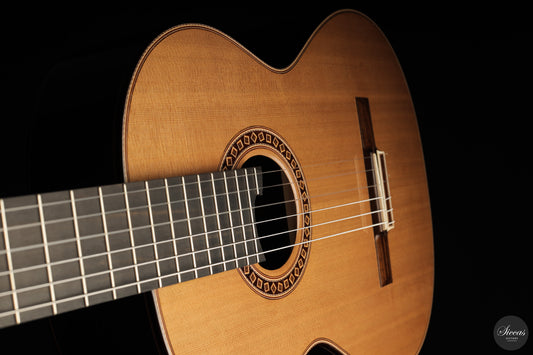
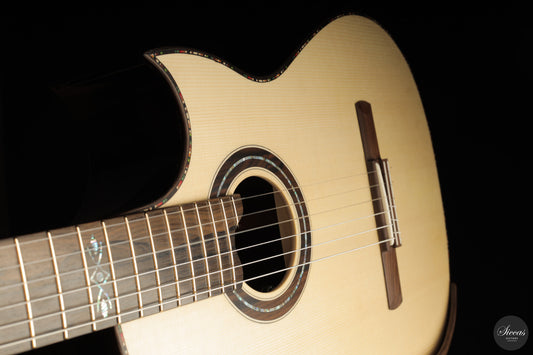
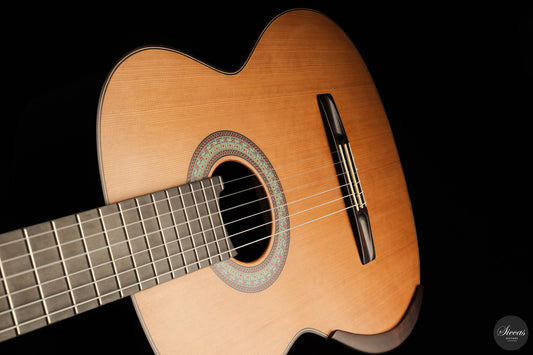
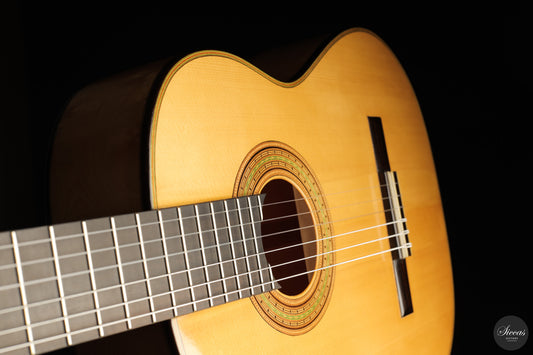
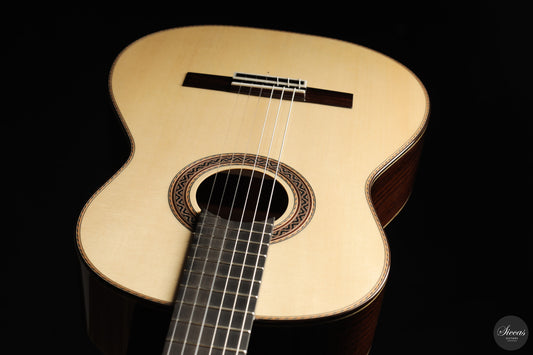
Saeid Aboutalebian belongs to a generation of luthiers who have carried their deep roots in traditional instrument making into the demanding world of concert classical guitar. Born in Isfahan, Iran, in 1980, he trained at the Isfahan Conservatory and spent the first decade and a half of his career building instruments rooted in Persian musical culture. When he redirected his craft toward the classical guitar in 2017, he brought with him not only refined woodworking skills but also an ear shaped by an entirely different tonal tradition — one that prizes warmth, resonance, and expressive colour above all else. Working today in Barcelona, he has established himself remarkably quickly as one of the most closely watched makers in the contemporary double-top scene.
Biography & Training
Aboutalebian grew up in Isfahan, a city renowned in Iran for its arts and craftsmanship. He graduated from the Isfahan Conservatory, where he developed both his musicality and his understanding of acoustic principles. From around 2000 he devoted himself to making traditional Persian instruments — a discipline that demands precision joinery, sensitivity to tonewoods, and a nuanced relationship between structure and vibration. These are, of course, exactly the skills that define great guitar making, and when Aboutalebian turned his attention fully to the classical guitar in 2017, the transition was rapid. Within a few years he had relocated to Barcelona, Spain, placing himself at the heart of the world's most concentrated community of classical guitar builders and players. The city gave him access to premier tonewoods, specialist suppliers, and a professional network that accelerated his development considerably.
Construction Philosophy
Aboutalebian has concentrated from the outset on double-top construction, the technique in which two thin sheets of tonewood sandwich a lightweight core material to create a soundboard of exceptional stiffness-to-mass ratio. Where many double-top builders favour Nomex honeycomb as the core, Aboutalebian works primarily with balsa wood — a choice that shapes the character of his instruments in distinctive ways. Balsa tends to impart a fuller, rounder quality to the low and mid frequencies while preserving transparency in the trebles, and reviewers have consistently noted that his guitars offer a warmth rare in the double-top category without sacrificing the projection that concert players require.
His approach to bracing draws on the wider fan-braced tradition of the Spanish school while adapting it to the particular physics of the composite soundboard. He works in relatively small batches, giving each instrument close personal attention, and his serial numbering reflects steady, focused output: by 2025 he had completed more than sixty instruments — a pace that balances quality with genuine availability for players seeking his work.
Signature Models
Aboutalebian's catalogue centres on the double-top guitar, offered with either cedar or spruce as the outer soundboard layer. His cedar double-tops are particularly praised for their immediate response and vocal midrange — qualities that suit repertoire calling for lyrical expression and subtle dynamic gradation. The spruce variants lean toward a brighter, more articulate character, often preferred for contrapuntal or Baroque-influenced playing. In both cases the balsa core is central to his tonal identity, and players who have moved between his instruments and double-tops by other makers tend to remark on the organic, un-mechanical quality of his sound. His construction details are consistently refined: the bindings, purflings, and overall finish reflect the care of a maker who trained in traditions where decorative craft and functional precision are inseparable. For further context on the double-top format and how different builders approach it, the overview of double-top guitar pioneers provides useful background.
Notable Players
For a builder only a few years into his guitar-making career, Aboutalebian has attracted an impressive roster of professional advocates. Álvaro Pierri — one of the senior figures of the international concert circuit and a professor at the University of Music in Vienna — has played and endorsed his instruments. Guillem Pérez, head of the guitar department at the Conservatori Superior de Música del Liceu in Barcelona, has also chosen an Aboutalebian, giving the luthier strong institutional visibility in his adopted city. The duo Resonantia, formed by Bernadeta Midziałek and Guy-Jean Maggio, is among the chamber ensembles that have performed on his guitars in concert settings. The breadth of this early support — spanning soloists and chamber musicians, conservatory professors and touring artists — suggests that Aboutalebian's instruments perform convincingly across a wide range of musical contexts and personal preferences. Understanding how concert guitarists practice and test instruments sheds light on why professional players return to a maker whose guitars reward sustained engagement.
Legacy
It is still early to speak of a definitive legacy, but the trajectory is clear. Aboutalebian has moved with uncommon speed from a standing start in a new instrument family to a position where his guitars are discussed alongside those of established double-top makers. His background in Persian instrument making has given him a perspective on tone and craft that sets him apart from luthiers trained exclusively in the Western European guitar tradition, and that difference of ear and hand is audible in his instruments. Barcelona has historically been one of the most fertile cities in the world for classical guitar making, and by establishing his workshop there Aboutalebian has placed himself within a lineage stretching back through José Romanillos and the great Spanish masters. Whether working with cedar or spruce, balsa or alternative cores, he continues to refine a voice that is distinctly his own — warm, resonant, and grounded in a deep love of the instrument's expressive possibilities.
Browse available Saeid Aboutalebian guitars → in the Siccas Guitars collection.