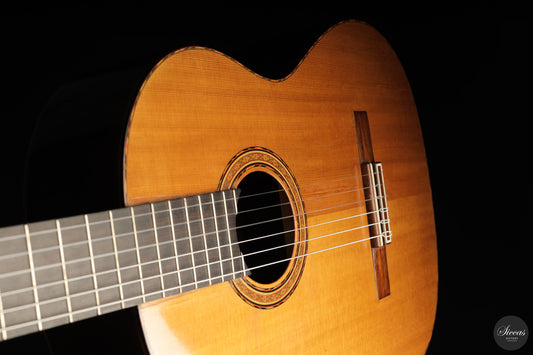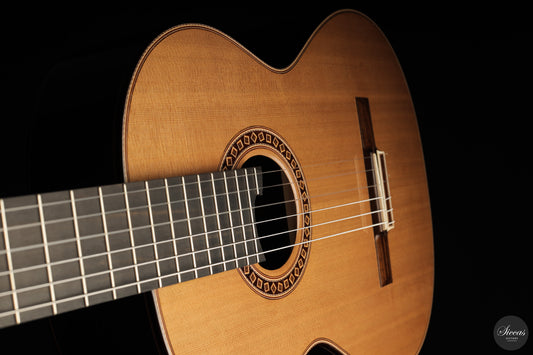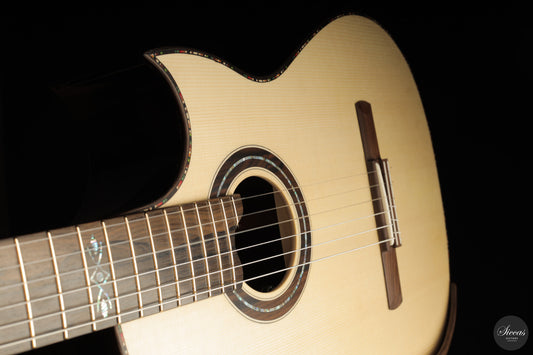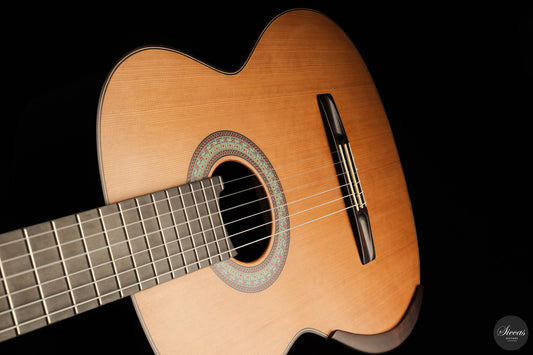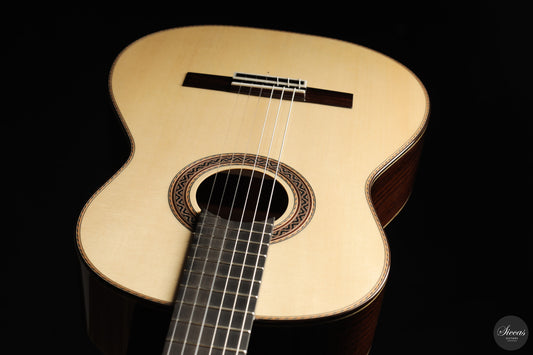

Simon Marty occupies a singular position in the world of classical guitar making. A Sydney-based luthier with a doctorate in electrical engineering, he approached the centuries-old craft not as a craftsman steeped in tradition, but as a scientist determined to solve a problem: why did so many expensive guitars from celebrated makers fail to deliver consistent projection, clarity, and tonal balance? His answer — a radial carbon-fibre bracing system developed with the help of laser holography and government-funded research — reshaped how the world thinks about Australian lutherie and earned his instruments a place on the concert stages of some of the world's finest guitarists.
Biography & Training
Simon Marty grew up in Australia and studied classical guitar seriously for a number of years before the instruments he played began to frustrate him. Having owned guitars by well-regarded makers, he found that the instruments lacked the consistency he sought in projection, clarity, and evenness of tone. That frustration, combined with his academic background in physics and mathematics, planted the seed of a new career. Around 1981–1982 he began learning the fundamentals of guitar construction under Gerard Gilet, a Sydney-based luthier who generously shared his knowledge and guided Marty through the basics of the craft.
From the outset, Marty had no interest in replicating existing designs. His engineering training pushed him toward experimentation, and within a few years he had attracted the attention of the Australian government. Between 1983 and 1987 he collaborated with CSIRO — Australia's national science agency — using an Australia Council grant to conduct rigorous acoustic research. The methods he employed were unusual for a guitar workshop: laser holography, frequency response testing, and finite element analysis computer modelling were all brought to bear on the behaviour of guitar soundboards. These tools allowed him to assess construction changes rapidly and with a precision that traditional trial-and-error could never match. The results formed the foundation of the radical bracing design for which he is now internationally known.
Construction Philosophy
The heart of Simon Marty's approach is his radial bracing system — a pattern of struts made from carbon-fibre composite that radiate outward from the bridge in a star-shaped arrangement. This departs sharply from the Torres fan-strutting model that has underpinned most classical guitar construction since the nineteenth century. Where the traditional approach relies on carefully graduated wooden braces arranged in a fan pattern beneath the lower bout, Marty's radial design distributes mechanical forces differently, allowing him far greater control over how the soundboard resonates at different frequencies.
Crucially, unlike the lattice-braced guitars popularised by Greg Smallman, Marty keeps his soundboards at a more traditional thickness. This means the instruments retain a woody, full-bodied warmth and sustain that thinner lattice tops can sometimes sacrifice. The combination — traditional thickness with an unconventional bracing geometry and the stiffness of carbon fibre — produces what many players describe as enormous volume, powerful basses, clear trebles, and a rich, dense overall tone. He works with both spruce and cedar tops, noting that while spruce demands an acoustically efficient design to project well, cedar opens a different palette of tone colours that many concert artists find compelling.
Marty also uses an arched back in rosewood alongside his scalloped bridge design. Every element of the instrument is treated as part of a system, not a collection of independent variables — a perspective that stems directly from his scientific training. He has written and spoken about the importance of understanding timber type, thicknessing, and bracing patterns as an integrated whole: it is the overall soundboard design, in his view, that ultimately determines the voice of the guitar. This philosophy links him, philosophically if not stylistically, to great analytical makers such as Daniel Friederich, who also brought systematic rigour to bear on questions of resonance and construction.
Signature Models
Simon Marty does not produce a wide catalogue of named models in the manner of some larger workshops. His output is small — measured in single-digit annual production — and each guitar is built individually to his specifications. Instruments are typically described by their top wood and year of construction: spruce-top and cedar-top variants are the two main configurations, each with its own tonal character. The spruce models tend toward brightness and articulation, while cedar instruments offer greater warmth and colour in the midrange. Both configurations share the radial bracing architecture and are built to concert standard throughout.
Earlier instruments from the 1990s and 2000s have appeared at leading international dealers and are considered highly collectible. More recent guitars — particularly those built from 2020 onward — have attracted significant attention for the refinement of the radial system after four decades of continuous development. For players interested in the broader landscape of innovative structural approaches, Marty's work sits naturally alongside the innovations discussed in our overview of classical guitar makers, as well as the engineering-led innovations of the double-top guitar pioneers.
Notable Players
Concert artists who have performed on Simon Marty guitars form an impressive roll call of international talent. Among the most prominent are Slava Grigoryan, one of Australia's most celebrated classical guitarists, and Karin Schaupp, another major figure on the Australian and international stage. Beyond Australia, his instruments have been taken up by Scott Tennant, a founding member of the Los Angeles Guitar Quartet; Marco Tamayo, the Cuban-born virtuoso renowned for his interpretive depth; Anabel Montesinos; Franz Halász; Mak Grgic; Irina Kulikova; Anthony Garcia; and the Zagreb Guitar Quartet, among others. The breadth of this roster — spanning Australia, North America, Europe, and beyond — speaks to the universality of what Marty has achieved with his design: guitars that serve equally well in a chamber setting and a large concert hall.
Legacy
Simon Marty's influence on the world of classical guitar lutherie is difficult to overstate for someone who has remained largely outside the mainstream of European instrument-making. He demonstrated that a scientifically rigorous approach to soundboard acoustics — one backed by formal research, government grants, and cutting-edge measurement technology — could produce instruments that rival and, in many contexts, surpass those of established masters working in older traditions. Alongside Greg Smallman, his work has placed Australian lutherie firmly at the centre of the global conversation about what a concert classical guitar can be.
He has also spoken about a longer-term aspiration: to see his design principles translated into a wider production context, making the acoustic benefits of his research accessible to players who cannot afford handmade concert instruments. That ambition — to democratise the science as well as the art — is the mark of a maker who understands that the true measure of an innovation is how far it travels. For anyone exploring the frontier of modern classical guitar construction, a Simon Marty guitar remains one of the most compelling instruments available anywhere in the world. Makers working in related traditions of innovation, such as Robert Bouchet and Ignacio Fleta, helped establish the vocabulary of modern lutherie — but Marty wrote an entirely new chapter of that story from the southern hemisphere.
Browse available Simon Marty guitars → in the Siccas Guitars collection.