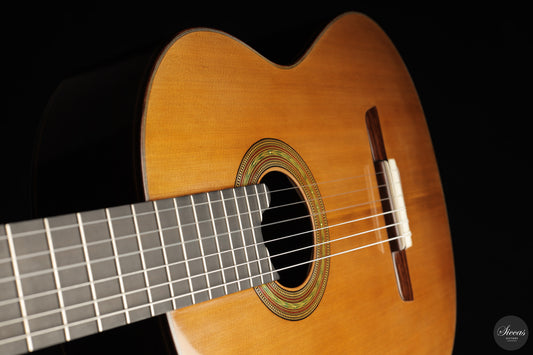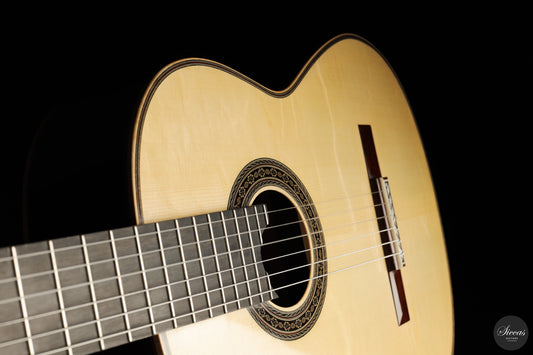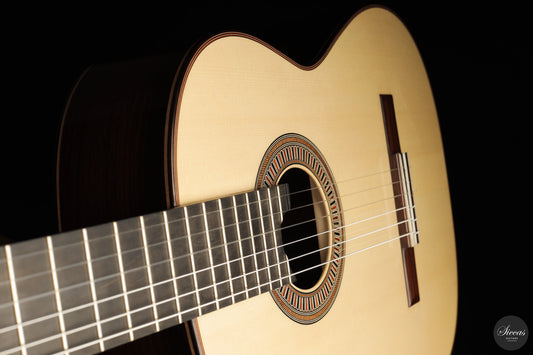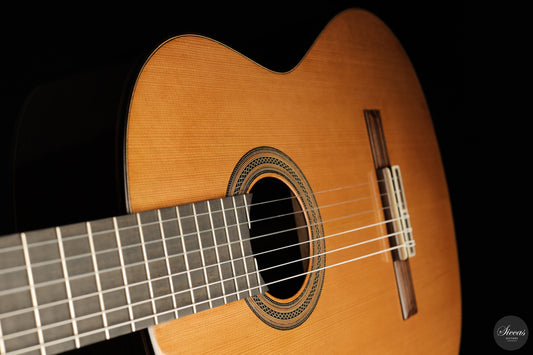

Stephen Hill occupies a rare position among contemporary classical guitar makers: a British luthier who followed the craft all the way to its heartland in Granada, Spain, and built a reputation there on his own terms. Since making his first instrument in 1985, Hill has developed a distinctive voice as a builder — one that honours the Granada tradition while embracing modern acoustic innovations such as lattice and double-top construction. His guitars are in the hands of internationally acclaimed concert players, and his European Institute of Guitar Making has trained a new generation of luthiers from around the world. Hill's story is one of deep vocation, shaped by decades of patient craftsmanship.
Biography & Training
Stephen Hill was born in London in 1967 and began studying classical guitar at the age of eight. Music was woven into his early life from the start — his parents exposed him to flamenco, specifically cante jondo, alongside Mexican and Greek folk music from infancy. That immersion left a lasting mark. When Hill left school at sixteen, he found immediate work as a cabinet maker and quickly launched his own woodworking business. The connection between fine joinery and the construction of musical instruments was not lost on him, and it was through this hands-on relationship with wood that the idea of building guitars began to crystallise.
In 1987, Hill enrolled at the Totnes School of Guitar Making in Devon, where he completed a short intensive course building a copy of a Stradivarius guitar. The experience confirmed his direction. By 1988 he was travelling regularly to Spain, spending time in guitar workshops and immersing himself in flamenco culture. Makers such as Manuel Reyes and Antonio Marín Montero were formative influences during these early visits, as was luthier Jonathan Hinves. He also undertook Paco Peña's celebrated flamenco course in Córdoba, deepening both his musical understanding and his feel for what a guitar needs to do in the hands of a serious player.
Through the late 1980s and 1990s, Hill built instruments and taught guitar making from his base in Lewes, East Sussex, guiding many students through their first builds and helping some of them establish their own careers as luthiers. In 2004, he made the commitment definitive: he relocated permanently to La Herradura, a small coastal town in the province of Granada, Andalucía. From that point on, his labels have carried the words "Granada, España" — an acknowledgement of belonging that speaks to his sustained engagement with Spanish lutherie at its source.
Construction Philosophy
What distinguishes Hill's approach is a willingness to work across several building traditions without abandoning the sensibility of any of them. His workshop produces guitars in three distinct structural systems: the traditional Granada fan-brace, the wood lattice, and the double top. This breadth is not eclecticism for its own sake — it reflects his conviction that each construction method serves a different musical purpose, and that a serious maker should be fluent in all of them.
His traditional Granada-braced instruments follow the principles of the Andalusian school, with refinements developed over decades of building and listening. His lattice guitars depart from the approach associated with makers such as Greg Smallman in one important respect: Hill builds his lattice tops without carbon fibre, relying instead on a purely wooden grid. This choice, he argues, preserves a natural warmth and sweetness of tone that can be lost when composite materials dominate the structure, while still delivering the added sustain and projection that a lattice design affords. The lattice model is closely associated with guitarist Gary Ryan, who has worked with Hill over many years and after whom the model is named.
The double-top construction employs a five-by-five wooden lattice system as the core bracing, sandwiched between two thin soundboard skins to achieve exceptional lightness with structural rigidity. This method, which places Hill within a broader movement of contemporary makers exploring tonal extremes, is discussed in depth across the wider world of fan-braced, double-top and lattice guitar building. Hill's double tops are noted for their clarity and dynamic range, qualities that suit the demands of the modern concert stage.
Signature Models
Hill's current production centres on three principal models. The Granada model represents his traditional output — instruments built with cedar or spruce tops and fan bracing in the Andalusian manner, producing warm, vocal tones well suited to a broad repertoire. The Lattice "Gary Ryan" model offers increased volume and a quicker treble attack alongside a powerful bass response, making it a compelling choice for players who need to project in large acoustic spaces without amplification. The Double Top model, which pairs the five-by-five lattice core with ultra-thin top plates, sits at the intersection of tonal subtlety and dynamic power, offering concert performers a versatile instrument capable of a wide range of colour and nuance.
All three models are handmade entirely by Hill in his Granada workshop, and each instrument is built to order, with close attention to the individual player's preferences regarding string length, nut width, top wood, and voicing. This level of customisation places his work firmly in the tradition of the great individual makers — figures such as José Luis Romanillos or Daniel Friederich — who built instruments as a dialogue between maker and player rather than as a standardised product.
Notable Players
The roster of guitarists who have chosen Hill's instruments is a testament to the quality and versatility of his work. Gary Ryan, the British guitarist known for his wide-ranging repertoire and refined technique, has been a close collaborator and the inspiration for Hill's lattice model. Artyom Dervoed, the award-winning Russian guitarist celebrated for his expressive musicality and technical precision, plays Hill guitars in concert and on recordings. Manus Noble, the Irish guitarist whose career spans solo recitals, chamber music, and new commissions, is another long-standing player of Hill instruments.
The trust placed in Hill's guitars by players of this calibre reflects not only the acoustic qualities of the instruments but also the relationship of confidence that comes from working directly with a maker who understands the performer's needs. This kind of partnership between luthier and artist is one of the defining characteristics of the finest concert instruments, and it is central to how Hill has always approached his work.
Legacy & Teaching
Alongside his building practice, Hill has invested significantly in passing on his knowledge. As Founder and Director of the European Institute of Guitar Making, based in Andalucía, he runs intensive month-long masterclasses in guitar construction for students from across the world. These courses offer participants the rare opportunity to work alongside a practising master luthier in a genuine Spanish guitar-making environment, learning not just technique but the broader culture and context in which fine guitars are made.
This commitment to teaching mirrors a tradition found throughout the history of classical guitar making, where knowledge has typically been transmitted through direct apprenticeship and personal instruction rather than through formal academic institutions. Hill's institute helps sustain that tradition while making it accessible to an international community of builders. His influence on the next generation of makers extends his legacy well beyond the instruments that leave his own workshop.
For those who want to understand where contemporary classical guitar making stands today — how it balances heritage and innovation, tradition and experiment — the work of Stephen Hill offers a compelling case study. His instruments are the product of four decades of dedicated craft, of listening carefully to players, and of a sustained commitment to the acoustic and cultural environment of Granada that has shaped some of the greatest guitars ever built.
Browse available Stephen Hill guitars → in the Siccas Guitars collection.