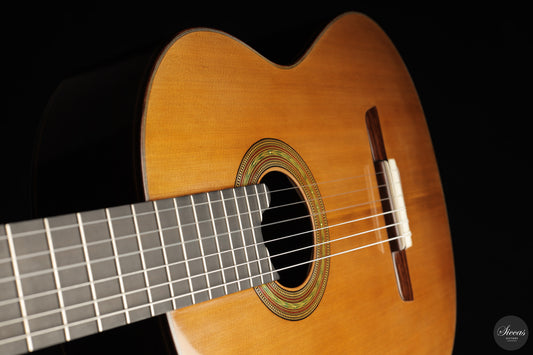
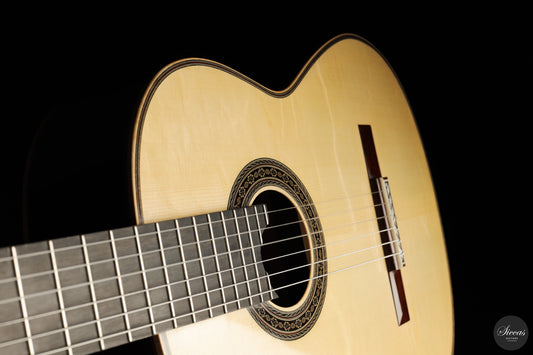
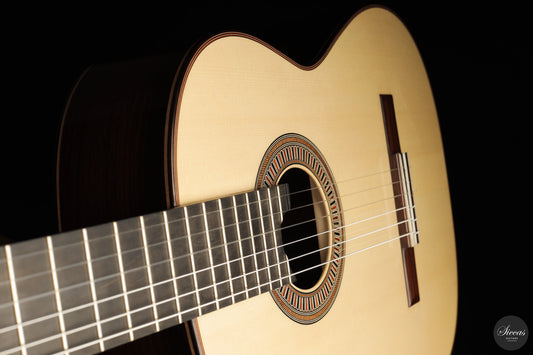
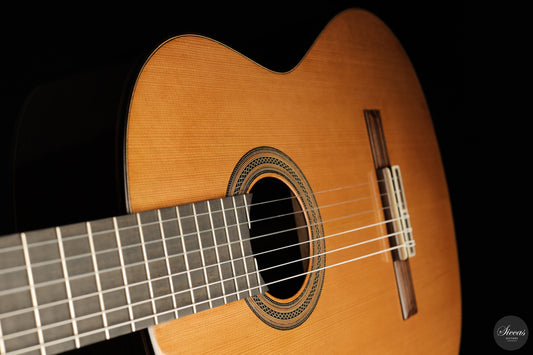
Thomas Dauge is one of the most compelling figures to emerge from the French school of classical guitar making in recent decades. Based in the Bordeaux region of southwest France, he has built a reputation for instruments that combine the warmth and directness of the old Spanish masters with the refined tonal complexity that defines the French lutherie tradition. His guitars are sought after by discerning players worldwide and are regularly found in the stock of leading specialist dealers — a testament to the consistent quality and distinctive voice that characterises every instrument bearing his name.
Biography and Training
Thomas Dauge was born in 1979 in Libourne, a town situated in the Gironde department not far from Bordeaux. He came to guitar making through a combination of personal passion and rigorous self-directed study. In 1998 he began building his first instruments, initially drawing on folk and gypsy jazz traditions before gravitating decisively towards the classical guitar. Those early years were defined by an immersion in the work of the great Spanish makers — Antonio de Torres, Santos Hernández, and Miguel Rodríguez among them — whose structural logic and tonal ideals provided the foundation for everything that followed.
Rather than enrolling in a formal lutherie school, Dauge pursued an unusually independent path. He studied in depth the acoustic research carried out by Daniel Friederich and Emile Leipp at the musical acoustics laboratory in Paris, working through their writings alongside French and Anglo-Saxon lutherie literature. This combination of hands-on building and theoretical inquiry shaped a maker who understood not only how guitars were constructed but why they sounded the way they did. By 2006, after eight years of self-taught practice, Dauge opened his own workshop — a milestone that marked his formal entry into the world of professional lutherie.
Alongside his lutherie work, Dauge also studied flamenco guitar from 2000 onwards, training at the Concha Castillo academy with Felipe Castillo and Tony Hernandez, and later deepening his knowledge through workshops with artists including Serge Lopez, Ramon Sanchez, and Miguel Fernandez. This close relationship with performance gave him an embodied understanding of what a guitar must deliver in the hands of a player — a perspective that continues to inform every instrument he builds.
Construction Philosophy
At the heart of Dauge's approach is an unwavering commitment to materials. He sources tonewoods with exceptional care: spruce from the Alps and the Jura, red cedar, rosewood, cypress, ebony, mahogany, and walnut all feature in his work, and every piece of wood is seasoned for a minimum of ten years. Some of the timber stocks in his workshop exceed seventy years of age — a level of material preparation that places him among the most thorough craftsmen working today. This investment in wood quality is not merely traditional habit; Dauge adapts his bracing systems carefully to the specific flexibility of each soundboard, treating each instrument as an individual acoustic problem to be solved.
His finishing work is equally exacting. Dauge creates his own rosettes and purfling by hand, and formulates his own shellac recipe — applied using a pad with pumice and oil in the French polishing tradition. The entire polishing process takes approximately six weeks. The result is a surface that breathes with the instrument, contributing to tonal development over time in a way that modern lacquers cannot replicate. This dedication to traditional methods connects his work directly to the lineage of Robert Bouchet, the French painter-luthier whose approach to finish and decoration set a standard that continues to inspire makers across France.
Understanding different bracing approaches is central to appreciating where Dauge's work sits in the broader landscape of contemporary lutherie. His instruments are fundamentally rooted in traditional fan-bracing derived from the Spanish school, but refined through the analytical framework of the French tradition. The soundboard is treated not as a fixed formula but as a responsive surface to be tuned to the particular qualities of each piece of wood.
Signature Models
Among the models most closely associated with Thomas Dauge is his tribute to Daniel Friederich — an instrument that has appeared in the inventories of Siccas Guitars and other leading dealers under designations such as the "Daniel Friederich Model." This guitar draws on the structural features that made Friederich's instruments legendary: a bridge positioned proportionally closer to the soundhole than in the Spanish tradition, a body geometry refined for projection and sustain, and a tonal palette that balances clarity in the trebles with depth in the bass. Dauge does not merely copy the Friederich template; he reinterprets it through his own accumulated experience, producing instruments that carry the DNA of the French school while speaking in his own voice.
His standard concert models — offered in a range of tonewood combinations including spruce with Indian rosewood, spruce with maple, and cedar with various back and side timbers — demonstrate remarkable consistency. Scale length is typically 650 mm, fingerboard width at the nut commonly 52 mm, and each guitar is finished to a standard that makes them competitive with instruments from the most celebrated classical guitar makers working anywhere in the world. A 20th Anniversary model released in 2022 (No. 155) marked a significant milestone in his career, reflecting two decades of continuous refinement.
Restoration and Historical Influence
An aspect of Dauge's formation that distinguishes him from many contemporaries is his experience as a restorer. Over the years he has worked on instruments by Daniel Friederich, Ignacio Fleta, Manuel Ramírez, and Miguel Rodríguez, making detailed technical recordings of each guitar for personal analysis. This hands-on study of historical masterworks gave him access to construction knowledge that cannot be learned from books alone — the thickness graduations, the internal geometry, the ageing of wood and finish — all absorbed directly through the process of careful repair. Such experience has profoundly shaped the way he approaches new builds, informing decisions that a maker without restoration experience would be unlikely to make.
Legacy and Recognition
Thomas Dauge represents a generation of French luthiers who have taken the innovations of Friederich and Bouchet and carried them forward into the twenty-first century with fresh energy and independent thinking. His instruments appear regularly at Siccas Guitars alongside guitars by the most respected makers in the world, and they hold their own on that demanding stage. The qualities that define a Dauge guitar — balanced tone across the register, complex timbre, excellent playability, and meticulous craftsmanship throughout — are qualities that serious players recognise and return to.
His position in the Bordeaux region places him within a rich French musical culture, and his dual background as a builder and a performer gives his work a depth of understanding that purely technical training alone cannot provide. As his catalogue grows — each instrument numbered, each one a considered object built from materials prepared over decades — the body of work he is assembling will stand as a significant contribution to the living tradition of the concert classical guitar.
Browse available Thomas Dauge guitars → in the Siccas Guitars collection.