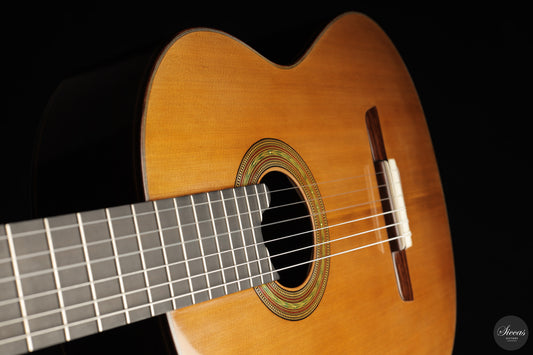

Walter Vogt (1936–1990) stands among the most respected and visionary classical guitar makers Germany has ever produced. Working within a tradition that stretches back centuries across the German-speaking world, Vogt distinguished himself through a relentless commitment to quality, a deliberately limited annual output, and a genuinely experimental approach to guitar construction. His instruments — elegant, thoughtfully built, and acoustically refined — have earned an enduring reputation that continues to grow long after his passing, placing him in the company of the great European luthiers who shaped the modern concert guitar.
Biography & Training
Walter Johannes Vogt was born in 1936 in Bad Horb, a small town in the Swabian region of southwestern Germany, an area with deep roots in skilled craftsmanship and woodworking. He came of age during a period when the classical guitar was undergoing rapid evolution in both playing technique and instrument design, with makers across Europe pushing the boundaries of what the instrument could achieve in terms of projection, balance, and tonal variety. Vogt trained in the German tradition of precise, disciplined handwork, developing the technical foundation that would define his career as an independent luthier.
Rather than founding a workshop with apprentices or scaling production to meet commercial demand, Vogt chose a different path entirely. He kept his annual output small — deliberately so — building only a limited number of instruments each year in order to give each guitar the full attention it deserved. This was not simply a matter of preference; it reflected a deeply held conviction that a handmade instrument should bear the singular mark of its maker at every stage. In this respect, Vogt shared the philosophy of those master luthiers of the European tradition who understood that quantity and quality are rarely compatible.
Construction Philosophy
What set Walter Vogt apart from many of his contemporaries was his willingness to question received wisdom about guitar construction. While he worked within established tonal ideals — clarity in the treble, warmth and depth in the bass, even sustain across the register — he explored unconventional design choices to achieve those ends. Among the most striking of these was his development of a mechanism allowing frets to be repositioned on the fretboard, enabling the instrument to be adjusted for different musical temperaments and intonation systems. This innovation, which would later be taken up by other researchers and builders in subsequent decades, reflected a technical curiosity that went well beyond the ordinary scope of a working luthier.
His instruments typically featured first-grade spruce tops, chosen for their responsiveness and tonal clarity, paired with Indian rosewood for the back and sides — a combination prized across the classical guitar world for the warmth and definition it brings to the instrument's overall voice. Some of his later guitars incorporated a distinctive oval soundhole, a departure from the standard circular opening that reflects his ongoing experimentation with how the body resonates and projects sound into the room. He also refined the bridge design on certain instruments, employing segmented bone to improve both intonation accuracy and sustain. These are the kinds of incremental but meaningful refinements that separate a craftsman from a true maker. The approach has something in common with the rigorous construction thinking found in fan-braced and alternative bracing systems that other innovative luthiers have pursued across Europe.
Vogt also explored scale length with an open mind. Some of his instruments were built to a shorter 64 cm scale — notably comfortable for players with smaller hands or those seeking a more responsive, nuanced touch — without sacrificing the tonal depth that concert performance demands. This attention to the player's physical experience, as well as to the purely acoustic dimensions of the instrument, speaks to a maker who understood that a guitar exists in the relationship between builder, instrument, and musician.
Signature Models & Notable Instruments
Vogt did not build to standardised catalogued models in the way that larger workshops have done. Each instrument emerged from his own ongoing dialogue with materials, acoustics, and the demands of professional performance. Nevertheless, certain recurring features characterise his work: the oval soundhole variants, the refined bridge construction, the careful choice of tonewoods, and the distinctive headstock design that has become immediately recognisable to collectors and players familiar with his output.
Among the instruments that have attracted particular attention in recent years is a 1981 guitar built to the 64 cm scale, featuring a first-grade spruce top, Indian rosewood back and sides, and the improved segmented bone bridge. This instrument is reportedly the same model as the one used by Swiss guitarist Johan Smith when he won first prize at the prestigious Guitar Foundation of America (GFA) competition in 2019 — a result that brought renewed attention to Vogt's legacy and demonstrated the enduring concert-level quality of his instruments. His 1973 and 1984 guitars have similarly changed hands among serious collectors, each one a testament to the standards he set across the full span of his working life.
Vogt's guitars occupy an interesting position in the broader landscape of twentieth-century German lutherie. Germany produced a remarkable number of accomplished and distinctive makers in the postwar decades, and while figures such as Daniel Friederich achieved wider international recognition, Vogt's work rewards careful attention for its intelligence, originality, and consistent level of execution. His instruments invite comparison with the finest European concert guitars of the same era.
Notable Players
Walter Vogt built instruments for professional musicians, and his guitars found their way into the hands of serious concert players during his lifetime. The connection to Johan Smith — whose GFA win on a Vogt instrument brought the maker's name to a new generation of guitarists — is perhaps the most well-documented association between his work and the competitive and concert circuit. More broadly, the fact that his instruments have been held in private collections and sought by players and dealers specialising in fine classical guitars speaks to a reputation built on genuine musical merit rather than marketing.
The qualities that players consistently note in Vogt guitars — clarity of voice, responsive touch, tonal balance, and a sense of crafted individuality — align with the qualities that professional performers look for in a concert instrument. These are not guitars built for display; they are tools for music-making, and the best of them perform at the level their maker intended.
Legacy
Walter Vogt died in 1990 at the age of 54, leaving behind a relatively small but consistently distinguished body of work. Because he built fewer instruments than many of his contemporaries, each surviving guitar carries particular weight. His instruments are now sought by collectors and performers who understand the value of a handmade classical guitar built with both technical intelligence and genuine artistic vision.
His legacy also includes his contribution to thinking about guitar intonation and temperament — a thread of inquiry that connects him to the broader history of instrument innovation, and that anticipates concerns which have become increasingly important to musicians working with period tunings and microtonality. In this sense, Vogt was not only a fine craftsman but a thoughtful contributor to the ongoing conversation about what the guitar can be and do.
For those interested in the history of European lutherie, Vogt's work sits naturally alongside that of makers such as José Luis Romanillos and Robert Bouchet — makers who brought a similar seriousness of purpose to their craft and whose instruments have outlasted their makers' lifetimes to remain relevant, playable, and deeply musical. The German tradition Vogt represented deserves its place in any serious account of twentieth-century classical guitar making.
Browse available Vogt Guitars guitars → in the Siccas Guitars collection.