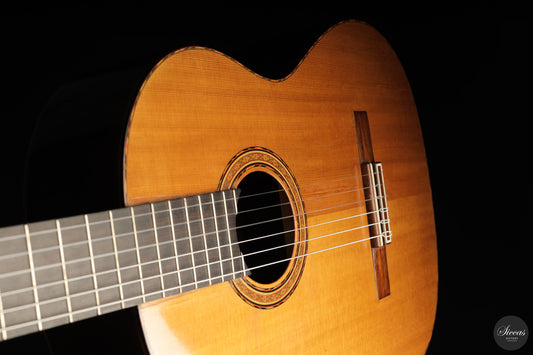
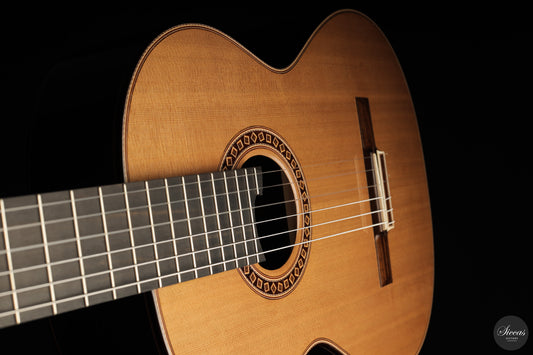
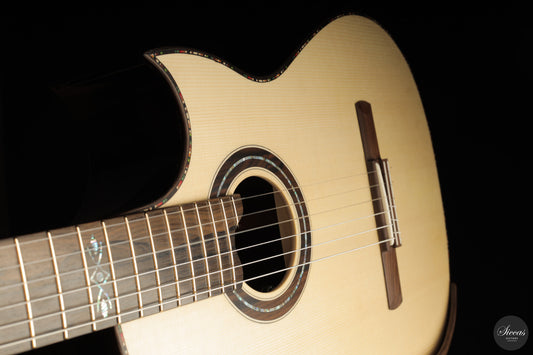
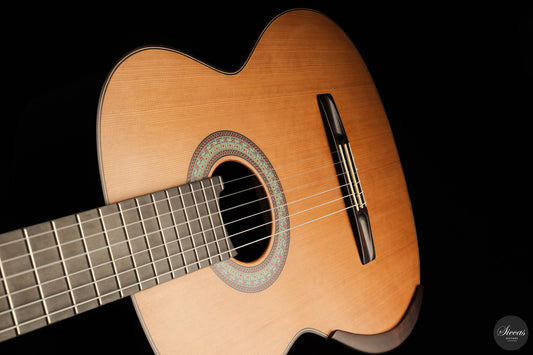
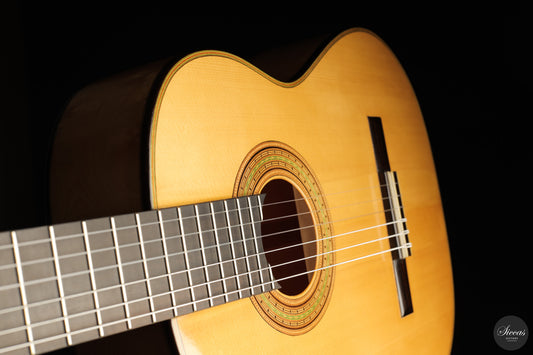
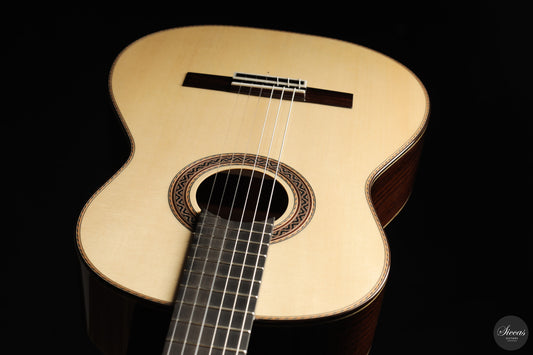
Youri Soroka is one of the most compelling stories in contemporary classical guitar making. A French-Ukrainian luthier working from Orléat in the Puy-de-Dôme region of France, he arrived at instrument building not through a formal apprenticeship or conservatory programme, but through an act of pure curiosity — and a battered old plywood guitar bought for a few dollars in Ukraine. Within just a few years of officially establishing his workshop in 2018, Soroka had become a fully booked luthier whose instruments attract players, collectors, and dealers across the classical guitar world. His is a story of radical reinvention, meticulous self-teaching, and an unwavering reverence for the tradition of classical guitar making.
Biography & Training
Youri Soroka was born in Ukraine and later relocated to France, where he spent a substantial portion of his career as a software development engineer for a major banking company in Paris. It was a profession that rewarded logic and precision — qualities that would later serve him well at the workbench — but it left something essential unfulfilled. At the age of 38, Soroka began reading books about guitar making and cabinetmaking. The catalyst was disarmingly modest: an old Czech plywood guitar he had purchased as a teenager in Ukraine for the equivalent of thirty dollars. When he decided to replace its factory soundboard with solid wood, something shifted. The craft absorbed him entirely.
He built five guitars in his garage before taking the professional leap. Completely self-taught, he studied the work of the historical masters through books, photographs, and the close examination of surviving instruments, developing an intimate understanding of construction principles that formal students often absorb more abstractly. By 2018 he had officially registered as a luthier, trading his desk in Paris for a workshop in the quiet Auvergne countryside. The transition was total. Within a few years, his waiting list had grown long enough that new commissions required patience, a reliable indicator that the market had recognised genuine quality.
Construction Philosophy
Soroka's approach to guitar making is rooted in a deep respect for historical methods and a principled rejection of shortcuts. He uses traditional animal glues throughout the building process rather than synthetic adhesives, applies French polish using only natural resins, and handcrafts virtually every component of each guitar — with the sole exception of the machine heads. His rosettes are assembled directly into the soundboard, which allows him to customise the design for individual instruments while maintaining a visual language that feels connected to the historical tradition he admires.
The luthier he returns to most consistently is Antonio de Torres, the nineteenth-century Spaniard widely regarded as the father of the modern classical guitar. Soroka has studied Torres' surviving instruments with the attention of a scholar, noting, for example, Torres' tendency to use relatively thick backs, very thin sides, and soundboards that taper in thickness from the centre toward the periphery. His own Torres-model guitars draw particular inspiration from two legendary instruments: "La Leona" and "La Invincible." The rosette on a Soroka Torres model is a considered synthesis of features drawn from both, a small but telling detail that reveals how carefully he thinks about heritage. His study of the historical corpus places him in a lineage that includes other tradition-rooted builders such as Daniel Friederich and Robert Bouchet, makers who similarly transformed deep historical study into living instruments.
Signature Models
Two models define the current Soroka catalogue. The Torres model is perhaps the more personal: a fan-braced instrument built to ultra-lightweight specifications, conceived to honour the tonal ideals of the nineteenth-century master while meeting the expectations of twenty-first-century concert players. These guitars are known for rich, resonant bass registers and what players consistently describe as creamy, singing trebles. The combination of a spruce or cedar soundboard with rosewood back and sides produces an instrument of warmth and clarity — balanced across the strings in a way that rewards both solo recital and intimate chamber performance.
Alongside the Torres model, Soroka has developed a double-top instrument that positions him firmly in the contemporary wing of classical guitar making. His double-top construction pairs Italian spruce as the outer face of the composite soundboard with Western Red Cedar as the inner layer, separated by a Nomex honeycomb core. The result is a top that is both lighter and stiffer than a conventional solid board, producing greater projection and more immediate response without sacrificing warmth. Soroka retains a traditional seven-fan bracing pattern even within this modern construction, an approach that links the acoustic logic of the double top to the proven voice of the historical fan-braced tradition. For those interested in understanding the broader context of this construction method, the double-top guitar guide and the history of double-top guitar pioneers offer valuable background. Equally, his work sits naturally alongside the broader conversation about fan-braced, double-top, and lattice guitars in contemporary lutherie.
Notable Recognition
For a luthier who arrived at the craft relatively late and without formal instruction, Soroka's competitive record is striking. He entered the Antonio Marín Montero International Competition in Granada on two separate occasions and was awarded the second prize in the competition's second edition — a significant result from one of the most respected contests in the classical guitar world. The Antonio Marín Montero competition, held in Granada, is a gathering point for serious instrument makers, and placing among the top finishers in that company confirmed what collectors and dealers were already beginning to sense: that Soroka's guitars possess a quality well beyond what his years in the craft might suggest.
His instruments are now represented at leading specialist dealers internationally, and the Siccas Guitars collection has featured several of his guitars over recent years. The Dutch Guitar Foundation has also profiled his work, reflecting the broad European recognition his instruments have attracted.
Legacy
What makes Youri Soroka's trajectory so significant is not only the quality of the guitars themselves, but the model of learning it represents. In an era when many aspiring luthiers complete formal training at established schools, Soroka arrived by a different path: self-directed, obsessive, and grounded in direct engagement with historical sources. His story carries echoes of the great autodidacts of the tradition — makers who learned by doing, by reading, and by playing their own instruments until they understood what needed to change. His background as an engineer almost certainly sharpens the analytical rigour he brings to the workbench, helping him understand why Torres built backs thick and sides thin, and what that means acoustically rather than just aesthetically.
Still relatively early in his career, Soroka is building instruments that are already sought after by serious players and collectors. The combination of traditional construction values — animal glue, French polish, handmade components, historical bracing patterns — with a willingness to engage the double-top format on his own terms suggests a maker who will continue to evolve. His workshop in Orléat, tucked into the Auvergne landscape far from any established lutherie centre, is quietly producing guitars that hold their own against the best instruments available today.
Browse available Youri Soroka guitars → in the Siccas Guitars collection.