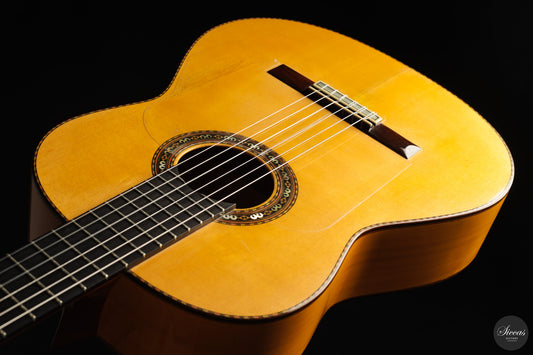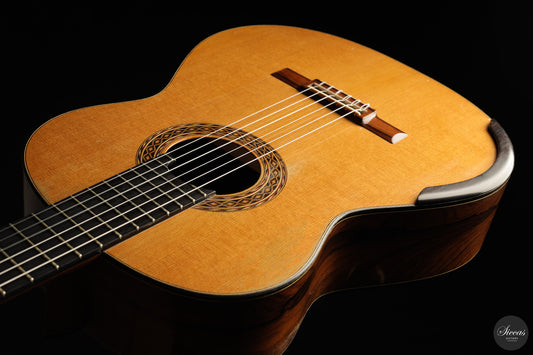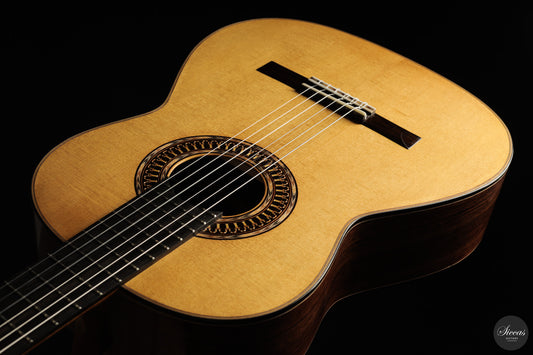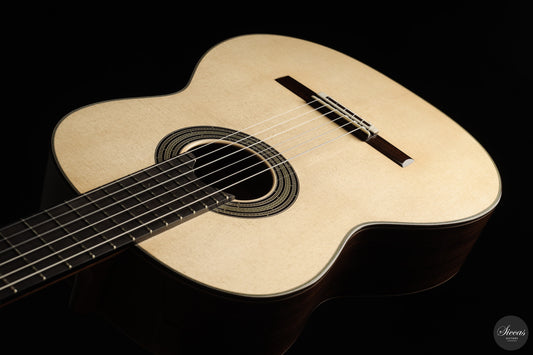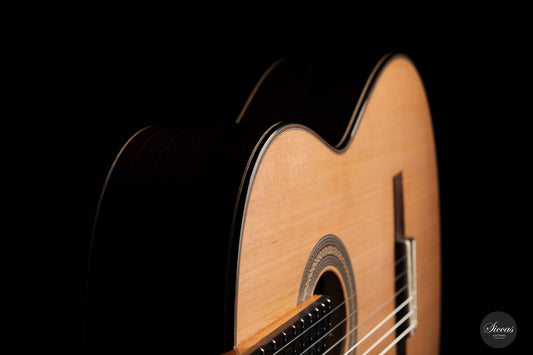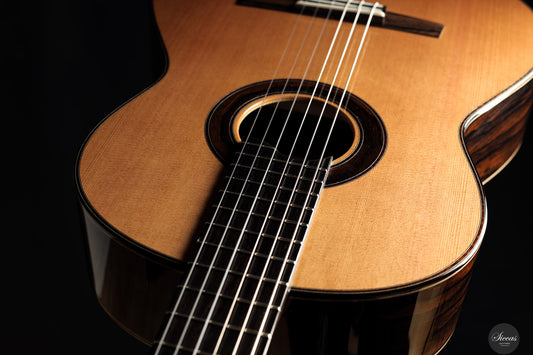

Most beginner guides are written to sell you the cheapest guitar in stock. This one isn't. At Siccas Guitars we've handled thousands of instruments — from a first student guitar to concert instruments by the world's leading luthiers. That perspective is exactly why we can tell you, plainly, what matters when you buy your first classical guitar, and where it's smart to spend (and where it isn't).
Here's the short version: a beginner doesn't need an expensive guitar, but a playable one. A poorly set up €90 guitar with high action and sharp frets will make you quit. A well-made, properly adjusted instrument makes practice feel good — and that's what keeps you playing.
What actually makes a classical guitar good for a beginner
Forget marketing specs. Four things decide whether you'll enjoy learning:
Nylon strings, not steel. A true classical (or "concert") guitar uses nylon strings and a wider, flat neck. They're gentler on the fingertips than steel strings and are the right tool for classical, flamenco, fingerstyle and bossa. If a "classical guitar" has steel strings, it isn't one.
A solid top vs. laminate. The soundboard (the top) is where most of the tone lives. A solid cedar or spruce top resonates and opens up over time; a laminate (plywood) top stays flat and lifeless. Even at entry level, a solid top is the single upgrade most worth paying for.
Setup and action. "Action" is the string height above the fretboard. Too high and chords hurt and notes buzz out of tune; too low and strings rattle. Most cheap guitars ship badly set up. A proper setup is the difference between a guitar that fights you and one that invites you to practise.
Neck width and scale length. Classical necks are wider than steel-string necks (around 50–52 mm at the nut) — good for clean fingering, but worth trying if you have small hands. Younger players should look at smaller scale lengths (see "size" below).
A realistic budget framework
There's no single "best" price — there's the right tier for your commitment:
- Entry (≈ €150–300): a solid-top student guitar, properly set up. Fine for the first months to find out if the instrument is for you.
- Serious start (≈ €300–800): noticeably better tone, materials and playability. If you already know you'll stick with it, start here — you won't outgrow it in a few weeks.
- Buy once, buy well (≈ €800–2,000+): a handmade or workshop instrument that will carry you for years and holds its value. Many players regret not starting here. Browse our classical guitars up to €3,000 to see what this range offers.
Whatever you spend, buy from someone who sets the guitar up before it ships and stands behind it. We set up and check every instrument, offer personal consultation, ship worldwide and give a 14-day return window — so you can decide with the guitar in your hands.
Solid top vs. laminate, in one sentence
If you can stretch the budget for one thing, make it a solid top — it's the upgrade you'll hear every day and the one a laminate can never match.
What size for a child or smaller player?
Scale length matters more than age. As a rough guide: 1/2 size for roughly 5–7 years, 3/4 for ~8–11, 7/8 for smaller teens/adults, full size (650 mm scale) from there. If in doubt, a slightly smaller guitar that's comfortable beats a full size that's a stretch.
New or used?
A good used classical guitar can be excellent value — a solid-top instrument often sounds better after years of playing. The catch is condition: cracks, neck angle and a worn setup are hard to judge online. Buy used from a specialist who has inspected and set up the instrument, not from an unknown private seller.
Three mistakes we see most often
- Buying a steel-string "by accident." If your goal is classical, flamenco or fingerstyle, you need nylon.
- Going too cheap to "test the waters." A guitar that's hard to play is the most common reason beginners stop.
- Skipping the setup. Even a great guitar plays badly without it.
When should you upgrade?
When the instrument starts limiting you rather than your technique — when you can hear a difference you can't yet produce, or you've simply fallen in love and want a guitar for life. When that day comes, we're here for it. In the meantime, if you'd like to understand tonewoods before you buy, read our guide to spruce vs. cedar tops, or, if you're still deciding between guitar types, acoustic vs. classical guitar.
Frequently asked questions
How much should a beginner spend on a classical guitar?
Enough for a solid-top, properly set-up guitar — realistically €150–300 to start, or €300–800 if you already know you'll keep playing. Below that, playability usually suffers.
Nylon or steel strings for beginners?
Nylon, if you want to play classical, flamenco or fingerstyle. Nylon is also easier on the fingertips. Steel-string guitars are a different instrument for a different style.
Do I really need a solid top?
It's the upgrade most worth paying for. A solid top sounds better and improves with age; laminate stays the same.
What size classical guitar for a child?
Go by scale length: 1/2 (~5–7 yrs), 3/4 (~8–11), 7/8 (small teen/adult), full size (650 mm) thereafter. Comfort beats size.
Can I learn on any classical guitar?
You can — but a well-set-up, solid-top instrument makes learning far more enjoyable and is the biggest reason beginners keep going.