The Cinema Paradiso Theme by Ennio Morricone is one of the most beautiful film scores ever written — a melody of such warmth and nostalgia that it seems to bypass the intellect and go directly to the heart. On classical guitar it sounds as if it were written for the instrument.
About the Film and the Score
Cinema Paradiso (Italian: Nuovo Cinema Paradiso) is a 1988 Italian film directed by Giuseppe Tornatore. It tells the story of Salvatore, a successful film director who returns to his Sicilian hometown after decades away, and recalls his childhood friendship with Alfredo, the projectionist at the village cinema. The film won the Academy Award for Best Foreign Language Film in 1990 and is widely regarded as one of the great Italian films of the postwar era.
The score was composed by Ennio Morricone (1928–2020) together with his son Andrea Morricone. Ennio Morricone was one of the most prolific and distinguished film composers of the twentieth century, with credits including Once Upon a Time in the West, The Good, the Bad and the Ugly, The Mission, and The Hateful Eight, for which he received an Academy Award for Best Original Score in 2016. He composed music for more than 500 productions across his career.
The main theme of Cinema Paradiso is among his most celebrated works. Its character is deeply lyrical: a long, arching melodic line built from simple intervals, supported by a light accompaniment. Morricone constructed the theme so that it can carry entirely different emotional weights depending on context — the same melody appears at moments of childhood joy, adult loss, and final reconciliation. That flexibility is part of what makes the music so durable and so widely performed outside the concert hall.
The Melody and Its Structure
The main theme moves at a moderate, unhurried pace. The melody is built largely from stepwise motion and small leaps, with a clear arch that rises toward a high point and descends back to resolution. There are no rhythmic complexities that obscure the melodic line — the accompaniment serves purely as a harmonic and rhythmic background, keeping the melody in the foreground at all times.
This structural simplicity is not a limitation. It is the reason the theme translates so naturally to solo instruments. A pianist, a violinist, or a guitarist can take the melody and the basic accompaniment pattern and produce something that retains the essential character of the orchestral original. The emotional content lives entirely in the melody itself, not in elaborate orchestration.
The harmony is tonal and relatively straightforward, moving through a series of diatonic chords with occasional chromatic color. The overall sound is warm, modal in places, and unmistakably Italian in character — influenced by the folk and operatic traditions that run through much of Morricone's film work.
Why Classical Guitar Suits This Piece
The classical guitar is, at its core, a melody instrument with built-in accompaniment. Its natural voice — warm on the lower strings, clear and slightly vocal on the upper strings — suits any piece built around a sustained singing melody. The Cinema Paradiso theme is exactly this kind of music.
The nylon strings of a classical guitar produce a tone that is slightly soft at the attack, with a long sustain and a gentle decay. That character works against anything brittle or percussive, and works strongly in favor of anything lyrical and connected. The main theme, played on the treble strings with a supported bass beneath it, sits in a register where the guitar sounds at its most resonant and expressive.
There is also a practical advantage: the piece does not require the guitar to do things it does not do naturally. The melody is not in a register that demands artificial harmonics or extreme left-hand stretches. The accompaniment is not so dense that voicing becomes a technical problem. The piece asks for musicianship more than technique — which is one reason it works so well as a recital piece for players who are past the beginner stage but not yet performing the advanced repertoire.
Guitarists performing the theme often arrange it with the melody on the first or second string and the bass and inner voices on the remaining strings. The natural separation between treble and bass on a classical guitar makes this texture very clear even in a simple arrangement. When played with attention to tone production — using the fingertip or the combination of nail and flesh to produce a warm rather than bright sound — the guitar captures the quiet melancholy of the original score with remarkable fidelity.
How to Approach the Piece
The most common mistake in playing this theme is treating it as a technical exercise. The notes are not difficult. What is difficult is producing a legato, singing quality throughout, controlling the dynamic balance between melody and accompaniment, and finding the appropriate use of rubato.
Rubato is essential here. The theme should not be played strictly in time. The melody needs to breathe — slight delays before the highest note of a phrase, small pushes through passages of forward motion, pauses that allow the harmony to settle before moving on. This kind of flexibility is idiomatic to Italian film music and to the operatic tradition that underlies it. Played metronomically, the theme loses its expressive quality and becomes background music. Played with sensitive rubato, it becomes a performance.
Dynamic control is the other key element. The accompaniment should generally sit well below the melody in volume. On guitar, this is achieved partly through right-hand placement — playing the melody closer to the soundhole for warmth, playing the bass lighter — and partly through conscious attention during practice. A good test is to record a run-through and listen back: if the melody does not stand out clearly above the bass and inner voices, the balance needs adjustment.
The phrasing should follow the shape of the melody. As a phrase rises toward its highest note, a slight increase in volume and a slight slowing of tempo is natural and appropriate. As it descends toward the cadence, a gentle easing back — both in volume and tempo — lets the phrase settle. This applies the logic of vocal phrasing to the guitar, which is exactly what the piece demands.
Difficulty and Technique
The Cinema Paradiso theme is generally classified as intermediate in difficulty. A player who can handle pieces in the early intermediate classical repertoire — simple counterpoint, basic arpeggios, clean position shifts — will be able to read through the notes without major obstacles. The left-hand demands are modest: the piece does not require extreme stretches, fast position changes, or complex left-hand independence.
The technical focus falls on the right hand. Producing a consistent, warm tone across the melody line — ensuring that each note has a similar attack and sustain, that the tone does not thin out in higher positions — requires controlled right-hand technique and careful attention to the angle and contact point of the fingers on the string. For players still developing their right-hand technique, this piece is excellent practice material precisely because the left-hand demands are low enough to allow full concentration on tone production.
Dynamics, as noted, are a significant challenge. Moving smoothly between different dynamic levels, maintaining the balance between melody and accompaniment throughout, and executing crescendos and diminuendos that feel natural rather than mechanical — these are the real technical goals of the piece.
Ennio Morricone and the Guitar
Morricone studied trumpet and composition at the Conservatorio di Santa Cecilia in Rome and was a prolific arranger early in his career, working extensively in the Italian pop and film industries through the 1950s and 1960s. His film work often incorporated unusual timbres — electric guitar, solo voices used as instruments, whistling, unconventional percussion — alongside traditional orchestral writing.
The acoustic guitar appears in several of his most famous scores. In the Spaghetti Western films he composed for Sergio Leone, electric and acoustic guitars are central to the sound world. For Cinema Paradiso, the orchestral score was the primary medium, but the nature of the main theme — its melodic simplicity, its vocal quality — made it immediately attractive to solo instrument arrangements. Morricone was reportedly pleased by the widespread adoption of his film themes by classical and acoustic guitarists, seeing it as a sign that the music had moved beyond its original context.
He continued composing into his late eighties and received an honorary Academy Award in 2007 in recognition of his contributions to film music. His death in July 2020 at the age of 91 prompted tributes from film directors, composers, and musicians across the world.
Cinema Paradiso and the Guitar Repertoire
The Cinema Paradiso theme has become one of the most frequently performed film music pieces on classical guitar. It sits alongside works like Astor Piazzolla's tangos and Joaquín Rodrigo's Adagio from the Concierto de Aranjuez in the category of pieces that draw audiences unfamiliar with the classical guitar repertoire into a concert setting.
Its usefulness as a recital piece is practical as well as musical. It is short enough to fit comfortably into a program without dominating it, immediately recognizable to general audiences, and demanding enough in expressive terms to demonstrate genuine musicianship. For guitarists who perform in mixed programs — combining classical repertoire with film music or popular pieces — it is a natural choice.
If you are interested in exploring more of the repertoire that classical guitar handles particularly well, the guide to famous classical guitar pieces covers a range of works from different periods and styles. For players drawn to melody-focused music, the pieces associated with Francisco Tárrega — whose Recuerdos de la Alhambra and Lágrima share something of the lyrical directness of the Morricone theme — are particularly worth exploring.
The broader tradition of expressive, melody-driven guitar writing also connects to composers like Agustín Barrios Mangoré, whose Paraguayan guitar music combines technical complexity with a deeply vocal approach to melody. And for players interested in how counterpoint and structure can coexist with expressive playing, the Bach on classical guitar guide offers a different kind of insight into what the instrument can do.
Choosing a Guitar for This Repertoire
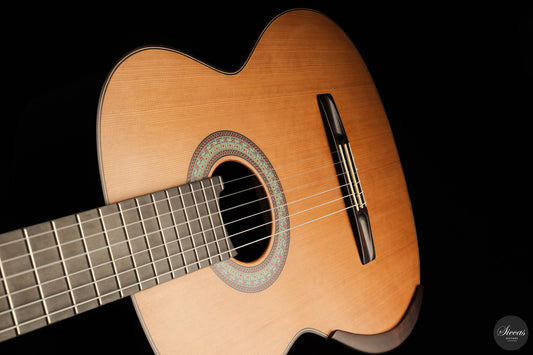
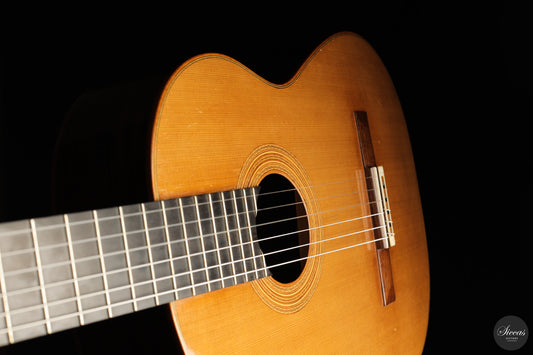
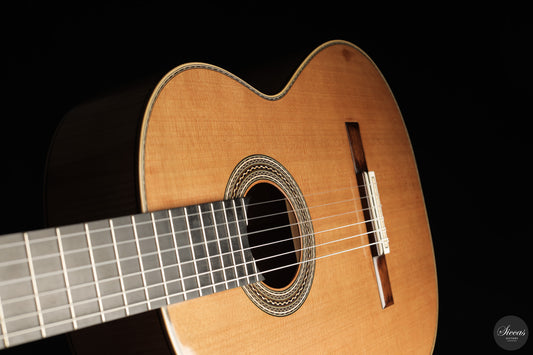
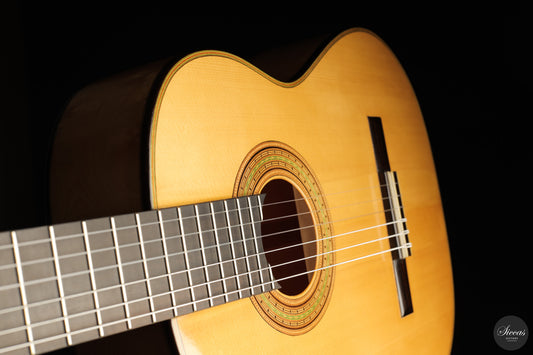
A piece like the Cinema Paradiso theme rewards a guitar with a warm, balanced tone and good sustain on the upper strings. Cedar-topped instruments often have a natural warmth that suits lyrical, melody-centered music. Spruce tops tend to be brighter and may emphasize the attack of each note more than the sustain — which is not necessarily a disadvantage, but changes the character of the sound.
For players at the intermediate level, a well-made student or mid-level classical guitar will handle this repertoire without difficulty. The most important factor is that the action is comfortable — a guitar with high action makes dynamic control significantly harder, because more right-hand force is required to produce a full sound, which in turn makes soft playing more effortful.
The classical guitar collection at Siccas Guitars includes instruments across a wide range of price points and tonal characters. Players looking for guidance on which instrument suits their level and playing style are welcome to get in touch directly — matching instrument to repertoire and player is something we take seriously.
For a broader introduction to the instrument and its players, the guide to great classical guitarists covers the major figures in the instrument's history and provides context for understanding why certain pieces became central to the repertoire.