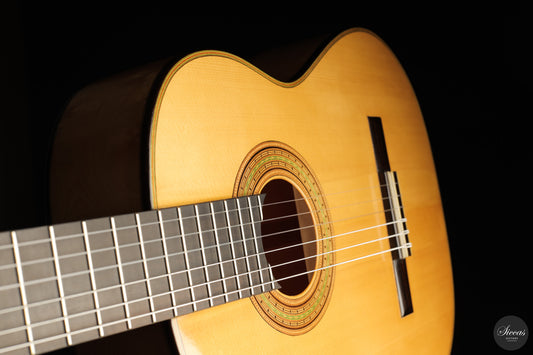
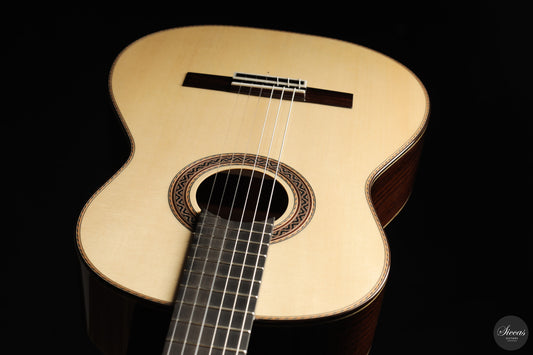
Buying a classical guitar involves more variables than most instruments: tonewoods, scale length, construction method, nut width, setup quality and budget all interact. Get one badly wrong and the guitar fights you. Get them right and the instrument stays with you for decades. This guide works through each factor in order, with links to deeper articles where the topic warrants them.
Budget tiers — what your money actually buys
Classical guitars divide into three broad price bands. The boundaries are not arbitrary; they track real differences in wood selection, construction time and luthier experience.
Student level. Makers such as Altamira and Raimundo produce instruments in this range that are properly set up and playable from the first day. A student guitar does everything a beginner or intermediate player needs. The compromise is in the tonewoods: laminate backs and sides are normal here, and even the soundboard may be laminate on the cheapest models. That limits resonance and long-term tonal development, but it also limits the price.
Intermediate level. Builders like Hanika, Duke and Yulong Guo occupy this tier. At this price, solid tops are standard and solid back and side sets appear more often. Construction tolerances tighten, the neck join is more precise and the setup leaves the factory in better condition. Players who practise seriously and intend to keep the guitar for many years get far more from this tier than from the student category.
Concert level. Luthiers such as Marin Montero, Redgate and Dammann work here. Each guitar is built individually, usually by one person. The tonewoods are selected for the specific instrument, not batch-sorted. Setup is done by hand for the individual guitar. Volume, dynamic range and tonal complexity are measurably different from factory production. Concert instruments hold or increase their value over time; student guitars do not.
The soundboard: spruce or cedar
The top is the most consequential single choice in a classical guitar. It drives more than eighty percent of the instrument's acoustic output, so the species and quality of the wood matters enormously.
Spruce produces a bright, focused tone with a wide dynamic range. It tends to sound somewhat tight when new and opens up over years of playing. Players who work across repertoire from Baroque to contemporary often prefer spruce for its clarity and projection in ensemble settings.
Cedar responds more immediately. A cedar top is warm-sounding from the first session and suits fingerstyle playing where tonal colour matters as much as volume. It reaches its peak tonal development faster than spruce, which can be an advantage for players who do not want to wait years for their instrument to open.
At student and intermediate level, a solid top of either species is far more important than which species it is. A solid cedar top outperforms a laminate spruce top regardless of other factors. Confirm that the top is solid before anything else.
Construction methods: fan bracing, double-top, lattice
The internal bracing pattern determines how the soundboard vibrates and how efficiently it converts string energy into sound.
Fan bracing is the Torres-derived system used on most classical guitars. Seven or more spruce braces radiate across the lower bout. It produces a balanced tone across registers and responds well to traditional technique. The overwhelming majority of classical guitars — from student models to concert instruments — use fan bracing.
Double-top construction replaces the standard spruce or cedar soundboard with a sandwich: two thin layers of wood bonded to a Nomex honeycomb core. The result is a top that is very light but structurally rigid. Double-tops project more efficiently than conventional tops and suit concert hall performance. They are more sensitive to humidity changes and less forgiving of rough handling.
Lattice bracing takes efficiency further. Carbon fibre or wood strips form a grid across the soundboard. Lattice guitars are exceptionally loud and project with unusual evenness. The tone is modern and somewhat different from the traditional classical sound. Players who perform regularly in large halls find lattice instruments practical; players who want a classical guitar for chamber or home use often find the sound less suited to that context.
For most buyers, fan bracing is the correct choice. Double-top and lattice instruments make sense once you know your playing context well.
Scale length and neck dimensions
Standard scale length for a classical guitar is 650 mm, measured from nut to saddle. This is the international reference point and suits adult hands of average size.
Short-scale instruments — typically 630 mm or 640 mm — reduce the string tension and bring the frets closer together. Players with small hands, younger students, or anyone who finds full stretch uncomfortable on the standard scale benefit from the shorter mensur. The tonal difference is modest at a given quality level; the ergonomic difference can be substantial.
Nut width on a classical guitar is conventionally 52 mm, wider than on a steel-string acoustic or electric guitar. This spacing accommodates right-hand fingerstyle technique and reduces the chance of accidentally muting adjacent strings. Some concert luthiers offer 50 mm or 51 mm options; this is worth requesting if your left hand is small.
Setup — why it matters as much as the guitar itself
A guitar that leaves the factory with high action, uneven fret ends or a poorly fitted nut is harder to play than a cheaper guitar that has been properly set up. Setup issues are correctable, but correction costs time and money, and most buyers are not equipped to identify them in a photograph or a short trial.
Action — the string height above the frets — should be low enough that fretting requires modest hand pressure but high enough that the string does not buzz under normal playing. A saddle height that suits heavy strumming is usually too high for classical technique.
At Siccas Guitars, every instrument is inspected and set up before it ships. String height is adjusted for classical playing, fret ends are dressed and the nut is checked. This step eliminates the most common reason that a buyer's first weeks with a new guitar are frustrating.
Strings — the overlooked variable
Classical guitar strings are made from nylon or similar polymers for the trebles and silver-wound nylon for the basses. Tension is a key variable: normal tension suits most players and instruments, high tension increases volume and projection at the cost of more left-hand effort, and low tension is easier on the fretting hand and on lighter-built guitars.
String brand and formulation change the perceived tone of a guitar more than most players expect before they experiment. The same guitar with two different string sets can sound noticeably different in the treble register. A student guitar with a good set of strings will outperform a neglected guitar with old strings in most listening comparisons. Change strings when intonation becomes unreliable or when tone turns dull — roughly every two to three months for regular players.
What strings you should not use on a classical guitar: steel strings. Steel-string tension damages the top bracing and neck of a classical instrument and cannot be corrected cheaply.
Vintage and used instruments
Older classical guitars can be excellent value. A concert-level guitar from the 1970s or 1980s may cost significantly less than a comparable new instrument while offering fully developed tone — spruce and cedar tops improve tonally over decades of playing. The risks are checking in the finish, structural cracks, fret wear and neck geometry shifts that develop over time.
Buying a vintage classical guitar from a dealer who has inspected it reduces the risk substantially. Buying privately requires either personal expertise or a pre-purchase inspection by a luthier. A guitar with structural cracks that have not been properly repaired will decline further; a guitar with cosmetic wear only is generally fine.
Classical or flamenco?
Classical and flamenco guitars look similar but differ in construction, sound and technique. Flamenco guitars are built lighter, typically use cypress for the back and sides, have lower action and produce a drier, percussive tone suited to the rhythmic demands of flamenco. Classical guitars are built for projection and sustain. Playing flamenco on a classical guitar or classical repertoire on a flamenco guitar is possible but not optimal for either genre. If you are specifically studying flamenco, a flamenco guitar is the correct instrument.
The 14-day home trial
One problem with buying a classical guitar — particularly at intermediate or concert level — is that short in-store trials in a busy shop do not reliably predict how an instrument feels over weeks of daily practice. The guitar that impresses in fifteen minutes is not always the guitar you want at the end of a month.
Siccas Guitars offers a 14-day home trial on instruments we ship. You receive the guitar, play it under your normal conditions, and return it within the window if it is not right. This eliminates the core purchase risk and makes it practical to consider instruments at a higher price point than you might otherwise commit to without extended contact.
Recommended starting points by profile
Adult beginner, no previous instrument experience. A solid-top student or entry-intermediate guitar from Altamira or Raimundo. Standard 650 mm scale unless hand size is a clear concern. Normal-tension strings.
Player returning after a break. Step directly to intermediate level if budget allows. The improvement in tone and response compared to a student instrument is immediately audible and sustains motivation.
Conservatory student or advancing amateur. Intermediate to low concert level. A Hanika or Yulong Guo at intermediate, or a Marin Montero at entry concert level. The guitar should not limit the player technically or tonally.
Performing professional. Concert instruments only. The specific choice depends on preferred tone, playing style and repertoire. Personal consultation is the practical route — no guide can substitute for extended playing time with candidate instruments.
Small hands or younger student. 630 mm or 640 mm scale. A properly scaled guitar reduces injury risk and makes technique formation easier.
Further reading
Classical guitar sits within a centuries-long tradition of composition and performance. If you want context for the instrument you are buying, the following articles on this site go deeper on specific topics:
- Famous classical guitar pieces — the core repertoire
- Francisco Tárrega — the father of the modern classical guitar
- Agustín Barrios and his music
- Bach on classical guitar
- Great classical guitarists
And if you are still narrowing down what to buy, these guides go deeper on the practical questions:
- How much does a classical guitar cost? A price guide
- Buying a classical guitar — expert tips for every level
- Which classical guitar is right for you?
- The complete beginner’s guide to classical guitar
- Left-handed classical guitar — the complete guide
- Classical guitar strings — the ultimate buying guide
- Double-top guitars — what makes these instruments exceptional
- A gift guide for classical guitar lovers
Browse our full range of classical guitars — every instrument inspected, set up and ready to play.