
Why Scales and Arpeggios Are the Foundation of Classical Guitar Technique
Every classical guitarist — from the very first weeks of study to the concert stage — returns again and again to the same two technical building blocks: scales and arpeggios. These exercises are not merely warm-up routines. They are the primary tools through which the right hand develops evenness, tone control, and speed, and through which the left hand builds independence, strength, and muscle memory across the entire fingerboard.
Practised with attention and patience, scales and arpeggios unlock the physical vocabulary needed to perform the great repertoire — from Tárrega's Recuerdos de la Alhambra to the études of Villa-Lobos. This guide covers the most important patterns, fingerings, and practice strategies in full detail.
Classical Guitar Scales — Technique and Patterns
Rest Stroke vs. Free Stroke
For scales, the standard classical guitar technique is the rest stroke (apoyando). After plucking a string, the fingertip comes to rest against the adjacent lower string. This approach produces a fuller, more projected tone and is the preferred method for melodic lines that need to cut through or lead the texture. The rest stroke naturally encourages a firm, committed finger motion, which is why it is central to scale practice from the earliest stages.
The free stroke (tirando), where the finger clears the adjacent string entirely, is also used in scale passages — particularly when the melody sits on a non-bass string surrounded by accompanying voices, or when the musical context calls for a lighter, more transparent quality. Both techniques deserve equal attention in a well-rounded practice routine.
Right-Hand Fingering: i-m Alternation
For single-note scale runs, the standard right-hand pattern is i-m alternation (index and middle fingers alternating). This combination produces the most consistent tone balance, as both fingers are similar in length and angle of attack. Some players also use m-a (middle and ring) alternation, particularly for passages on the higher strings, and three-finger patterns (i-m-a) are used in certain extended scale passages to build stamina and evenness across all three fingers.
A crucial principle: never allow the stronger or more dominant finger to rush ahead. The goal is mechanical equality — each stroke identical in tone, weight, and timing.
Major Scales in All Positions
The classical guitar approach to scales differs from that of other stringed instruments in one important way: the same scale can be played in multiple positions on the neck, each with its own fingering logic and tonal character. Learning major scales across all twelve keys and in multiple positions — particularly the standard two-octave fingerings beginning on the sixth, fifth, and fourth strings — is a core component of technical development.
Practising all twelve major scales systematically, moving through the circle of fifths or chromatically, ensures that no key feels unfamiliar. It also trains the left hand to navigate the full length of the fingerboard with confidence.
Minor Scales: Natural, Harmonic, and Melodic
Each form of the minor scale presents its own technical and musical challenges:
- Natural minor — The most straightforward form, sharing its fingering structure closely with the relative major. Useful for internalising the minor sound and building positional fluency.
- Harmonic minor — Features a raised seventh degree, creating the distinctive augmented second interval between the sixth and seventh scale degrees. This interval appears constantly in the classical and romantic repertoire and must feel natural under the fingers.
- Melodic minor — Raises both the sixth and seventh degrees ascending, then reverts to the natural minor descending. This form demands particular mental alertness, as the ascending and descending versions use different notes.
All three forms should be practised with the same thoroughness as major scales, in multiple keys and positions.
The Chromatic Scale
The chromatic scale — twelve consecutive semitones — is a powerful technical exercise for both hands. On the classical guitar, it is typically practised with a one-finger-per-fret left-hand approach, which stretches all four fingers evenly. For the right hand, i-m alternation is standard, though three-finger variations are also used. The chromatic scale develops fluency in position shifts and prepares the hand for the dense chromatic writing found in many twentieth-century works.
Slow Practice with the Metronome
Speed is never the starting point. Every serious classical guitar teacher emphasises the same principle: begin slowly enough to play each note cleanly, evenly, and without tension, then gradually increase the tempo with a metronome. Attempting to play fast before slow practice is solid only embeds errors and uneven tone into muscle memory — and those errors become progressively harder to correct.
A practical approach is to set the metronome to a tempo at which you can play perfectly, practise at that tempo until it feels completely secure, then raise the metronome by a small increment (typically two to five beats per minute) and repeat. Patience at this stage pays enormous dividends later.
Classical Guitar Arpeggios — Essential Patterns and Studies
What Is an Arpeggio Pattern?
In classical guitar technique, an arpeggio is a right-hand pattern in which the thumb (p) and fingers (i, m, a) each play assigned strings in a defined sequence. Unlike strumming, each finger acts independently, producing a flowing, layered texture. Arpeggios underpin some of the most beloved passages in the classical guitar repertoire — and developing clean, equal-tone arpeggios is a lifelong pursuit.
The p-i-m-a Pattern
The most fundamental and widely used arpeggio pattern is p-i-m-a: thumb on a bass string, followed by index (third string), middle (second string), and ring finger (first string). This pattern appears in countless pieces from the baroque era through to the twentieth century. Mastering it thoroughly — with a rich thumb tone, a singing a finger, and absolute evenness in i and m — forms the foundation of all further arpeggio work.
Further Essential Patterns
Once p-i-m-a is secure, the following patterns extend technical range and musical flexibility:
- p-i-a — Thumb, index, ring finger. Used in passages where the middle string is absent from the arpeggio texture.
- p-m-a — Thumb, middle, ring finger. Less common but useful for specific voicings.
- p-i-m-a-m-i — An extended six-note pattern that returns through the fingers in reverse order. This pattern demands that all three fingers produce equal tone in both directions and is excellent for developing independence between i, m, and a.
- p-a-m-i — The reverse of p-i-m-a, rolling from ring finger back to index. Creates a different musical texture and tests finger independence in the opposite direction.
Giuliani's 120 Right-Hand Studies
The 120 right-hand studies by Mauro Giuliani (Op. 1) are one of the most comprehensive and time-tested arpeggio workouts in the classical guitar tradition. Each study uses the same left-hand chord sequence — an open C major position — while the right hand works through 120 distinct arpeggio and fingerpicking patterns. Practising these studies systematically trains every combination of p, i, m, and a, building strength, coordination, and independence across all fingers of the right hand. They remain a standard part of classical guitar pedagogy worldwide.
Villa-Lobos Études
The twelve études by Heitor Villa-Lobos are among the most important technical and musical works in the classical guitar repertoire. Several of them are built around specific arpeggio patterns pushed to their technical and expressive extremes. Étude No. 1, for example, is essentially an extended study in right-hand arpeggios across shifting left-hand positions, requiring absolute evenness and tonal consistency throughout. The études by Villa-Lobos bridge the gap between technical exercise and concert repertoire, making them invaluable at the intermediate and advanced level.
Equal Tone from Every Finger
The defining standard of arpeggio technique — and one of the hardest to achieve — is equal tone from every finger. In practice, most players find that a (ring finger) is weaker than i and m, and that the thumb tends to dominate the bass. Deliberate, slow practice with attention to tone on every individual note is the only reliable way to address these imbalances. Recording yourself and listening back is one of the most effective diagnostic tools available.
Building a Daily Practice Routine Around Scales and Arpeggios
A well-structured daily routine might dedicate fifteen to twenty minutes to scales and a similar amount of time to arpeggios, with the remainder of the session devoted to repertoire and sight-reading. Consistency over weeks and months is what drives progress — brief daily sessions outperform infrequent long ones for technical development.
Consider rotating your scale focus across keys and positions on different days, and working through the Giuliani studies in sequence, spending several days on each before moving to the next. Keep a practice log to track tempos and identify which patterns or keys need more attention.
The Guitar Makes a Difference
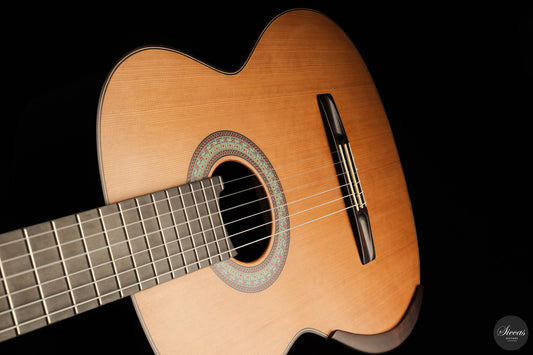
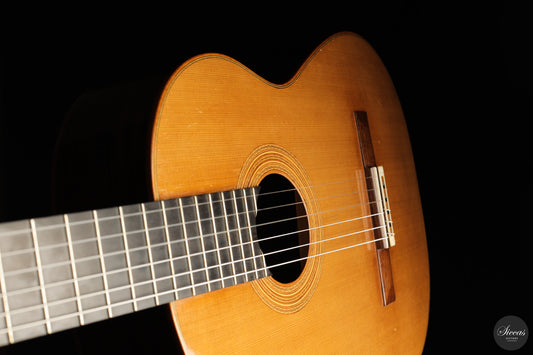
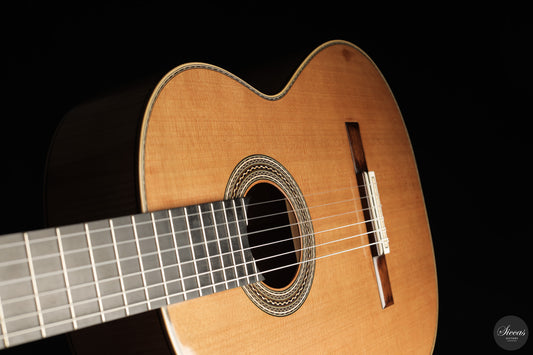
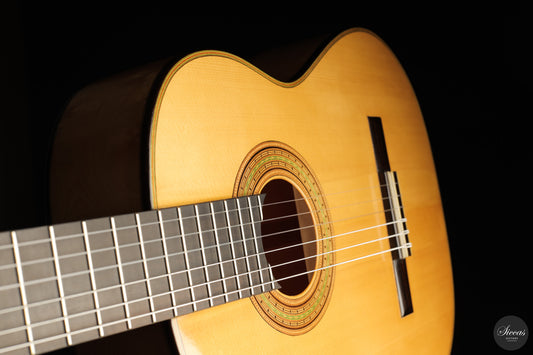
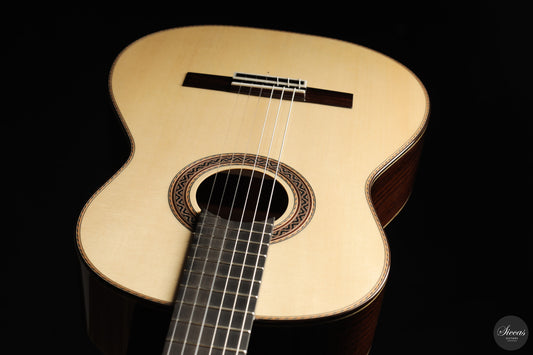
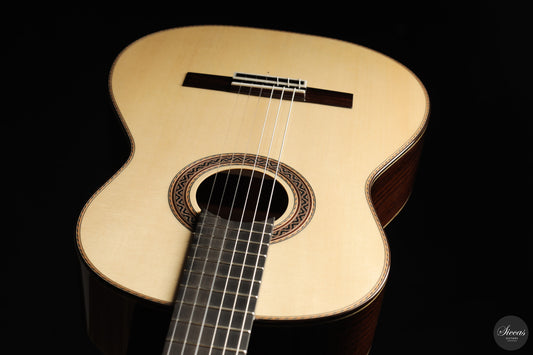
Technical exercises reveal the qualities of the instrument with particular clarity. On a well-made classical guitar, scale runs ring out with sustain and projection, and arpeggio patterns bloom with tonal depth. Exploring the full range of classical guitars at Siccas Guitars — including instruments with spruce tops and cedar tops, each with its own tonal character — will help you find the instrument that responds most naturally to your technique. The tonal differences between spruce and cedar are especially noticeable in scale and arpeggio passages, where the clarity and sustain of the top wood come to the foreground.
For those interested in the finest handmade instruments, double-top guitars offer extraordinary responsiveness and projection — qualities that reward the technical refinement that scales and arpeggios build over time.
Further Reading
If you are developing your classical guitar technique from the ground up, these related guides will support your progress: how long it takes to learn classical guitar, the easiest classical guitar pieces for beginners, and how to tune a classical guitar. For inspiration from the masters who shaped the instrument's technical tradition, the profiles of Andrés Segovia and Julian Bream are essential reading.