
"Classical or acoustic?" is one of the first questions every new guitarist faces, and the labels cause more confusion than they should. A classical guitar is an acoustic instrument — nobody plugs it into an amp to make it work. What people usually mean by "acoustic guitar" is the steel-string guitar you hear in folk, pop and singer-songwriter music, as opposed to the nylon-string classical guitar of Segovia, flamenco and the concert hall. Once you see what actually separates the two, choosing becomes easy.
The one difference that drives all the others: the strings
Almost everything else follows from a single decision the builder makes — whether the guitar is strung with nylon or with steel. Nylon strings (the trebles are clear nylon or fluorocarbon, the basses are nylon floss wound with metal) are under far less tension and produce a warm, round, mellow tone. Steel strings pull much harder on the body and give the bright, loud, ringing sound most people picture when they think "guitar." Because steel strings put roughly twice the tension on the top, the whole instrument has to be built differently to survive it. That is the real story behind classical versus acoustic.
How they are built
The higher pull of steel forces a sturdier construction. Steel-string acoustics are braced internally in an X-pattern and almost always carry an adjustable steel truss rod inside the neck to counter the string tension. Classical guitars, under gentler nylon tension, use lighter fan bracing (or modern lattice and double-top systems) and traditionally have no truss rod at all — the neck is simply built strong enough. You will also notice the bridge: a classical guitar's strings are tied to the bridge, while a steel-string usually anchors them with bridge pins.
The neck and how it feels in the hand
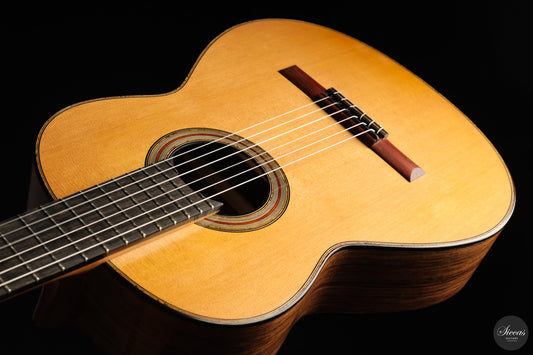
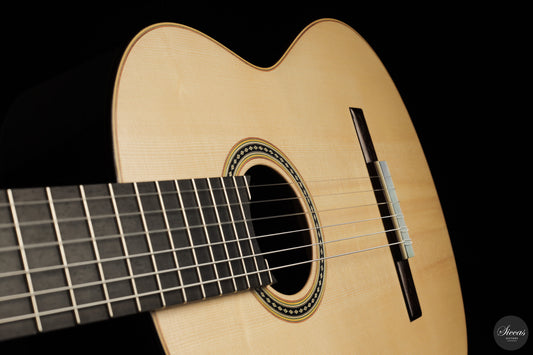
This is the difference your hands notice first. A classical guitar has a wide, flat fingerboard — around 50–52 mm at the nut — with no position dots on the face and a flat (non-radiused) surface, giving each finger room for clean, independent classical technique. A steel-string neck is noticeably narrower — typically around 43 mm — usually with a curved (radiused) fingerboard and fret markers, which suits chord-strumming and wrapping the thumb over the top. Classical guitars also join the body at the 12th fret in the traditional design, while most steel-strings join at the 14th, giving easier access to the high notes.
How they sound
Nylon gives a soft, warm, intimate voice with a quick decay — ideal for fingerstyle counterpoint, where several voices need to stay clear at once. Steel gives volume, brightness and long sustain that cuts through a room and sits beautifully under a singing voice or in a band. Neither is "better"; they are built for different music.
Which should you choose?
Let the music you want to play decide. Reach for a classical (nylon-string) guitar if you are drawn to classical repertoire, flamenco, bossa nova or Latin styles, or if you want the gentlest experience for your fingertips while learning. Reach for a steel-string acoustic if your goal is to strum chords and sing, or to play folk, pop, country and contemporary fingerstyle. A common myth is that beginners should always start on nylon "because it's easier on the fingers" — that is only half true. Nylon is gentler on the fingertips, but the right choice is simply the guitar that plays the music you actually love, because that is the one you will keep picking up.
Two things people often get wrong
First, you cannot simply put steel strings on a classical guitar — the extra tension can wreck an instrument built for nylon. Second, "acoustic-electric" does not mean a different family of guitar; it just means a steel-string (or sometimes a classical) with a pickup fitted so it can also be plugged in. The acoustic-versus-classical distinction still comes down to the strings and the build.
FAQ
Is a classical guitar an acoustic guitar?
Yes. A classical guitar is acoustic. In everyday use, though, "acoustic guitar" usually means a steel-string guitar, while "classical" means the nylon-string instrument.
What is the main difference between classical and acoustic guitars?
The strings: nylon on a classical, steel on an acoustic. That single choice shapes the bracing, the neck width, the body strength and the sound.
Which is easier for beginners?
Nylon strings are gentler on the fingertips, but the best beginner guitar is the one suited to the music you want to play — that is what keeps you practising.
Can I put steel strings on a classical guitar?
No. A classical guitar is built for the lower tension of nylon; steel strings can damage it. Use the string type the guitar was made for.
If you are weighing up your first or next instrument, our classical guitar buying guide walks through woods, sizes and budgets — or browse our classical guitars →