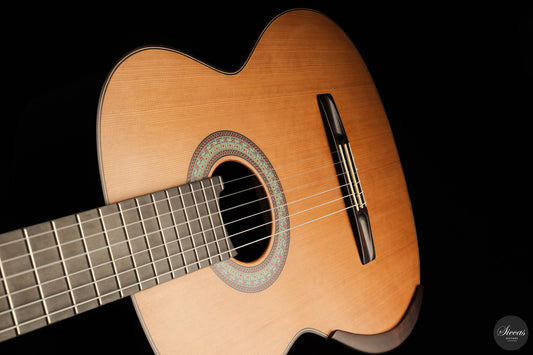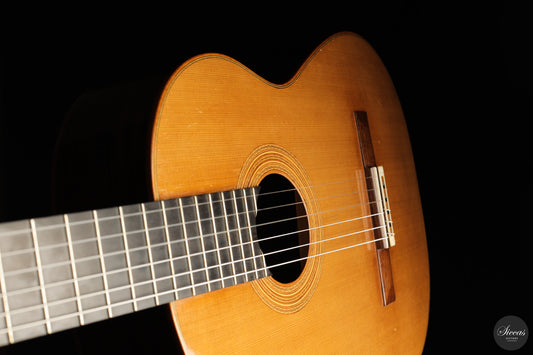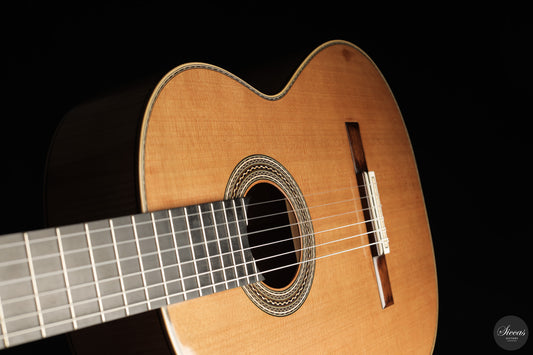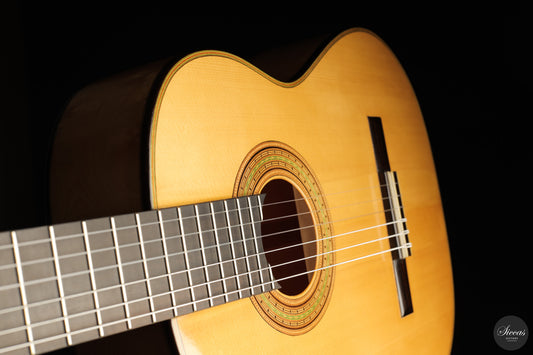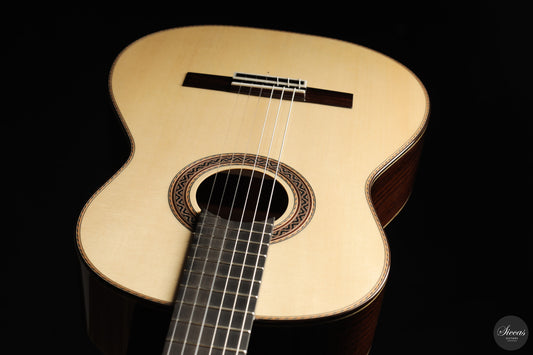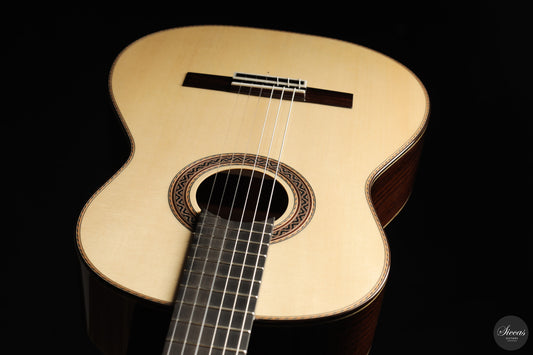

Daryl Perry: American Classical Guitar Luthier
Daryl Perry builds classical guitars in the United States. His instruments have been played by professional concert guitarists and are part of a growing tradition of North American lutherie that has earned serious attention in the classical guitar world over recent decades.
Siccas Guitars carries instruments by Daryl Perry, making his work accessible to players who want a guitar built with the care and intent that defines serious concert lutherie.
North American Classical Guitar Lutherie
For much of the twentieth century, the dominant names in classical guitar lutherie came from Europe — Spain above all, but also France, Germany, and Austria. Antonio de Torres established the structural template in the mid-1800s. José Romanillos, Robert Bouchet, and Daniel Friederich each refined it. Spanish makers like Ignacio Fleta and Manuel Ramírez built instruments that defined what a concert guitar could sound like.
North America entered this conversation more slowly. The classical guitar had a strong performing tradition in the United States — players like Andrés Segovia toured extensively, and American conservatories developed serious classical guitar programs — but the lutherie side lagged. Building a concert-level classical guitar requires a specific skill set, access to aged tonewoods, and years of accumulated knowledge that was historically concentrated in European workshops.
That changed in the second half of the twentieth century. American and Canadian luthiers began studying the European tradition seriously, some traveling to Spain or working directly with established makers. Guitar societies and schools provided a community for sharing technical knowledge. Over time, a North American lutherie tradition developed that was neither imitative nor entirely independent — it absorbed the structural logic of Spanish and French building while developing its own sensibilities.
Daryl Perry is part of this tradition. Building in the United States, he works within a lineage that takes the Torres-derived structure seriously while bringing a contemporary maker's perspective to materials, voicing, and refinement.
The Classical Guitar: What a Luthier Is Actually Building
A classical guitar is a deceptively simple object. Six strings, a spruce or cedar top, back and sides typically in rosewood or cypress, a cedar or mahogany neck. The dimensions have been relatively stable since Torres codified them in the 1850s. And yet the difference between a mass-produced classical guitar and a hand-built concert instrument is vast — in responsiveness, projection, sustain, and the ability to differentiate between notes at complex dynamic levels.
That difference comes from decisions made at every stage of construction. Wood selection matters enormously. Tonewoods for serious instruments are typically aged for years before use. The top — the most acoustically critical element — is graduated by feel and tap tone rather than to a fixed thickness, because each piece of wood behaves differently. The bracing pattern determines how the top vibrates under string tension: the fan-brace system Torres developed remains standard for good reasons, but the precise placement, height, and taper of each brace shape the guitar's voice.
The neck joint, the binding, the nut and saddle, the finish — each affects playability and sound. A well-fitted bone nut transfers string energy efficiently. A properly set neck angle means the action can be low enough for easy playing without buzzing. The finish needs to protect the wood while adding as little mass as possible, since any coating damps vibration.
Luthiers who build concert instruments typically make one guitar at a time, or a small number in parallel. This allows the attention each instrument requires. Factory instruments are made in batches with standardized processes; a hand-built guitar is the product of sustained individual judgment.
Tonewoods and Materials
The choice of tonewoods is one of the first decisions a luthier makes, and it shapes everything that follows. For the top, the choice is usually between European or Sitka spruce and Western red cedar. Spruce tops tend toward clarity and projection; cedar tops often have a warmer, more immediate response with somewhat less upper-frequency emphasis. Neither is universally better — the choice depends on the player's touch, the repertoire, and the specific piece of wood.
Back and sides in classical lutherie are conventionally made from Brazilian rosewood — long considered the benchmark material for its density, workability, and acoustic properties. Brazilian rosewood has been restricted under CITES regulations since 1992, making legally sourced material rare and expensive. Many contemporary luthiers work with Indian rosewood, which is abundant and acoustically excellent, or with alternatives like maple, mahogany, koa, or various other rosewoods. Each species has a different acoustic character.
For a player choosing between instruments, the tonewood combination is worth understanding but shouldn't be treated as determinative. A guitar with Indian rosewood back and sides, built by a skilled luthier with good wood and careful construction, will typically outperform a guitar with Brazilian rosewood back and sides that was built less carefully. The luthier's judgment and execution matter more than the specific materials.
Voicing: The Work That Defines a Guitar
Voicing is the process by which a luthier shapes the tonal character of an instrument as it's being built. It happens primarily through the graduation of the top — the careful thinning of the spruce or cedar plate to achieve specific flex and resonance — and through the fitting and adjustment of the braces.
This is where lutherie crosses from craft into art. The luthier listens to how the top responds as material is removed, using tap tones and deflection tests to judge stiffness and flexibility across different areas of the plate. The goal is a top that responds across the full frequency range of the instrument, with balanced sensitivity in the bass, midrange, and treble.
Fan bracing — the pattern Torres established — distributes structural support and controls how vibration travels across the top. A stiffer brace controls overtones; a lighter brace allows more complex resonance. Every change affects the whole system. Experienced luthiers develop an intuitive feel for this over years of building, but it never becomes entirely predictable because each piece of wood is different.
The result, when everything works, is an instrument that feels alive under the fingers — one that responds to changes in right-hand pressure, angle, and position in ways a factory guitar doesn't. Professional players talk about guitars that "speak" or "open up," that have different personalities in different registers, that reward dynamic control. This is what voicing produces.
What Makes a Concert-Level Guitar
Concert guitarists who perform in large halls without amplification have specific requirements. The guitar needs sufficient projection to carry clearly to the back of an auditorium. It needs tonal balance — a bass that doesn't overwhelm the treble, a treble that doesn't sound thin against the bass. It needs dynamic range: the ability to go from very soft to very loud while maintaining clarity and musicality. And it needs sustain — notes that continue to speak long enough for musical phrases to connect.
Beyond the acoustic requirements, a concert guitar needs consistent action across the fingerboard, reliable intonation, and a neck that's comfortable for long playing sessions. These factors are interrelated. If the neck angle is slightly off, the action compensation affects intonation. If the nut slots are poorly filed, open strings buzz or choke. Small tolerances matter at the concert level.
Luthiers who build guitars that reach this standard have typically spent years developing their methods. The early instruments in any luthier's output show the development of technique; the mature instruments reflect accumulated understanding. When Siccas Guitars selects instruments to carry, they're evaluating where in that arc a given guitar falls — whether it meets the standard that professional players require.
The Daryl Perry Guitar in the Context of American Lutherie
American lutherie has produced a number of makers whose instruments have found their way into the hands of working concert guitarists. The classical guitar community is small enough that reputations travel: players talk to each other about instruments, teachers recommend makers to students, and recordings eventually demonstrate what a guitar can do in capable hands.
For a player in the United States or Canada, working with an American or Canadian luthier has practical advantages. There are no import concerns, currency complications, or the uncertainty of ordering an instrument from abroad without having played it. Communication is straightforward. And in some cases, a luthier will work with a player to build an instrument suited to their specific needs — in terms of scale length, string spacing, body dimensions, or tonal goals.
The presence of Perry's instruments at Siccas Guitars places them in a specific context. Siccas operates as a specialist dealer focused on high-quality classical and flamenco guitars, working with both established European makers and significant contemporary luthiers. An instrument in their inventory has been evaluated against that standard.
Choosing a Classical Guitar: What to Consider
For a player considering a serious classical guitar, the process of selection is worth taking seriously. The most important factor is usually how the instrument responds to your specific playing technique — your touch, the angle at which you approach the strings, whether you tend to play with a lot of nail or less. A guitar that suits one player well may feel uncomfortable to another, even if both are excellent instruments by objective measures.
Action and setup matter as much as the instrument itself at the point of purchase. A guitar that arrives with the action too high can often be improved significantly by a good setup; one with the neck too low-set may be more difficult to correct. When evaluating any instrument, it's worth distinguishing between what reflects the quality of the build and what reflects the setup condition.
The tonal balance question is worth thinking about in relation to repertoire. If you spend most of your time on Bach or Weiss — composers whose lute music translated to guitar demands clarity and separation of voices — you may want a guitar that leans toward transparency. If your core repertoire is Tárrega, Barrios, or Villa-Lobos, a guitar with more warmth and resonance in the midrange may serve you better. Most good concert instruments cover both convincingly, but individual instruments have characters.
The question of new versus used is also worth considering. A fine instrument from an established luthier often appreciates over time, particularly as the guitar "opens up" with playing. Many of the great instruments now in circulation were built decades ago and have developed their full resonance through years of use. Conversely, a new instrument from a contemporary luthier comes with the advantage of being precisely documented — the materials, the date of construction, the maker's direct contact.
For players interested in classical guitar history and the broader repertoire, the Siccas blog covers composers and performers in depth. Articles on Francisco Tárrega and Agustín Barrios give context for the music these instruments were built to play. An overview of famous classical guitar pieces and great classical guitarists offers entry points into the repertoire and performance tradition. Players selecting instruments can also browse the full range of classical guitars at Siccas Guitars.
The Relationship Between Luthier and Player
The best classical guitars are built with specific players in mind — or at least with a clear sense of what kind of player will use the instrument. A guitar intended for concert performance in large halls is voiced differently from one intended for intimate studio recording. A guitar for a player with a powerful right-hand attack is set up differently from one for a player who favors a light touch.
When a luthier and player work together over time, this relationship can produce instruments closely matched to a player's needs. Historical examples include the guitars Torres built for specific performers, the instruments Robert Bouchet made for players in his circle, or more recently the ongoing relationships between contemporary luthiers and the performers who rely on their guitars exclusively.
For most players, this level of collaboration isn't available — a new custom instrument from a reputable luthier carries a waiting list and a price point that places it out of reach for many. The alternative is finding an instrument through a dealer whose selection represents the quality threshold relevant to professional performance. This is the function Siccas Guitars serves: access to instruments that meet concert standards from luthiers across the United States, Europe, and beyond.
Daryl Perry Guitars at Siccas Guitars
Instruments by Daryl Perry available through Siccas Guitars represent his work as a North American concert guitar maker. Each instrument has been assessed as meeting the quality standard Siccas applies to the guitars they carry — built to serve players who require an instrument capable of concert-level performance.
For players looking for a serious American-made classical guitar, Perry's work is worth considering as part of a broader comparison. The classical guitar market at this level is not large, and instruments from makers with established reputations at the concert level are relatively scarce. When a guitar from a maker like Perry becomes available through a specialist dealer, it's an opportunity to evaluate the instrument directly against the repertoire and performance demands relevant to your playing.
Siccas carries guitars by luthiers from multiple traditions — Spanish, German, French, Austrian, and North American. This breadth makes direct comparison possible in a way that's difficult to achieve otherwise. A player evaluating a Perry guitar can compare it against European instruments of similar specification and price, arriving at a decision based on sound and feel rather than reputation alone.
Details on currently available instruments, including specifications and pricing, are listed on the Siccas Guitars classical guitar collection page. For context on the instruments in relation to the repertoire they serve, the article on Recuerdos de la Alhambra — one of the most technically demanding and frequently recorded works in the guitar repertoire — gives a sense of the standard a concert instrument needs to meet.