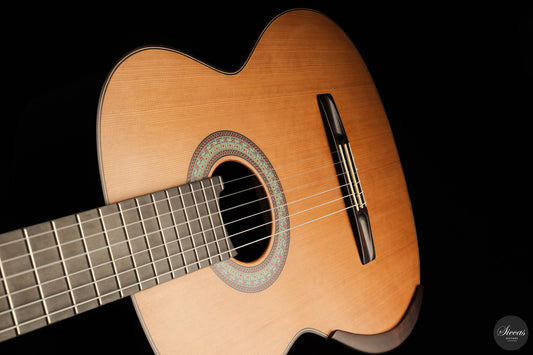
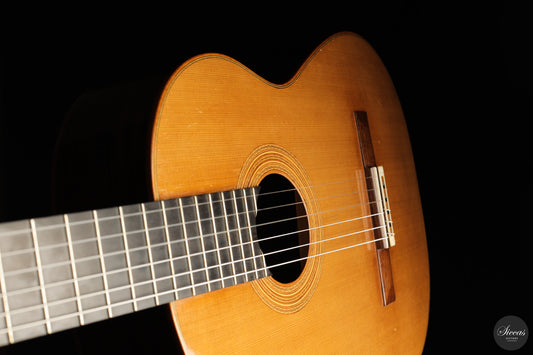
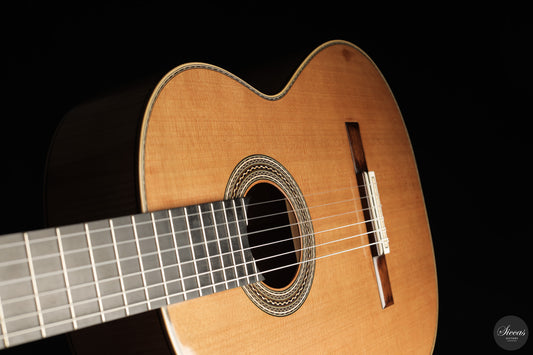
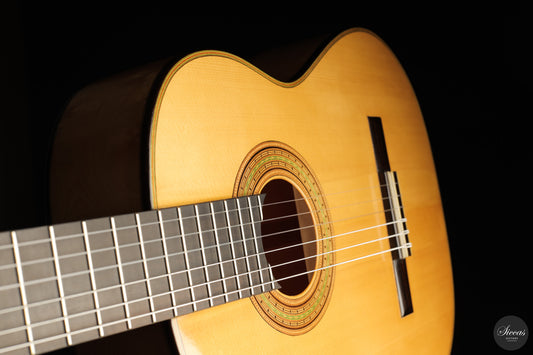
In the world of classical guitars, some instruments stand out not just for their craftsmanship but for the stories and history they carry. Denis, our Guitar Acquisition Manager at Siccas Guitars, has selected nine guitars that have left a deep impression on him over the years. With his vast knowledge of classical guitar history and luthiery, Denis brings a unique perspective to these instruments. Here's his personal selection of guitars that have stuck with him and why they're truly exceptional.
What Makes a Classical Guitar Truly Rare?
The term "rare" is used loosely in the guitar world, but when it comes to vintage classical guitars, rarity is defined by a convergence of factors: the luthier's historical significance, the provenance of the instrument, the materials used, and — perhaps most powerfully — the hands that once played it. A guitar that passed through the fingers of a concert master, or that represents a luthier's sole experiment with a particular tonal wood, occupies a category entirely its own.
At Siccas Guitars, we have handled instruments from virtually every era and school of guitar-making. From the early history of the classical guitar through to the innovations of the late 20th century, the instruments Denis has selected below each represent a turning point — in a luthier's career, in an era of guitar-making, or in the personal history of a great performer. Understanding why these guitars are rare requires a brief look at the conditions that made them possible.
Brazilian Rosewood: The Wood That Changed Everything
Several of the instruments below feature Brazilian rosewood back and sides — a material that was commonplace for much of the 20th century but became increasingly difficult to source after Brazil's export restrictions tightened in 1967 and the wood was listed under CITES Appendix I in 1992. Guitars built before these restrictions, particularly those by top-tier luthiers, now carry an additional layer of rarity and value simply by virtue of their tonewoods. The dense, oily grain of Brazilian rosewood contributes a warmth and harmonic complexity that many players and collectors consider unmatched by any alternative.
Provenance and the Concert Guitar Tradition
Many of the great guitars of the 20th century were built for — or acquired by — the concert virtuosos who defined the repertoire. Andrés Segovia, Julian Bream, and their contemporaries did not simply play any available instrument. They sought out specific luthiers, sometimes waiting years for a commission. When those instruments later enter the secondary market, they carry not only the luthier's artistry but the living memory of performances and recordings made famous across generations. A guitar with documented concert provenance is, in the truest sense, a piece of musical history.
Denis' Personal Selection: Nine Exceptional Instruments
- Hernandez y Aguado – 1961 (Ex Sainz de la Maza) Played by Regino Sainz de la Maza, the guitarist who premiered Concierto de Aranjuez, this guitar is a key piece of Spanish guitar history. Built in 1961, the instrument is a product of two of Spain's finest luthiers, Hernandez y Aguado. The guitar features a cedar top and beautiful Brazilian rosewood back and sides, resulting in a unique warmth and projection. Sainz de la Maza's connection to this instrument further cements its status as a truly historical piece.
- Hermann Hauser I – 1914 This guitar, built by Hermann Hauser I, is the first Hauser to feature Brazilian rosewood. Crafted in 1914, the guitar laid the groundwork for Hauser's legacy of world-class instruments. Known for its clarity and depth, this guitar combines the traditional techniques of Spanish luthiery with Hauser's German precision, creating a bridge between two great schools of guitar-making. The rich sound and historical importance make this instrument a true gem.
- Ignacio Fleta – 1977 (Ex Maria Luisa Anido) Crafted by Ignacio Fleta in 1977 and previously owned by Maria Luisa Anido, an influential South American guitarist, this guitar carries both technical brilliance and rich historical significance. Fleta, known for his meticulous craftsmanship, used a cedar top and Indian rosewood back and sides to create an instrument with exceptional tonal complexity and depth. Anido's legacy as a pioneering female guitarist in South America only adds to the allure of this already remarkable instrument.
- Robert Bouchet – 1977 This is the only cedar-top guitar ever built by Robert Bouchet, one of the most revered luthiers of the 20th century. Bouchet, known for his detailed and careful approach to luthiery, typically worked with spruce, but this particular instrument, with its cedar soundboard, has a warmer, fuller tonal range. The guitar features Indian rosewood back and sides and embodies Bouchet's signature sound qualities: balance, clarity, and projection. It stands out not only for its rarity but also for its breathtaking tonal richness.
- Daniel Friederich – 2013 This guitar, one of the last ever made by the legendary Daniel Friederich, represents the culmination of decades of luthiery experience. Built in 2013, the guitar features a spruce top and Indian rosewood back and sides, offering an ideal balance of brightness, depth, and power. Known for his precise craftsmanship and meticulous attention to detail, Friederich's instruments are considered some of the best in the world. This particular guitar is a testament to his legacy and is regarded as one of his finest works.
- Matthias Dammann Doubletop – 1990 This 1990 Matthias Dammann Doubletop is one of the earliest examples of his revolutionary doubletop construction, featuring a spruce-balsa combination. The guitar delivers incredible power and tonal variety, making it a standout instrument for concert players. Dammann's innovation in doubletop design has transformed the sound capabilities of classical guitars, and this early model showcases the beginning of that evolution, offering exceptional volume and a wide palette of tonal colors.
- Manuel Ramirez – 1910 A sister guitar to the legendary 1912 Ex-Segovia housed at the MET, this 1910 Manuel Ramirez is one of the rarest and most historically significant guitars in existence. With a spruce top and Brazilian rosewood back and sides, this guitar delivers a beautiful balance of brightness and warmth. Its intricate craftsmanship and connection to one of the most respected luthiers of the early 20th century make it a standout piece.
- Vicente Arias – 1913 This 1913 Vicente Arias guitar is one of the last instruments made by the Spanish luthier before his death in 1914. The guitar is renowned for its intricate craftsmanship and rich, warm sound. Arias was known for his attention to detail, and this guitar, with its beautiful decorative elements and maple body, exemplifies his artistry. It stands as a testament to one of Spain's finest luthiers.
- Santos Hernandez – 1924 This 1924 Santos Hernandez guitar stands out for its rare flamed maple back and sides—an unusual feature for Hernandez's guitars. The spruce top is in excellent condition with minimal repairs, and the original tuning machines are still intact. Known for its deep bass resonance and clear, brilliant trebles, this guitar offers a balanced and expressive sound. For Denis, this instrument holds personal significance as the guitar that moved him the most emotionally, serving as a reference for depth, richness, and expression.
The Broader Context: Vintage and Rare Classical Guitars in the Market Today
The market for vintage classical guitars has developed considerably over the past two decades. Where once these instruments changed hands almost exclusively within a small network of professional players and dealers, they are now sought by collectors, institutions, and advanced amateurs who recognize the irreplaceable quality of older craftsmanship. Several factors drive this interest.
Tonal Maturation
An aged guitar — particularly one that has been played regularly — develops a tonal character that new instruments simply cannot replicate. The top wood becomes lighter and more resonant over decades of vibration, and the varnish and binding settle into the body in ways that affect both the acoustics and the visual character of the instrument. A well-preserved guitar from the early or mid 20th century carries this maturation as a fundamental part of its identity. This is why collectors and discerning players consistently find that the finest classical guitars from earlier eras remain reference instruments even when compared to the best modern work.
Scarcity of Materials
As noted above, Brazilian rosewood — used on the Hernandez y Aguado 1961, the Hermann Hauser I 1914, and the Manuel Ramirez 1910 — is no longer freely available for new construction. This material scarcity means that the pool of instruments featuring it is fixed and will only decrease as individual guitars are lost to damage or deterioration. The same applies, to a lesser extent, to particular grades of spruce or cedar from old-growth forests that were the standard for top luthiers in earlier generations.
The Luthier Legacy
Each maker represented in Denis' selection belongs to a tradition of guitar-making that can be traced directly or indirectly to the workshop of Antonio de Torres, whose innovations in the mid-19th century established the template for the modern classical guitar. Understanding this lineage helps explain why instruments from makers like Hermann Hauser I or Daniel Friederich occupy such a distinct position: they represent the direct continuation and refinement of a craft tradition, not a departure from it.
The great works of the classical guitar repertoire — from the transcriptions of Francisco Tárrega to the compositions of Agustín Barrios — were conceived on and for instruments in precisely this tradition. Playing a vintage or rare guitar from this lineage is not merely a matter of tone; it is an act of connection to the full arc of the instrument's history.
Caring for Rare and Vintage Classical Guitars
Ownership of a rare classical guitar comes with a responsibility that goes beyond musical performance. These instruments require stable humidity (typically between 45% and 55% relative humidity), protection from temperature extremes, and careful handling to preserve both their structural integrity and their value. Regular setup by a specialist luthier familiar with older construction methods is advisable. The combination of aged tonewoods and original finishes means that well-intentioned but inappropriate repairs can significantly diminish both the sound and the provenance value of an instrument.
Each of these guitars holds a special place in Denis' heart and reflects the deep history and craftsmanship of the classical guitar world. This selection offers just a glimpse into the incredible variety and quality of the instruments we encounter at Siccas Guitars, each with its own story and legacy.