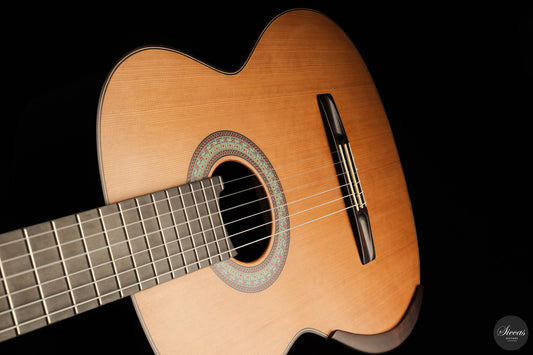
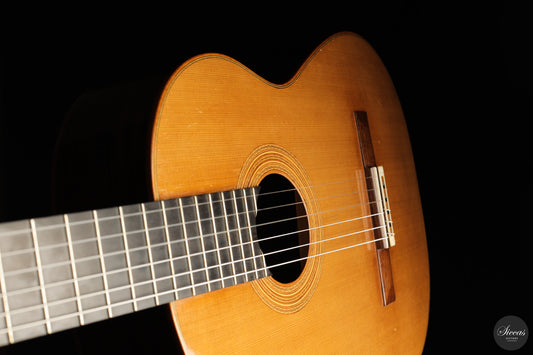
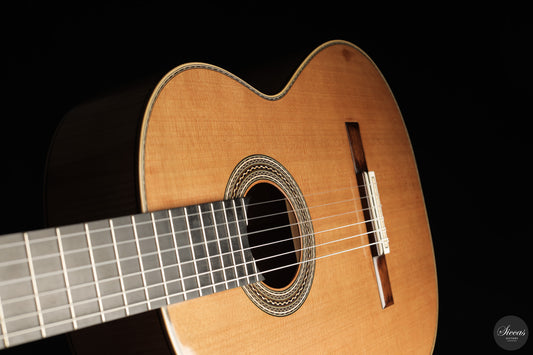
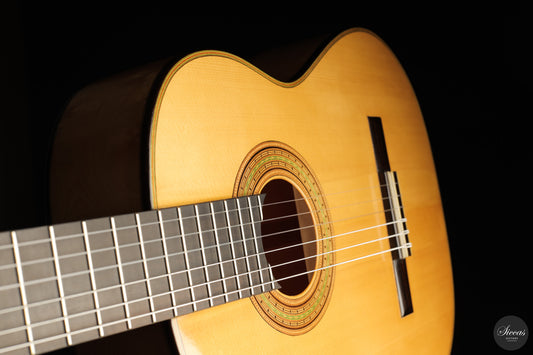
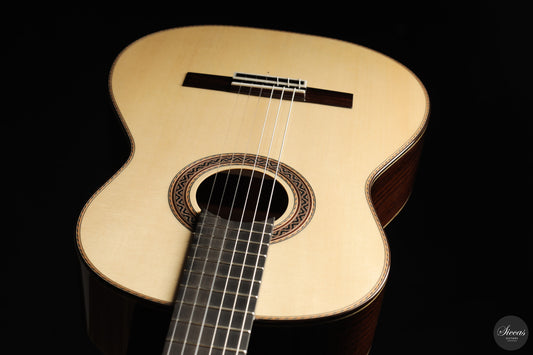
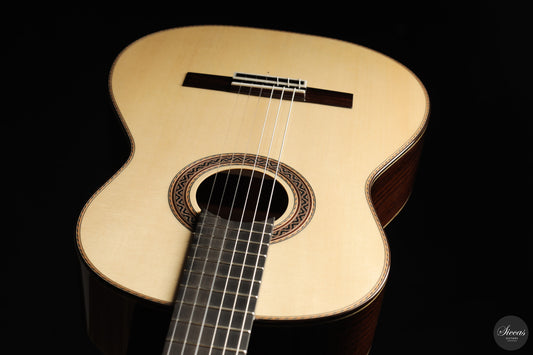
Kim Lissarrague: Australian Classical Guitar Luthier
Australia has produced some of the most influential classical guitar makers of the last fifty years. Greg Smallman, Jim Redgate, Stephen Connor — these are names that appear in the workshops of professional soloists and on the stages of major concert halls worldwide. Kim Lissarrague belongs to this tradition. His instruments are built with the same care and acoustic ambition that defines Australian lutherie at its best, and his guitars are available through Siccas Guitars.
The Australian School of Classical Guitar Making
The phrase "Australian school" refers to a distinct approach to classical guitar construction that emerged in Australia from the 1970s onward. It is defined less by a single technique than by a shared commitment to questioning inherited conventions. Where European lutherie — particularly the Spanish tradition — had established norms around bracing, top thickness, and body geometry that remained largely unchanged for generations, Australian makers began systematically reconsidering these variables.
Greg Smallman's lattice bracing system, developed over decades of close collaboration with John Williams, became the most internationally recognized product of this movement. The lattice replaced traditional fan bracing with a grid of small carbon-fiber-reinforced struts, allowing the top to be made thinner and more responsive without sacrificing structural integrity. The result was a guitar with exceptional projection and tonal clarity — qualities that Williams used to redefine expectations for concert-level classical guitar sound.
Jim Redgate, based in Adelaide, took a different path. His instruments are known for their refinement of tonal balance and their responsiveness across the full dynamic range. Redgate has worked with a number of leading soloists and is regarded as one of the most technically precise makers working today. Stephen Connor, another figure in this tradition, has built a reputation for instruments that combine structural innovation with tonal warmth.
Kim Lissarrague works within this lineage. Australian lutherie is not a school with a single fixed doctrine — it is defined by the willingness to investigate, refine, and build instruments capable of meeting the demands of serious concert performance. That orientation is present in Lissarrague's work.
Craftsmanship and the Making of a Classical Guitar
A classical guitar is not a complicated object in terms of the number of its parts. The top, back, sides, neck, bridge, fretboard, and bracing — the total count of distinct components is modest. What makes classical guitar lutherie demanding is the degree to which the acoustic outcome depends on the interaction of these parts, and how sensitively each must be prepared.
The soundboard — typically Sitka spruce, Western red cedar, or European spruce — is the primary acoustic surface of the instrument. Its thickness, stiffness, and the geometry of the bracing beneath it determine how the top responds to string vibration. A top that is too stiff will produce a guitar that sounds hard and lacks sustain. A top that is too flexible will lack projection and tonal definition. Experienced makers develop the judgment to work within this range through years of building and listening.
The back and sides contribute to the resonant character of the body. Rosewood, maple, cypress, and various other tonewoods each produce different acoustic signatures. The choice of materials is not simply aesthetic — it reflects considered decisions about how the final instrument should sound and respond.
Bracing systems are among the most consequential variables in the instrument. Traditional fan bracing, as codified by Antonio de Torres in the nineteenth century, remains in widespread use. Torres established the basic geometry of the modern classical guitar, and his fan-brace pattern — typically five to seven struts radiating from the area below the soundhole — continues to influence builders worldwide. The makers of the Australian school have in many cases moved beyond Torres's model, but they engage with it as a starting point rather than ignoring it.
For a luthier like Kim Lissarrague, each guitar represents a specific set of choices about materials, geometry, and construction sequence. The process is iterative. Instruments are built, played, assessed, and the findings inform subsequent work. Over years, a maker's approach becomes more precise — not because the variables are eliminated, but because the builder understands them more fully.
Classical Guitar and the Repertoire
The instruments built by makers in the Australian tradition are designed for the full scope of the classical guitar repertoire. That repertoire spans roughly two and a half centuries and encompasses music of considerable variety — from the Baroque transcriptions and original works of the early nineteenth century to the major solo pieces composed for the instrument since.
Francisco Tárrega, the Spanish guitarist and composer who worked in the late nineteenth and early twentieth centuries, is among the most important figures in the instrument's history. His compositions — Recuerdos de la Alhambra, Capricho Árabe, Lágrima — remain central to the repertoire and are among the pieces most closely associated with the classical guitar's identity as a concert instrument. You can read more about Francisco Tárrega and his influence, or explore the history of Recuerdos de la Alhambra in depth.
Agustín Barrios Mangoré, the Paraguayan guitarist and composer, expanded the instrument's expressive range in the early twentieth century. His works draw on South American musical traditions and demonstrate a technical and harmonic complexity that places serious demands on both the player and the instrument. A guitar built for professional performance must be capable of articulating these demands clearly. More on Agustín Barrios and his legacy is worth reading for any guitarist serious about the repertoire.
The broader context of the classical guitar's development is covered in our overview of famous classical guitar pieces. From the Baroque lute transcriptions of Johann Sebastian Bach to the major works of the twentieth-century repertoire, the instrument's history is rich and the literature demanding. Instruments built to this standard need to be capable of navigating all of it.
What Makes an Instrument Exceptional
Guitarists who have played across a range of instruments often describe the difference between a competent guitar and an exceptional one in terms that resist easy quantification. Projection is part of it — the ability of the instrument to fill a concert hall without forcing the player to sacrifice tonal quality at high dynamic levels. Responsiveness is another factor: how quickly and accurately the top reacts to changes in touch, how faithfully the instrument translates the player's intentions.
Tonal balance across the full range of the instrument matters as well. A guitar that sounds warm and full in the bass but thin in the treble, or vice versa, limits what a player can do musically. Balance between registers is not automatic — it results from specific choices in construction and voicing.
Sustain is often discussed in connection with projection. A note that decays quickly is less useful in the concert hall than one that sustains and carries. The relationship between sustain and responsiveness is not straightforwardly linear — a very stiff top may sustain notes but respond slowly; a very flexible top may respond immediately but not carry. The task of the builder is to find a combination that serves the player across the full range of musical demands.
Playability — the feel of the instrument under the hands — is a factor that is sometimes underemphasized in discussions focused on acoustic qualities. A guitar that is difficult to play cleanly across the full range of the neck, or whose action is inconsistent between positions, creates problems that no amount of tonal quality can compensate for. Careful construction and finishing, including the precision of the nut, saddle, and fret work, determine whether the instrument is genuinely usable at a professional level.
Kim Lissarrague's Instruments at Siccas Guitars
Siccas Guitars works with luthiers whose instruments meet the standards required for professional performance. Kim Lissarrague's guitars are available through Siccas, representing his place within the Australian lutherie tradition and the qualities that tradition has come to stand for internationally.
For players considering instruments at the professional level, the Australian makers represent one of the most active and well-regarded currents in contemporary lutherie. The combination of acoustic ambition, material quality, and long-term structural integrity that characterizes this tradition makes these instruments a serious option for soloists, advanced students, and collectors.
Siccas Guitars maintains a selection of classical guitars built by makers working at the highest level of the craft. If you are interested in the broader context of who is building instruments of this caliber today, our overview of great classical guitarists provides a sense of the players these instruments are built to serve.
The Tradition Behind the Instrument
Classical guitar lutherie in Australia developed alongside, and in some cases in direct response to, the needs of specific players. The relationship between John Williams and Greg Smallman is the most documented of these collaborations, but it is not unique. Across the Australian school, makers have worked closely with performers to understand what professional concert playing requires from an instrument — and to build toward that understanding.
This relationship between maker and player is part of what distinguishes the Australian approach from lutherie traditions organized primarily around historical models. The question driving the work is not "how was this done before?" but "what does the instrument need to do, and how can it be built to do that more effectively?" That question does not have a final answer, which is why the tradition continues to produce interesting work.
Kim Lissarrague's place within this tradition reflects the ongoing vitality of Australian classical guitar making. His instruments are not replications of established models — they are built by someone who has absorbed the lessons of the tradition and applies them in his own work. That is what the Australian school has always produced: makers who think carefully about what a classical guitar should be capable of, and then build toward that.
Acquiring a Kim Lissarrague Guitar
For players in the market for an instrument at the professional level, the process of selection is worth approaching carefully. Playing multiple instruments before deciding, where possible, gives a clearer sense of how different builders' approaches translate into actual playing experience. The qualities that matter most vary by player — a soloist performing large-hall recitals has different priorities than a chamber musician or a player primarily focused on recording.
Siccas Guitars can provide detailed information about specific instruments in stock, including tonal characteristics, materials, and construction details. Contact is the most direct route for players with specific requirements or questions about instruments currently available.
The broader selection of classical guitars at Siccas Guitars includes instruments at various price points and from makers across different traditions. For players interested specifically in the Australian school, instruments by Kim Lissarrague represent an opportunity to acquire a guitar from a maker working in one of the most respected lineages in contemporary lutherie.