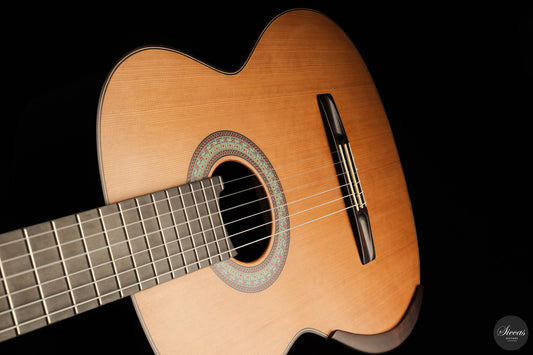
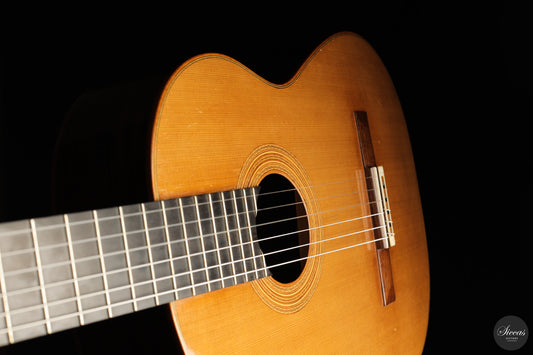
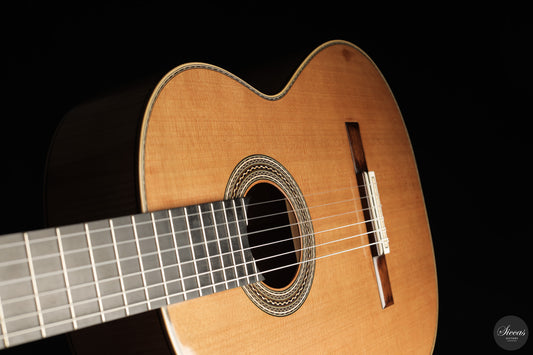
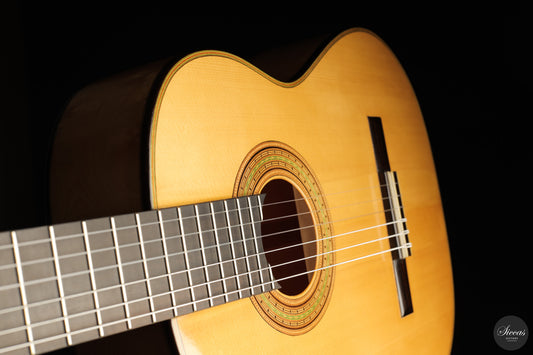
Long before Spanish guitars were common outside Spain, one London workshop was already building them — and saying so on every label. Louis Panormo (1784–1862) proudly stamped his guitars "The Only Maker of Guitars in the Spanish Style," and in doing so he became one of the most important and forward-looking Gitarrenbauer of the nineteenth century.
An Italian family in London
Panormo was born in 1784 into a musical, instrument-making family of Italian origin. His father, Vincenzo Panormo, was a violin maker trained in Naples who worked in Paris before settling in England around 1789 with his sons. Louis grew up in that craft tradition and turned his attention to the guitar, working from various addresses in London including Bloomsbury and High Holborn.
Spanish-style, decades early
What made Panormo remarkable was his eye for Spanish design. While most northern-European makers were still building in older styles, he adopted the lighter, fan-braced Spanish approach — the direction the whole instrument would eventually take. From 1828 his labels carried that bold claim to be the only maker working "in the Spanish style," and his guitars are considered among the finest early Spanish-style instruments made anywhere outside Spain.
His place in history
Panormo is regularly named alongside Pierre René Lacôte of Paris and Johann Georg Stauffer of Vienna as one of the three greatest guitar makers of the early nineteenth century. His instruments were played by leading guitarists of the day, and they remain prized by collectors and by performers of early-Romantic music — a Panormo even found its way, much later, into the hands of Italian songwriter Pino Daniele. Panormo died in 1862, far from where he had begun, in Orua Bay, New Zealand.
FAQ
Who was Louis Panormo?
A London guitar maker (1784–1862) of Italian descent, famous for building Spanish-style guitars decades before they were common outside Spain.
What does his label say?
From 1828, "Louis Panormo, the Only Maker of Guitars in the Spanish Style."
Why do his guitars matter?
They are among the finest early Spanish-style instruments made outside Spain, prized by collectors and early-Romantic performers.