
This guide is part of our overview of the essential classical guitar repertoire. Napoléon Coste (1805–1883) was the finest French guitarist of the Romantic era — a disciple of Fernando Sor, a champion of the seven-string guitar, and a composer whose atmospheric character pieces evoke the landscapes and seasons of his native Franche-Comté with unusual poetic force. His life spans almost the entire arc of the Romantic movement, from Napoleon's empire through the upheavals of 1848 to the Franco-Prussian War and the early years of the Third Republic. Through all of it he remained committed to the guitar at a time when the instrument was struggling to maintain its position against the ascendant piano, and his determination to write serious music for the instrument — music that stood comparison with the keyboard miniatures of Schumann and Chopin — is the foundation of his enduring importance.
Early Life and Musical Formation
Napoléon Coste was born on 28 June 1805 in Amondans, a small village near Besançon in the Franche-Comté region of eastern France. The Franche-Comté is a landscape of rivers, forests, and limestone plateaus — a region with a distinct character that sets it apart from the Ile-de-France, from Provence, from Alsace. It is not fanciful to hear something of this landscape in Coste's music: the autumn colouring of Feuilles d'automne, the open-air melancholy of Le Départ, the expansive ambition of the Grande Sérénade all have a quality that feels rooted in a particular geography and climate.
His mother was an accomplished guitarist and gave him his first lessons. This was not unusual in the early nineteenth century: the guitar was widely considered a domestic instrument suitable for women and for the parlour, and many of the era's finest players had mothers or female relatives as their first teachers. What was unusual was the quality of the instruction Coste received and the speed of his development. By his early teens he was already performing and teaching in the local area — an early sign of the remarkable facility he would carry into professional life.
The France of Coste's youth was a country in which the guitar had become a fashionable instrument. The Romantic movement was reshaping all the arts, and the guitar was acquiring a new expressive vocabulary shaped by composers such as Mauro Giuliani and, above all, Fernando Sor. The instrument was everywhere in Parisian cultural life: in the salons, in the concert halls, in the music shops that lined the boulevards. It was toward Paris — the cultural capital of Europe — that ambitious musicians naturally gravitated, and in 1829 Coste made the move that would define his career.
The decision to move to Paris in 1829 was not without risk. Coste was twenty-four years old, a provincial musician with a local reputation but no connections in the capital. The Parisian music world was competitive, hierarchical, and not always welcoming to newcomers. But Coste had one great advantage: he was going to study with Fernando Sor, the most celebrated guitarist in Europe, who had been based in Paris since the early 1820s. This connection would transform his career.
Study with Fernando Sor in Paris
In Paris, Coste entered the orbit of the broader world of Romantic guitar mastery by studying directly under Fernando Sor, the Spanish guitarist and composer who had settled in the French capital and was widely regarded as the greatest guitarist alive. The relationship between teacher and student was clearly one of deep mutual respect. Sor recognised Coste's gifts and Coste absorbed not only Sor's technique but also his rigorous, almost architectural approach to composition and his insistence on the guitar as a serious concert instrument rather than a mere accompaniment device.
Fernando Sor (1778–1839) was one of the towering figures of the early Romantic guitar. A Catalan by birth, he had spent years in London and in Moscow before settling in Paris, where he ran a school, composed prolifically, and performed at the highest levels of Parisian musical society. His guitar method — published in French in 1830, with an English translation following almost immediately — was the most systematic and intellectually rigorous pedagogical text the instrument had yet seen. It drew on principles derived from the violin and the piano as well as from guitar tradition, and it laid out a complete approach to technique and musical interpretation that Coste absorbed thoroughly.
Coste rapidly established himself after Sor's death in 1839 as the pre-eminent French guitar virtuoso of his generation. He performed in the Paris salons, published his own compositions, and moved in the circles of serious musicians who were defining what Romantic instrumental music could be. His reputation reached well beyond France. When the journal La Guitare surveyed the guitar world in the 1840s and 1850s, Coste's name appeared consistently among the foremost practitioners.
The Parisian salon circuit of the 1830s and 1840s was the primary venue for instrumental music of the kind Coste was writing. Most serious music was heard in private houses, at gatherings of the educated upper-middle class, where a skilled guitarist or pianist could hold an audience of fifty or a hundred people in intimate, concentrated attention. Coste was ideally suited to this environment. His music does not project into a large hall in the way that Liszt's piano music does; it rewards close, concentrated listening in a smaller space.
After Sor's death, Coste undertook a project of lasting scholarly importance: he edited and republished his teacher's guitar method, ensuring that Sor's pedagogical thought — among the most coherent and demanding in the history of the instrument — would remain available to the next generation of students. This act of discipleship says much about Coste's character. He was not content merely to inherit Sor's mantle; he felt an obligation to transmit what he had received. The edition was meticulous, and Coste's own annotations made it more useful to the students of his generation without distorting the essential character of Sor's teaching.
The Seven-String Guitar and the Heptachord
One of the most distinctive aspects of Coste's artistic personality was his commitment to the seven-string guitar. While the six-string guitar was becoming standardised across Europe, Coste played a specialised instrument built by the Parisian luthier René Lacôte, known as the Heptachord. This guitar featured a floating seventh string in the lower register that provided additional bass depth and harmonic richness — particularly valuable in solo repertoire that aimed at the orchestral textures Romantic composers admired.
René Lacôte (1785–1855) was the leading French guitar maker of the first half of the nineteenth century. His instruments are characterised by a warm, singing tone and a refined response across the full range of the fingerboard. They are lighter in construction than the Spanish guitars that would become the norm after Antonio de Torres, and they have a different balance of resonances — more present in the middle register, less focused in the bass. The Heptachord that Lacôte built for Coste modified this basic design by extending the bass range with the additional string, compensating to some degree for the natural limitation of the smaller-bodied French guitar in the lower register.
The Heptachord was not merely a curiosity. Coste composed specifically for its expanded range, and his use of the low seventh string can be heard as an integral part of the harmonic architecture of several of his most ambitious works. The seventh string allowed him to sustain bass notes under moving upper voices in ways that would otherwise require either left-hand compromises or the omission of harmonically essential tones. It was, in short, a compositional resource as much as a technical one, and Coste exploited it with the intelligence of a musician who thought in terms of harmonic completeness rather than idiomatic convenience.
For players today, the Heptachord repertoire is most often performed on a standard six-string guitar with appropriate adaptations, but hearing the pieces as Coste conceived them — with those deep resonances in the bass — reveals dimensions of the music that can otherwise go unnoticed. If you are curious about what makes the classical guitar such a flexible and expressive instrument, our guide to acoustic vs classical guitar explores the instrument's range in detail.
Key Compositions
Coste's output centres on works for solo guitar: studies, character pieces, fantasies on operatic themes, and transcriptions of earlier music. He published a substantial body of work during his active career, and many of his pieces remained in circulation long after his death. His compositional voice is immediately recognisable — lyrical without being sentimental, harmonically inventive within the conventions of his time, and deeply attentive to what the guitar can do as a vehicle for sustained melodic lines and rich inner voices.
Le Départ Op. 31
Le Départ is one of Coste's most admired pieces and one of the most frequently performed works from the French Romantic guitar repertoire. Its title — "The Departure" — signals the narrative and emotional character that Coste brought to his best work. The piece moves through contrasting sections with a sense of dramatic inevitability, evoking leave-taking without ever becoming merely illustrative. It is a serious concert piece that rewards the same quality of attention one gives to comparable piano miniatures of the period.
The opening section of Le Départ establishes a mood of contained emotion — not the extravagant grief of operatic farewell, but the quieter, more complex feeling of actual departure: the mixture of anticipation, regret, and resolution that attends real leave-taking. The middle section shifts to a brighter, more animated character before the return of the opening material, now coloured by everything that has intervened. It is a small but complete emotional arc, and Coste manages it with the economy and precision of a writer who knows exactly how much to say.
Feuilles d'automne (Les Jours d'automne) Op. 41
Feuilles d'automne — "Autumn Leaves" — is perhaps the work that most clearly reveals Coste's gift for atmospheric writing. The piece evokes autumnal moods with the intimacy and colour of his Romantic sensibility: a falling melodic line, harmonies that shade toward the minor, a texture that feels simultaneously sparse and rich. It is music that knows exactly what the guitar does well and exploits it without ostentation.
The seasonal imagery connects Coste to a broader tradition of Romantic programme music, though his means are always those of a guitarist rather than a pianist or orchestral composer. He does not attempt to render the sounds of autumn directly — falling leaves, wind, rain — but rather its mood: the quality of light, the sense of things winding down, the particular melancholy that the season carries in northern cultures. This is programme music of the most refined kind, where the programme is a feeling rather than a story.
Grande Sérénade Op. 30
The Grande Sérénade is Coste's most ambitious single work. It aims at near-orchestral textures within the solo guitar — a goal that the Romantic generation pursued with varying success. Coste achieves it more convincingly than most, partly because his technique was entirely equal to the demands of the score and partly because his sense of large-scale form gives the piece a structural coherence that prevents it from collapsing under its own ambitions.
The work is a serenade in the older sense — a multi-movement piece suitable for evening performance — rather than the single-movement character piece that the word sometimes implies. Its several sections contrast in tempo, mood, and texture, and the transitions between them are managed with a skill that reflects Coste's deep absorption in the formal practices of Viennese Classicism as well as the expressive freedoms of Romanticism. For players looking to understand the outer reach of what the Romantic guitar repertoire attempted, the Grande Sérénade is essential.
Studies and Pedagogical Works
Like his teacher Sor, Coste wrote études that are simultaneously technical exercises and satisfying musical works. His studies address the full range of right-hand and left-hand techniques — arpeggios, scales, position work, tone production — and they do so through pieces that a listener would recognise as music rather than mere drill. This dual quality — technical utility combined with musical integrity — is a mark of the best Romantic guitar pedagogy and one of the reasons Coste's studies remain in use today.
The studies are also a window into Coste's pedagogical thinking. Unlike some Romantic-era method books, which present technique as a series of isolated problems to be solved in sequence, Coste's studies tend to integrate multiple technical challenges within a single piece. A study in arpeggios will also require position work; a study in scales will demand careful attention to tone production. This integration reflects a sophisticated understanding of how real musical playing works — not as a collection of isolated skills but as a continuous, dynamic process in which multiple demands are made simultaneously.
Scholarly Work: Transcribing Early Guitar Music
Alongside his composing and performing, Coste was among the first scholars to transcribe seventeenth-century guitar music into modern notation. The guitar repertoire of the Baroque era — music by Gaspar Sanz, Robert de Visée, and others — was preserved in tablature systems that were largely inaccessible to nineteenth-century players trained in staff notation. Coste's transcription work opened this material to a new audience and contributed to the gradual recovery of the instrument's earlier history that accelerated later in the nineteenth century and into the twentieth.
This scholarly dimension of Coste's career is sometimes overshadowed by his achievements as a composer and performer, but it was genuinely important. The Baroque guitar repertoire that Coste transcribed includes some of the finest music ever written for the instrument, and without the work of scholars like Coste it might have remained inaccessible to players for much longer. The recovery and transmission of historical repertoire has been one of the defining projects of classical guitar culture — a culture shaped by figures like Andrés Segovia and the broader movement he represented. Coste was a precursor of this project, working at a time when the tools and methodologies of historical musicology were still undeveloped.
The transcription work also reflects Coste's musicianship. Translating tablature into staff notation is not a mechanical process: it requires musical judgment about ornamentation, about harmonic realisation in places where the tablature is ambiguous, about the relationship between the written text and the performance practice of the period. Coste brought the same intelligence and seriousness to this work that he brought to his composing, and the results were substantial contributions to the documentation of the guitar's history.
The Injury of 1863 and Its Aftermath
In 1863 a serious fall caused an injury to Coste's right arm that effectively ended his concert career. The details of the injury are not fully documented, but its consequences were clear: a guitarist who had been one of the most admired performers in France could no longer play at the level his career required. For a musician in his late fifties, at a time when there was no pathway back through rehabilitation or surgery, this was a devastating blow.
For a performing guitarist, such an injury is catastrophic. The guitar demands precise, independent control of both hands; a significant impairment to either makes public performance impossible at the level a professional career requires. The right hand — the hand that produces the tone, controls the dynamics, shapes the articulation — is in many ways the more critical of the two for the concert guitarist, and an injury to it strikes at the very heart of the performer's art.
Coste, however, did not withdraw from musical life entirely. He continued to play, in reduced form, until 1881 — nearly two decades after the injury — and he remained engaged with the guitar world as a teacher, editor, and musical presence in Paris until his death in 1883. The tenacity this required, at a time when there were no surgical or rehabilitative interventions of the kind that exist today, speaks to the depth of his commitment to the instrument. His willingness to continue in reduced capacity, rather than simply retiring from music, is characteristic of a man for whom the guitar was not merely a career but a vocation.
His later years also saw him consolidate and revise earlier work. The edition of Sor's method that he had prepared in the years after his teacher's death remained the standard reference for students of the French guitar tradition. Coste's own compositions continued to circulate among players and teachers, maintaining his reputation even as the guitar world was beginning to shift toward the Spanish school and the technical revolution that would come with Francisco Tárrega and his successors.
Coste in the Context of Romantic Guitar History
To understand Coste's place in guitar history, it helps to set him against the broader map of the Romantic guitar repertoire and its major figures. The generation that preceded him — Sor, Giuliani, Dionisio Aguado — had established the guitar as a concert instrument and created a substantial body of original repertoire. Coste inherited this tradition and extended it in a distinctly French direction.
The French Romantic aesthetic — as expressed in the poetry of Lamartine and Hugo, the piano music of Chopin, the paintings of Delacroix — prized lyrical melody, atmospheric colouring, and emotional directness within formal structures. Coste absorbed these values and translated them into guitar music with unusual consistency. His work lacks the virtuosic extravagance of some of his contemporaries — the showy runs and theatrical gestures — but it compensates with depth of feeling and carefully wrought detail.
Among his contemporaries in the guitar world, the figure closest to him in spirit may be Agustín Barrios, though the Paraguayan master worked a generation later and in a very different musical environment. Both composers shared a commitment to atmosphere and poetic imagery as organising principles for their music, and both wrote études that are also genuine pieces of music. The comparison is imprecise — Barrios is more overtly virtuosic, more dramatically varied in his output — but it illuminates something of what made Coste distinctive among the Romantic guitarist-composers.
It is also worth placing Coste in relation to the broader history of French guitar culture. France produced a distinguished line of guitarist-composers throughout the nineteenth century, and the guitar had a stronger presence in French musical life than is sometimes acknowledged. Coste was the central figure in this French tradition, and understanding his work requires some sense of the musical environment in which it was produced: the Parisian salons, the music publishing industry that disseminated guitar music across France and beyond, and the network of teachers and performers who maintained the instrument's presence in French cultural life.
Performing Coste Today
For the contemporary guitarist, Coste's music presents challenges that are both technical and interpretive. Technically, his use of the full range of the guitar — particularly the demands the Heptachord repertoire places on the bass register — requires careful thought about fingering and tone production. His writing is not showy, but it is demanding in ways that reward patience and close reading of the score. The inner voices in particular require the kind of detailed attention that a pianist would give to the middle parts of a polyphonic texture.
Interpretively, the challenge is to honour the Romantic idiom without tipping into sentimentality. Coste's music has a reticence that distinguishes it from the more extravagant Romantic style: it does not insist on its own expressiveness, but invites the listener into its atmosphere. This quality is not always easy to convey in performance, but when a player gets it right the result has an intimacy and depth that is hard to find elsewhere in the nineteenth-century guitar repertoire.
The question of tempo and rubato is particularly important in Coste. Unlike the more metrically regular writing of the earlier Classical guitar composers, Coste's music benefits from a flexible approach to time — not the exaggerated rubato of late Romantic piano playing, but a subtle breathing in and out of the pulse that gives the melodic lines their characteristic freedom. Getting this balance right is one of the central interpretive challenges of the repertoire, and it requires a genuine absorption in the musical style rather than a surface imitation of period manners.
The question of what instrument to use is also worth considering. Coste wrote for the guitars of his time — instruments by Lacôte and others built on French principles that differed in significant respects from the Spanish-influenced instruments that became standard after Torres. Playing his music on a period-appropriate or historically informed instrument can reveal dimensions of the music that are less audible on a modern concert guitar. That said, his best works — Le Départ, Feuilles d'automne, the Grande Sérénade — communicate fully on whatever instrument is played with care and intelligence.
The Guitar in Romantic Paris: Cultural Context
To appreciate what Coste achieved, it helps to understand the cultural situation of the guitar in Paris during the decades when he was most active. The 1830s and 1840s were in many ways the peak years of the guitar's prestige in French cultural life. The instrument was fashionable, widely taught, and performed at the highest levels of Parisian society. But this prestige was fragile and contested. The piano was the dominant domestic instrument, and its claims to seriousness — its larger dynamic range, its ability to sustain all the notes of complex chords, its association with the major composers of the period — were difficult for the guitar to match.
The guitarists of Coste's generation responded to this challenge in different ways. Some leaned into the guitar's intimacy and its associations with song and simple accompaniment, writing music that was pleasant and accessible but made no great claims to seriousness. Others, following the path established by Sor and Giuliani, insisted on writing music of genuine compositional substance — music that engaged with the harmonic and formal practices of serious instrumental music rather than retreating into the salon.
Coste belonged firmly to the second camp, but with a distinctly French inflection. Where Sor's most ambitious music has a somewhat austere quality — the product of a mind trained in the rigour of Viennese Classicism — Coste's best work has a warmer, more atmospheric character that reflects his immersion in French Romantic culture. He attended concerts, read the poetry of his contemporaries, and absorbed the broader intellectual and aesthetic climate of the Paris in which he lived. This absorption is audible in his music.
The decline of the guitar's fashionable status in France began in the late 1840s and accelerated through the 1850s. By the time Coste suffered his injury in 1863, the instrument had lost much of the prestige it had enjoyed in his youth. The causes were multiple: the continued ascendancy of the piano, the decline of the salon culture that had been the guitar's natural home, the emergence of new popular music that no longer featured the guitar as a central instrument. Coste's career thus spans both the peak and the beginning of the decline of the Romantic guitar's cultural presence in France.
Coste's Published Works: A Survey
Coste published a substantial body of work during his career, much of it with leading Parisian music publishers. The opus numbers extend to at least 51, though not all of these represent complete works — some numbers cover collections of shorter pieces. The works range from the extended, multi-movement Grande Sérénade Op. 30 to shorter character pieces, from technically demanding études to simpler pieces aimed at the amateur market. This range reflects the realities of a professional musician's career in the nineteenth century: one wrote both for the concert platform and for the drawing room.
Among the works beyond those already discussed, the Souvenir de Flandre Op. 27 and the Rêverie Op. 47 are frequently cited as characteristic examples of Coste's shorter pieces. The Souvenir de Flandre belongs to a genre of nostalgic, geographically evocative pieces that was popular in the Romantic era, and Coste handles it with his characteristic mix of lyricism and formal intelligence. The Rêverie, one of his later pieces, shows a simplification of texture and a deepening of expressive concentration that may reflect both the limitations imposed by his injury and the mature wisdom of a composer at the end of a long career.
The fantasies on operatic themes — pieces that take a melody from a popular opera and elaborate it with variations and transitions — are less frequently performed today, but they were important to Coste's commercial success and to his reputation as an all-round musician. The operas he drew on were those of his contemporaries: Meyerbeer, Bellini, Donizetti. These pieces gave him the opportunity to demonstrate his skill at transcription and arrangement, his ability to make familiar melodies sound fresh and idiomatic on the guitar, and his understanding of what audiences in the Paris salons wanted to hear.
Legacy and Influence
Coste's reputation has waxed and waned since his death. In the late nineteenth and early twentieth centuries, as the Spanish school led by Tárrega came to dominate the guitar world, the French Romantic tradition retreated somewhat into the background. Coste's music was never entirely forgotten — it appeared in collections and anthologies — but it did not receive the sustained advocacy that might have kept it at the centre of the repertoire.
The revival of interest in Romantic guitar music that gathered momentum in the second half of the twentieth century brought Coste back to wider attention. Recordings by distinguished guitarists, critical editions of his scores, and growing scholarly interest in the nineteenth-century guitar all contributed to a reassessment. Today, works like Le Départ and Feuilles d'automne are firmly established in the concert and competition repertoire, and Coste is recognised as one of the essential figures in the history of the instrument.
His influence on subsequent French guitar culture is real. The tradition of atmospheric, poetically conceived guitar music that runs through the French school owes something to the model he established. His insistence on the guitar as a vehicle for serious musical thought, his commitment to formal rigour combined with expressive freedom, and his willingness to engage with the instrument's historical past all became characteristics of the tradition he helped to found.
For players and listeners interested in exploring the full range of what great classical guitarists have contributed to the instrument's history, Coste's music offers a distinctive and rewarding entry point into the French Romantic tradition. It is music of refinement, atmospheric intelligence, and genuine emotional depth — qualities that do not date.
Napoléon Coste on Siccas Guitars
At Siccas Guitars we have long admired the composers who pushed the classical guitar into new expressive territory. Coste's commitment to the seven-string guitar, his scholarly rigour, and his atmospheric compositional voice make him a figure of enduring relevance for anyone serious about the instrument's history and repertoire. Whether you are a player looking to add Romantic-era French music to your programme or a listener coming to the classical guitar for the first time, Coste's work is worth knowing.
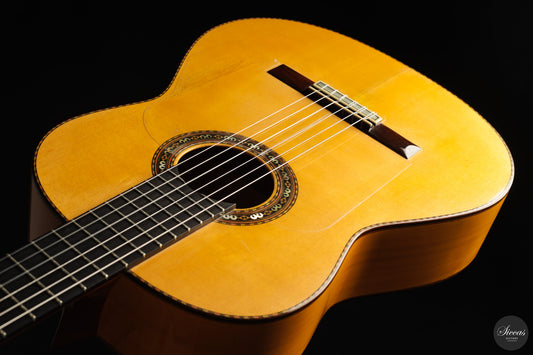
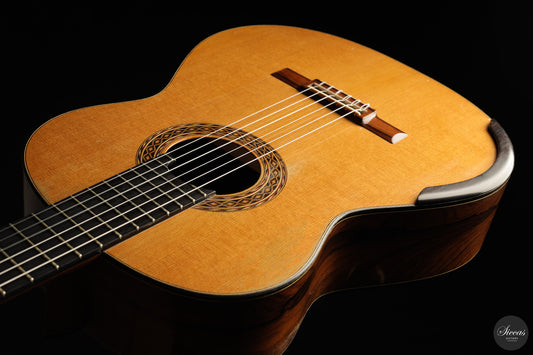
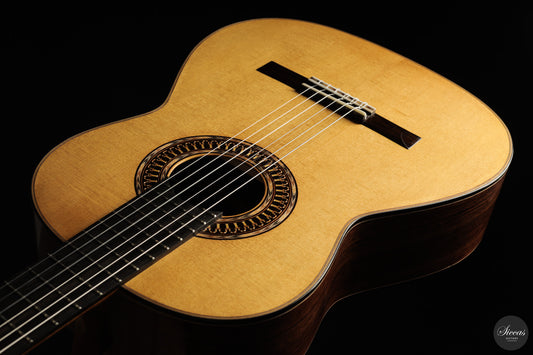
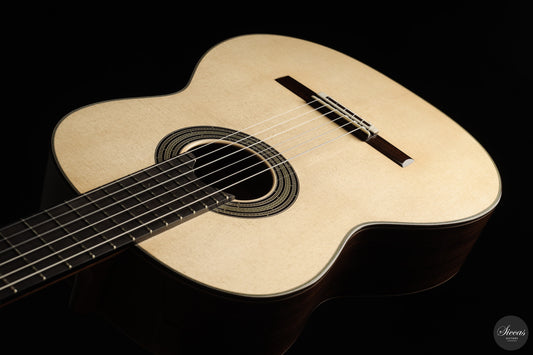
The instruments in our collection are chosen with repertoire like Coste's in mind: guitars that sing in the middle register, that sustain bass notes without muddiness, and that respond to the subtle dynamic shadings that this music requires. Explore our collection of classical guitars to find the instrument that will bring this repertoire to life for you.