
Two Strokes, One Instrument
Classical guitarists produce every note with one of two right-hand techniques: rest stroke or free stroke. The choice is rarely arbitrary. Each stroke has a distinct physical mechanism, a characteristic sound, and a set of contexts where it works better than the other. Understanding the difference is not academic — it changes what you hear.
Rest Stroke (Apoyando): Mechanics and Sound
In a rest stroke — apoyando in Spanish — the finger strikes the string and follows through until it rests on the adjacent string below. The motion is downward and decisive. After a rest stroke on the first string, the finger lands on the second string and stops there.
That contact with the adjacent string is not incidental. It is what produces the stroke's characteristic tone. Because the finger cannot follow through freely, the string gets more of the energy from the attack. The result is a fuller, more projected sound with greater volume and presence. Rest strokes carry across a room. They cut through ensemble textures. On a well-made cedar or spruce top guitar, the difference between apoyando and tirando on the same string is immediately audible.
The physical path of the rest stroke also places the finger's fleshy pad — rather than the tip — in contact with the string at the moment of attack, depending on nail length and hand position. This contributes to a rounder, warmer onset before the nail takes over. Players with longer nails may hear a slightly brighter attack, but the fundamental quality — projection, weight — remains.
When Rest Stroke Is Used
Rest stroke is the default technique for single-note scale passages. When a melody needs to be heard clearly above accompaniment — the right hand playing a bass line or inner voices simultaneously — apoyando gives the melodic line the presence it needs. Tarrega's Recuerdos de la Alhambra uses rest strokes on the melody notes that appear between tremolo passages. Barrios's single-note runs gain their vocal quality partly from committed apoyando execution.
Rest stroke is also standard for passages where tonal weight matters more than flexibility: slow, singing lines; melodic statements in the low register; passages marked forte where the guitar must project. It is not normally used for arpeggios, since landing on the adjacent string would interrupt the arpeggio pattern. There are exceptions — some players use rest stroke on the final note of an arpeggio figure to accent it — but these are deliberate choices, not defaults.
See the broader context of how stroke choice fits into classical technique in our overview of great classical guitarists and their approaches.
Free Stroke (Tirando): Mechanics and Sound
Free stroke — tirando — is the opposite motion. The finger strikes the string and lifts away, clearing the adjacent string entirely. There is no follow-through contact. The finger curves upward after the attack, returning to its starting position.
Without the damping effect of landing on the next string, the attacked string vibrates more freely. The tone is lighter, more transparent, with faster decay. Free stroke does not project as far as rest stroke, but it has qualities rest stroke cannot match: clarity in simultaneous voices, the ability to play chords without muting strings, and a delicacy suited to quiet, interior passages.
The sound of tirando is not weaker — it is different. At the same dynamic level as apoyando, free stroke produces a tone with more upper harmonics and less fundamental weight. This makes it ideal for the inner voices of a polyphonic passage, where too much weight on any single note would obscure the others.
When Free Stroke Is Used
Arpeggios require free stroke. When the right hand outlines a chord one note at a time — as in countless pieces from the Baroque and Romantic repertoire — each finger must lift clear to let the previous string keep vibrating. A rest stroke in an arpeggio would mute the string below it, destroying the harmonic shimmer that gives arpeggio texture its character.
Tremolo is another context where free stroke dominates. The classical tremolo — p, a, m, i on a single string — requires the a, m, and i fingers to clear the string quickly and accurately. Rest stroke would slow the recovery time and increase the risk of catching the adjacent string mid-pattern. The result would be uneven and percussive where evenness and legato are the goal.
Chords use free stroke for the same reason arpeggios do: multiple strings must ring simultaneously. A block chord played with rest strokes would mute the strings the fingers land on. Free stroke lets all notes sustain together.
Pianissimo passages often favour tirando regardless of texture. When volume is deliberately low, free stroke's lighter attack fits the dynamic better. Forcing a rest stroke at pianissimo often produces an awkward disconnect between the intended dynamic and the physical effort required.
The Tonal Logic Behind Each Stroke
The acoustic reason rest stroke projects more comes down to energy transfer. When a finger lands on the adjacent string, the attack is sharper — more energy is delivered to the string in a shorter time. A quicker, more forceful attack produces a stronger fundamental. Free stroke, with its follow-through into open air, delivers energy more gradually. The string responds with a softer onset and a tone that is richer in harmonics relative to its fundamental.
String tension and scale length affect how pronounced the difference is. On a guitar with higher tension strings and a longer scale — common in concert instruments built for projection — the contrast between apoyando and tirando is stark. On a smaller, lighter guitar with lower tension strings, the difference narrows but does not disappear.
Nail shape is a factor too. A nail with a steep ramp on the attack side produces a brighter tone regardless of which stroke is used. A more gradual nail profile softens the onset. Serious players spend considerable time filing nails to produce consistent tone across both strokes, because the nail's interaction with the string changes depending on the follow-through direction.
Historical Perspective
The terminology apoyando and tirando appears in 19th-century guitar method books, but the techniques themselves predate the terminology. Fernando Sor's Méthode pour la Guitare (1830) discusses tone production in ways that clearly refer to rest and free stroke principles, even without using those specific terms. Francisco Tárrega, who transformed classical guitar technique in the late 19th century, codified rest stroke usage for melody and is credited with refining the modern right-hand position that makes both strokes cleanly executable.
Andrés Segovia carried Tárrega's approach into the 20th century and brought it to concert halls worldwide. Segovia's recordings from the 1920s onward demonstrate both strokes in action: the warm, projecting quality of his melodic lines (apoyando) contrasts with the delicate shimmer of his arpeggios (tirando). His technique became the reference point for subsequent generations of guitarists trained in the Spanish-influenced conservatory tradition.
The 20th century also saw guitarists push the boundaries of when each stroke is appropriate. Julian Bream, John Williams, and later players like David Russell and Xuefei Yang each developed personal approaches to stroke selection that deviate from strict rules in favour of musical results. Williams, for instance, is known for using rest stroke in contexts where other players would default to free stroke, producing a distinctive tonal weight even in arpeggiated passages.
Read more about the composers whose music shaped how these techniques developed: Francisco Tárrega and Agustín Barrios.
Combining Both Strokes
Most passages in the standard repertoire use both strokes, often within the same bar. A common texture in Romantic guitar music involves the thumb (p) playing a bass note, the index finger (i) playing a melody note with rest stroke, and the middle and ring fingers (m, a) filling in inner voices with free stroke. Coordinating the different tonal weights of simultaneous apoyando and tirando strokes is one of the more advanced challenges of classical technique.
The separation between the melody and accompaniment voices that makes classical guitar polyphony legible to a listener depends on this combination. Without the tonal contrast, all voices blend into a homogeneous texture. With it, the ear can follow the melodic line independently of the bass and inner voices — an acoustic phenomenon that no amount of dynamic control alone can fully replicate.
Pieces like Recuerdos de la Alhambra and the broader classical guitar repertoire depend on this interplay. Tárrega's tremolo study is a textbook case: the thumb plays bass notes with rest stroke while the tremolo fingers use free stroke, creating a natural separation between the sustained melody and the accompanying bass line.
Practice Approach
Students learning rest stroke often start on the first string with the index finger, aiming to land cleanly on the second string after each attack. The goal is a firm, even sound — no scratching, no nail catching. The follow-through should be deliberate, not accidental.
Free stroke practice typically begins with simple arpeggios: p-i-m-a on adjacent strings, making sure each finger lifts clear without catching the string below. The common fault is a finger that half-rests, partially damping the string below without fully committing to either stroke. This produces a muddy, inconsistent tone.
Practising the same scale passage with both strokes — first apoyando, then tirando — makes the tonal difference concrete. The contrast is more useful than any written description. At moderate tempo, even students early in their studies can hear the difference clearly.
Advanced practice involves deliberately mixing strokes within a passage and listening critically to whether the tonal hierarchy — melody louder, accompaniment lighter — matches the musical intention. This is where stroke choice becomes interpretation, not just technique.
Choosing the Right Guitar
The guitar itself mediates how each stroke sounds. An instrument with strong projection and quick response amplifies the difference between apoyando and tirando. A guitar that is slow to respond or has a compressed dynamic range makes the contrast harder to hear and harder to control.
For players developing their technique, a guitar that responds clearly to right-hand nuance is more valuable than one that sounds impressive only at full volume. The ability to hear what each stroke is doing — in real time, during practice — accelerates technical development faster than any amount of isolated exercise.
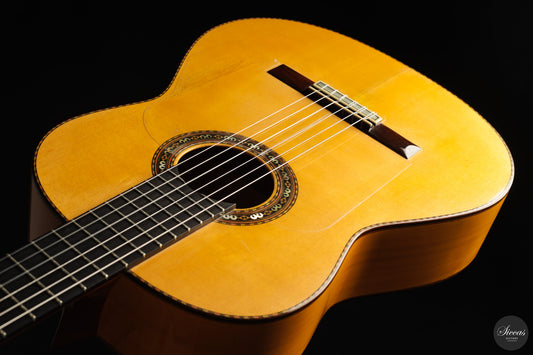
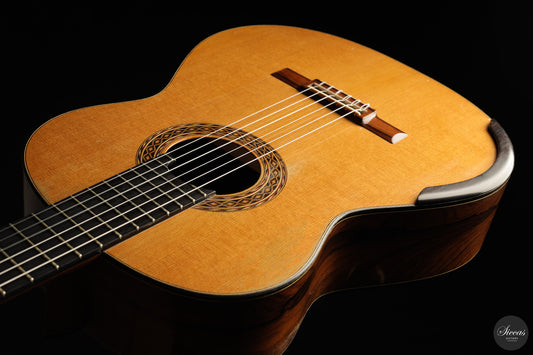
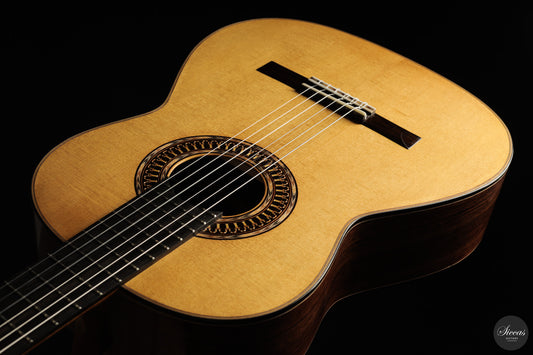
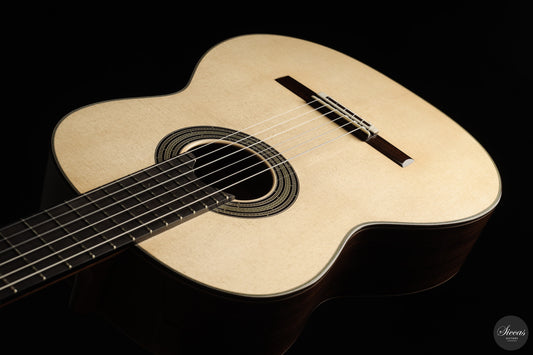
Concert-level instruments from luthiers who specialise in the Spanish tradition tend to respond well to both strokes, with cedar-top models often favouring the warmth of apoyando and spruce-top models offering clarity that suits tirando textures. Browse our current selection of classical guitars to find instruments suited to developing both techniques.
Summary
Rest stroke and free stroke are not interchangeable. Apoyando gives melody its weight and projection. Tirando gives arpeggios their shimmer and chords their sustain. The classical repertoire is built on the assumption that both are available — and that the player knows when to use each. Getting that right is less a matter of rule-following than of listening: the stroke that produces the sound the music requires is the correct one.