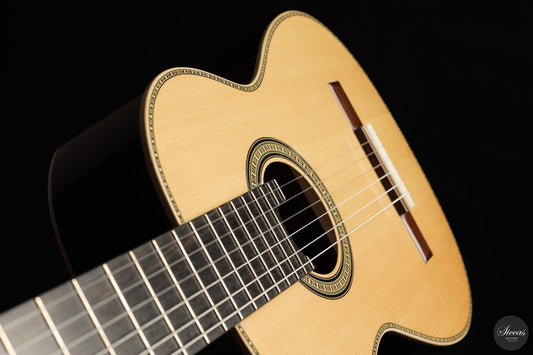
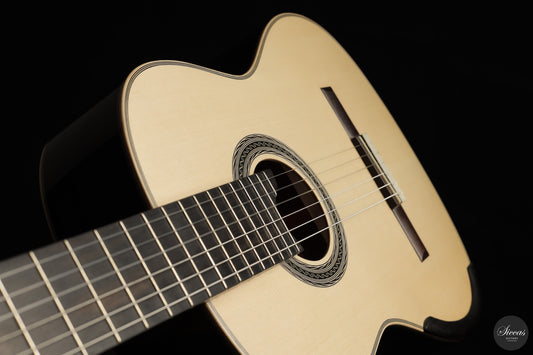
Few instruments have journeyed as far — through courts and cathedrals, across centuries and continents — as the classical guitar. From its distant ancestors plucked in medieval Iberia to the concert stages of the twenty-first century, the history of the classical guitar is a story of constant reinvention. Each era left its mark on the instrument's shape, tuning, repertoire, and technique. Understanding that evolution makes you a more informed player, a sharper listener, and a wiser buyer when you step into the world of fine classical guitars.
Ancient Roots: The Guitar's Distant Ancestors
The classical guitar belongs to a vast family of plucked chordophones that stretches back thousands of years. Archaeologists have found images of lute-like instruments on ancient Babylonian reliefs and Egyptian tomb paintings. The ancient Greek kithara — a large, box-bodied instrument played with a plectrum — gave the guitar its name through a long chain of linguistic transmission: kithara became the Latin cithara, then the Arabic qitara, the Spanish guitarra, and finally our modern word guitar.
The Moors brought sophisticated plucked instruments with them when they entered the Iberian Peninsula in 711 AD. Over the following centuries, two distinct instruments emerged in medieval Spain: the guitarra morisca (Moorish guitar), with a rounded back and multiple sound holes, and the guitarra latina (Latin guitar), with a flat back, a single sound hole, and a shape that foreshadowed the modern instrument. These early guitars typically had three or four courses (pairs of strings) and were tuned in fourths and thirds.
The Renaissance Guitar: Four Courses and a New Vocabulary
By the fifteenth and sixteenth centuries, a clearly recognizable guitar had emerged across Europe. The Renaissance guitar was a small, delicate instrument with four courses of doubled strings and a narrow waist. Its tuning (roughly G–C–E–A) was close to the top four strings of the modern guitar. Players used both rasgueado (strummed chords) and punteado (plucked single notes) techniques, and an extensive repertoire of fantasias, dances, and songs was published in tablature across Spain, France, Italy, and England.
Alongside the guitar, the vihuela flourished in Spain as the prestige instrument of the aristocracy. Visually similar to the guitar but tuned like a lute (in fourths with a major third in the middle), the vihuela inspired a golden-age repertoire from composers such as Luis de Milán, Luis de Narváez, and Alonso Mudarra. Their books of fantasias and intabulations, published between 1536 and 1554, are among the earliest surviving masterpieces for a guitar-family instrument and remain touchstones of the early music revival. Although the vihuela faded by the early seventeenth century, its legacy lived on in the guitar's developing repertoire and technique.
The Baroque Guitar: Five Courses and Emotional Eloquence
Around 1600, instrument makers added a fifth course to the guitar, extending its bass range and harmonic palette. This five-course Baroque guitar became enormously fashionable across Europe throughout the seventeenth and early eighteenth centuries. At the French court of Louis XIV, guitar playing was considered an essential social grace; King Louis himself was an enthusiastic player. Francesco Corbetta, Gaspar Sanz, Robert de Visée, and Santiago de Murcia composed an exquisite body of music for the instrument — suites, chaconnes, sarabandes, and folías — that bridges the worlds of popular dance and high art.
The Baroque guitar was strung in double courses (like a lute), with gut strings and gut frets. Its sound was bright, resonant, and somewhat percussive. Notation appeared in both tablature and a form of staff notation, and the repertoire drew freely on the Italian, French, and Spanish styles of the age. Bach himself arranged lute pieces that translate beautifully to the modern guitar, and many Baroque guitar works have been adapted into the concert repertoire — the connection between Baroque idiom and today's classical guitar is direct and alive. Explore more about Bach on the classical guitar in our dedicated article.
The Transition to Six Single Strings
The most transformative structural change in guitar history occurred around the last quarter of the eighteenth century: the shift from five courses of paired strings to six single strings. The exact date and place of this change is debated by historians, but by the 1780s and 1790s six-string guitars were being built in Italy, France, Germany, and Spain. The new stringing gave the instrument greater clarity of individual notes, made polyphonic playing more transparent, and simplified tuning — advantages that made the classical guitar far better suited to the demands of art music.
This era also saw the tuning settle into the standard E–A–D–G–B–E that every guitarist uses today. The instrument's range, covering more than three and a half octaves, rivalled that of the keyboard instruments of the day and attracted some of the most ambitious composers of the early nineteenth century.
The Romantic School: Sor, Giuliani, and Tárrega
The early nineteenth century was the guitar's first great concert age. Three composers stand above all others in establishing the guitar as a serious vehicle for art music.
Fernando Sor (1778–1839)
The Spanish-born Fernando Sor spent much of his career in Paris and London, where he composed études, sonatas, fantasias, and an opera — almost all of which featured the guitar. His Op. 9 Fantasy, Op. 35 Études, and Introduction and Variations on a Theme by Mozart, Op. 9 are cornerstones of the repertoire. Sor also wrote the first systematic guitar method in the modern sense, demanding proper right-hand technique and musical thinking over mere mechanical facility. Read more about Fernando Sor and his legacy.
Mauro Giuliani (1781–1829)
The Italian virtuoso Mauro Giuliani dazzled Vienna — then the musical capital of the world — with a guitar technique of breathtaking fluency. His three guitar concertos, written for guitar and orchestra, are among the most ambitious works ever composed for the instrument. Giuliani's right-hand arpeggios, his singing melodic lines, and his idiomatic writing for the instrument shaped teaching and performance for generations. Discover his music in our dedicated Giuliani article.
Francisco Tárrega (1852–1909)
If Torres built the modern guitar (see below), Tárrega discovered how to play it. The Valencian master Francisco Tárrega developed many of the right-hand techniques — free stroke (tirando), rest stroke (apoyando), and nuanced tone production using different angles of the fingertip and nail — that remain the foundation of classical guitar technique today. His compositions include some of the most beloved pieces in the repertoire: Recuerdos de la Alhambra, Capricho Árabe, and countless transcriptions of works by Bach, Beethoven, and Chopin. Tárrega also championed playing the guitar on the left knee — the standard concert position — and introduced the footstool. Explore his full story in our Francisco Tárrega biography.
The Torres Revolution: How One Luthier Changed Everything
Behind all of these musical developments stood one extraordinary craftsman: Antonio de Torres Jurado (1817–1892) of Almería, Spain. Torres is to the classical guitar what Stradivari is to the violin. Before Torres, guitars varied enormously in size, internal bracing, and tonal character. Torres standardised and enlarged the body, extended the scale length to approximately 650 mm (still the standard today), and — most crucially — invented the modern fan-bracing system for the soundboard.
Fan bracing places a series of radiating struts beneath the spruce or cedar top, stiffening it along the grain while allowing it to vibrate freely across the grain. The result is a soundboard that projects with power and sustain while remaining sensitive enough to respond to the softest pianissimo. Torres also thinned the top dramatically and reduced the weight of the sides and back, trusting the carefully engineered bracing — not sheer mass — to provide structural integrity. His insight was profound: the top does almost all the acoustic work, and it must be free to sing.
Torres built approximately 320 guitars over two periods of activity (1852–1869 and 1875–1892). Many survive in museums and private collections, and they still sound magnificent. Every modern classical guitar, whether built in a workshop in Córdoba, Mittenwald, or Tokyo, descends directly from the template Torres established. The great makers who followed him — Hermann Hauser I in Munich, Santos Hernández and Domingo Esteso in Madrid, José Ramírez III in the twentieth century — all worked within and refined the Torres tradition. Browse our collection of handmade classical guitars to see how luthiers today honour and extend this legacy.
The Twentieth Century: Segovia and the Concert Stage
Without Andrés Segovia (1893–1987), the classical guitar might never have entered the mainstream concert hall. When Segovia gave his Carnegie Hall debut in 1928, the guitar was still considered a parlour or folk instrument by most classical musicians and critics. Segovia systematically changed that perception through decades of advocacy, recording, and performing. He transcribed hundreds of Baroque and Romantic works — bringing Bach's Chaconne and Handel's sarabandes to guitar audiences — and personally commissioned new works from composers including Manuel de Falla, Mario Castelnuovo-Tedesco, Alexandre Tansman, and Joaquín Rodrigo.
Rodrigo's Concierto de Aranjuez (1939) — composed not for Segovia but for the guitarist Regino Sáinz de la Maza — became the most performed guitar concerto in history and brought the instrument to millions of listeners worldwide. Segovia's pedagogical work was equally influential: his edition of scales and arpeggios is still used in conservatories globally, and his master classes produced a generation of concert guitarists including Julian Bream, Ana Vidovic, and John Williams.
Julian Bream (1933–2020) and John Williams (b. 1941) each extended Segovia's legacy in different directions. Bream championed twentieth-century British composers — Benjamin Britten, William Walton, Hans Werner Henze — and was a passionate lutenist who deepened our understanding of the Baroque guitar. John Williams, trained in part by Segovia himself, brought an athletic precision and tonal purity that became a new standard. David Russell, born in Scotland and raised in Spain, continues this lineage with his deeply musical interpretations of the Spanish repertoire.
Villa-Lobos, Barrios, and the Widening Repertoire
Two composers expanded the guitar's world in the twentieth century beyond the European tradition. Agustín Barrios Mangoré (1885–1944), a Paraguayan guitarist-composer of extraordinary gifts, produced a vast catalogue of original works — La Catedral, Un Sueño en la Floresta, Choro da Saudade — that drew on the guitar's full expressive range. Long overlooked during his lifetime, Barrios is now recognised as one of the greatest guitar composers of all time. Explore his masterwork in our article on La Catedral.
Heitor Villa-Lobos (1887–1959), the towering figure of Brazilian classical music, wrote his twelve guitar Études and five Preludes at Segovia's request. These pieces fuse Brazilian rhythms, Bachian counterpoint, and an idiomatic understanding of the guitar that has made them indispensable in the concert repertoire. Villa-Lobos proved that the guitar could carry the weight of a fully modern compositional language.
Modern Innovations: Double Tops, Lattice Bracing, and New Materials
Guitar construction entered a new era of experimentation in the late twentieth century. Two innovations in particular have reshaped the landscape of the contemporary instrument.
Lattice Bracing
Australian luthier Greg Smallman, building guitars for John Williams from the 1980s onwards, replaced the traditional fan-bracing system with a lattice of carbon-fibre and balsa, combined with an extremely thin spruce top. The resulting instrument produces a dramatically louder, more projected sound — ideal for large concert halls — though its tonal character differs from the warmth many players associate with traditional Spanish guitars. Lattice-braced guitars have since been adopted by a number of prominent concert artists who prize projection above all.
Double-Top Guitars
A different approach was pioneered by German luthiers Matthias Dammann and Gernot Wagner in the 1990s: the double-top. In a double-top guitar, the soundboard consists of two extremely thin layers of wood (typically cedar or spruce) with a core of Nomex honeycomb material sandwiched between them. This construction produces a top of exceptional stiffness-to-weight ratio — far lighter than a solid top of conventional thickness, but structurally stable. The tonal result combines the warmth and responsiveness of a traditional guitar with greatly enhanced volume and sustain. Double-top guitars have found favour with some of the world's leading soloists and are considered by many builders and players to represent the most significant structural advance since Torres himself. Browse our curated selection of double-top classical guitars to experience this innovation for yourself.
Alternative Tonewood Research
Alongside structural innovations, contemporary luthiers have explored a wider palette of tonewoods in response to tightening CITES regulations on traditional species. Indian rosewood, ovangkol, ziricote, and sinker redwood have all entered the mainstream as back, side, and top materials. Each brings its own voice to the instrument, enriching the variety available to players. The classic debate between spruce and cedar tops — each with its own tonal profile and playing feel — remains central to the buying decision for any serious guitarist. Our guide to spruce vs cedar classical guitars explores that question in depth.
The Living Tradition
Today's classical guitar world is richer than at any previous moment in the instrument's history. The historical repertoire — from the Renaissance vihuela through the Baroque, Classical, Romantic, and twentieth-century schools — is performed, recorded, and taught globally. New compositions appear constantly. Luthiers on every continent are exploring new materials, new bracing systems, and new interpretations of the Torres template.
The guitar has never been a frozen museum piece. It has always been an instrument in dialogue with its time — absorbing new musical ideas, responding to the demands of great players, and being continually reimagined by gifted builders. That conversation continues today in every workshop where a luthier bends sides over a hot iron, in every practice room where a student works through a Sor étude, and in every concert hall where the guitar's voice reaches out across the darkness. Discover more about the repertoire that defines this tradition in our overview of famous classical guitar pieces, and explore this article alongside our full guide to great classical guitarists who shaped the instrument's history.