
Why Are Classical Guitars So Expensive? The Honest Answer
A serious classical guitar from a respected maker can cost anywhere from a few thousand euros to well over twenty thousand. For anyone coming from a different instrument — or even from the world of steel-string acoustic guitars — that price tag can feel like a shock. But the question "why are classical guitars so expensive?" has a straightforward, honest answer: you are paying for hundreds of hours of hand work, decades of accumulated expertise, rare and legally protected materials, and the simple arithmetic of extreme scarcity. This article breaks down every cost driver so you understand exactly what you are getting — and why the price is justified.
If you are researching a first serious instrument, or trying to understand what separates a €1,200 student guitar from a €12,000 concert guitar, keep reading. The gap is real, and it is not marketing.
The Labour Behind Every Guitar
The single largest cost factor in any hand-built classical guitar is time. A master luthier building at the highest level typically invests between 80 and 300 or more hours in a single instrument, depending on the complexity of the construction, the amount of decorative work, and how painstakingly each plate is tuned before assembly.
That range matters. An 80-hour instrument is already a significant commitment — roughly two full working weeks of uninterrupted attention, in a craft where a distracted moment can ruin a top that took six hours to graduate. A 300-hour guitar represents six to eight weeks of dedicated, focused work. Master luthiers at the top of the field typically complete between fifteen and twenty-five guitars per year. Some build fewer. That annual output, spread across twelve months, means each guitar is a genuinely rare object — not in a manufactured sense, but as a direct consequence of physics and human capacity.
Compare that to a factory instrument. A mass-produced classical guitar might pass through dozens of workers over a few hours of aggregate labour. Consistency is achieved through templates and machinery rather than individual judgement. Neither approach is wrong for its intended market, but they are fundamentally different products.
Hand-Graduation: The Most Time-Consuming Step
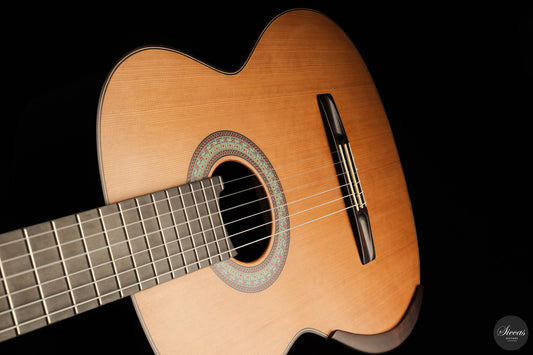
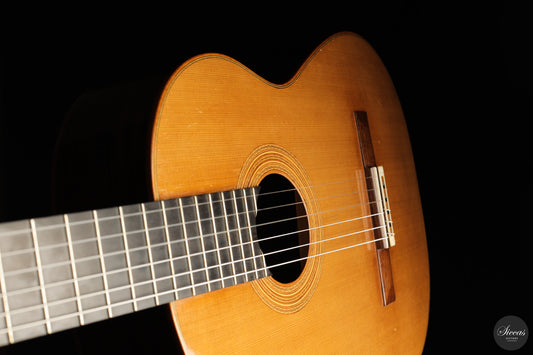
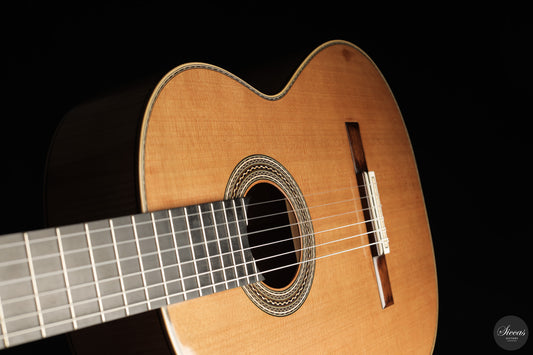
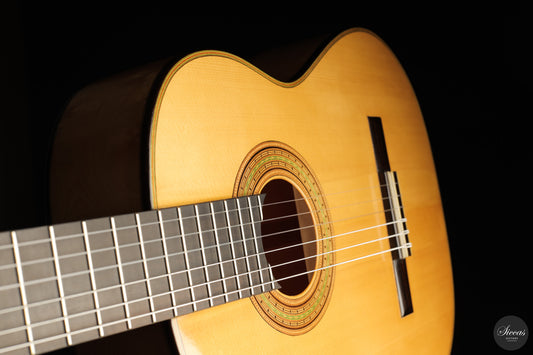
The soundboard — the top of the guitar — is responsible for the majority of the instrument's acoustic character. In a high-quality classical guitar, the top is hand-graduated: the luthier removes material from the inside of the plate in a precise, location-specific pattern, tapping and listening as they work, until the plate responds to their touch in the way they want. This is not a step that can be delegated to a machine or completed in a fixed number of minutes. It requires the luthier to interpret what they feel and hear in real time, adjusting as the wood reveals its character.
Hand-graduation alone can account for many hours of work on a single top. Combined with the same attention paid to the back, ribs, bracing geometry, neck angle, and nut and saddle fitting, you begin to understand where the time goes. Every joint, every curve, every millimetre of string height is the result of a deliberate decision by a person who has spent years learning what a good decision sounds like.
Materials: Rare, Protected, and Irreplaceable
Labour is the dominant cost, but materials are not trivial — and for the finest instruments, they are genuinely difficult to source.
European Spruce and Cedar
The most prized soundboard woods for classical guitars are European spruce (Picea abies) and Western red cedar. High-quality tonewood must be quarter-sawn, air-dried for a minimum of several years (often decades), and free from runout, knots, and irregular grain. A master luthier may select from hundreds of pieces to find the one that feels right for a particular guitar. The cost of quality tonewood at this level is not trivial, and good pieces take years or decades to become available.
Brazilian Rosewood: CITES-Protected and Legally Restricted
Brazilian rosewood (Dalbergia nigra) is widely considered the finest back-and-sides wood for classical guitars. It is also listed under CITES Appendix I, meaning international trade in new Brazilian rosewood is essentially prohibited. Instruments built with it before 1992 can still be legally traded with the correct documentation, but the supply is finite and shrinking. A set of certified pre-CITES Brazilian rosewood adds thousands of euros to the material cost of an instrument — when it can be found at all.
Indian rosewood, Madagascar rosewood, and other alternatives are used at various price points, and many exceptional guitars are built with them. But the scarcity and legal complexity of Brazilian rosewood is a real driver of cost at the highest level.
Bone Nuts and Saddles
The nut and saddle — the two contact points through which string vibration transfers to the neck and bridge — are made from bone on any serious classical guitar. Bone is harder and denser than synthetic alternatives, transmits vibration more efficiently, and can be shaped and filed with precision. It is not expensive in absolute terms, but it represents the standard that a well-built instrument meets. Cheaper instruments use plastic; better ones use bone.
French Polish: The Finish That Cannot Be Rushed
Most mass-produced guitars are finished with sprayed lacquer or catalysed polyester — processes that are fast, durable, and consistent. A traditional concert classical guitar is finished with French polish: shellac dissolved in alcohol, applied by hand with a pad in dozens of thin layers over many days or weeks.
French polish is more fragile than lacquer and requires careful maintenance, but it has one acoustic advantage that makes it the standard for high-end instruments: it is extraordinarily thin, which means it does not dampen the vibration of the soundboard the way a thick lacquer film can. The result is a guitar that responds more freely and dynamically to the player. Applying it properly takes significant time and skill. Getting it wrong — rushing a coat, introducing moisture, failing to build up the surface evenly — means stripping back and starting again.
Decades of Expertise You Cannot Buy Separately
The tools and materials for building a classical guitar are not, in themselves, extraordinarily expensive. What you are paying for when you buy a master-built instrument is the accumulated expertise of someone who has spent twenty, thirty, or forty years learning how wood behaves — how a particular piece of spruce needs to be graduated differently from the next one, how to read the tap tone of a back plate, how to set a neck angle that will still be correct in twenty years as the instrument settles.
That knowledge cannot be shortcut. It is the product of building hundreds of instruments, many of them flawed, and learning from each one. When a luthier with that background builds you a guitar, you are getting the benefit of every mistake they ever made before yours.
The classical guitars at Siccas Guitars come from makers with exactly this kind of background — instruments where the labour, materials, and expertise are all present and accounted for.
Why the Price Is Not Proportional to Materials Alone
A common misconception about expensive classical guitars is that the price reflects the cost of exotic woods. That is only partially true. A luthier might spend €500 to €1,500 on the materials for a concert-level instrument — tonewood, tuning machines, bindings, finishing materials, hardware. The guitar sells for €8,000 to €25,000. The difference is not profit margin in the conventional sense. It is the market price of the luthier's time and skill, spread across fifteen to twenty-five guitars per year, with all the overhead of a workshop, tools, insurance, and decades of training to recover.
When you compare this to other hand-crafted luxury objects — a bespoke watch, a hand-sewn suit from a specialist tailor, a piece of studio pottery from a recognised maker — the pricing structure is not unusual. What is unusual is that the classical guitar world still has many active makers at the top of their craft, and that instruments of extraordinary quality can still be acquired by serious players who are willing to invest.
What You Are Actually Paying For at Each Price Point
Under €1,500: Student and Beginner Instruments
At this level, you are buying a factory or workshop instrument with machine-cut parts, sprayed finish, and laminate or lower-grade solid tonewoods. These guitars are perfectly serviceable for learning and early development. They are not concert instruments and are not priced as such. The quality gap between a €400 guitar and an €800 guitar at this level is real and meaningful.
€1,500 to €5,000: Intermediate and Professional Entry Level
In this range you begin to find instruments with solid tops and backs, bone nuts and saddles, and in some cases hand work on the graduating and fitting. Spanish workshop guitars and instruments from established makers earlier in their careers often sit here. These are genuine instruments that can serve a developing professional.
€5,000 to €15,000: Master-Built Concert Instruments
This is the range where hand-graduation, French polish, and the full attention of an established luthier are standard expectations. Instruments here are built to last generations, hold their value, and respond to the demands of professional performance at the highest level. Many of the great classical guitarists of the modern era perform on instruments in or above this range.
Above €15,000: The Upper Tier
At this level, you may be adding premium certified tonewoods (including pre-CITES Brazilian rosewood), more complex decorative work, and the premium of working with a maker whose instruments are in active demand on the international concert circuit. The waiting list for some makers is measured in years.
The Guitar as a Long-Term Investment
Unlike most consumer products, a well-built classical guitar does not depreciate in the conventional sense. Instruments by respected luthiers often appreciate over time, particularly as the maker's reputation grows or as they retire and production ends. The tonewoods continue to dry and settle, and many players report that a guitar sounds better at twenty or thirty years old than it did when new.
This is not true of factory instruments, which tend to depreciate quickly and plateau in value early. But for a concert-grade hand-built guitar, the purchase is closer to buying a piece of furniture by a respected craftsperson than buying a consumer appliance. The instrument can be passed down, restored, and played for a century.
Understanding the repertoire that these instruments are built to serve helps put the investment in context. The music demands an instrument that responds at the highest level — and that instrument costs what it costs for reasons that have everything to do with skill, time, and care.
The Role of Tradition and the Guitar's History
The modern classical guitar as we know it was largely standardised by Antonio de Torres in the mid-nineteenth century, and the fundamental design — fan-braced soundboard, Spanish-heel neck joint, scale length around 650mm — has remained remarkably consistent since then. That continuity is not conservatism for its own sake. It reflects a design that, in the hands of a skilled builder, produces an instrument of extraordinary acoustic subtlety and expressive range.
The great composers who wrote for the guitar — from Francisco Tárrega to Agustín Barrios Mangoré — were writing for instruments built by hand, with the same attention to craft that defines the best work today. The music is inseparable from the instrument, and the instrument is inseparable from the tradition of making it well.
The Video: A Master-Built Instrument in Action
Hearing the difference between a factory guitar and a concert instrument is the most direct way to understand what the price buys. The video below captures the character of a high-quality classical guitar in performance — the dynamic range, the clarity of individual voices in polyphonic passages, and the way the instrument sustains and resonates under the hands of a skilled player.
Frequently Asked Questions
Is a more expensive classical guitar always better?
At the extremes, yes. A €15,000 concert instrument built by a master luthier will outperform a €300 factory guitar in every acoustic dimension. But within a narrower price band — say, €3,000 to €6,000 — the answer becomes more nuanced. Two instruments at similar prices from different makers may suit different playing styles, hand sizes, and tonal preferences. The best instrument is the one that responds well to the specific player.
Do classical guitar prices include the case?
Usually not, or only a basic case is included. A high-quality flight case for a concert instrument is a separate and worthwhile investment.
Why do some makers have multi-year waiting lists?
Because the maker produces fifteen to twenty-five instruments per year and demand from serious players and collectors exceeds supply. A waiting list is a direct consequence of the fact that the instrument cannot be built faster without reducing quality — and no serious luthier is willing to do that.
Can I find a good classical guitar for under €2,000?
Yes — there are solid, playable instruments in that range, particularly from established Spanish and European workshops. They will not match a concert-grade hand-built guitar in responsiveness or tonal complexity, but they are honest instruments that will serve a developing player well. Browse the classical guitars collection to see what is currently available at different price points.
What about Bach on classical guitar — does the instrument matter that much?
For demanding polyphonic repertoire — Bach's lute suites and partitas transcribed for guitar, for example — the ability of the instrument to clearly voice multiple independent lines simultaneously is genuinely important. A concert instrument with a well-graduated top and responsive bracing makes those distinctions audible in a way that a lesser instrument simply cannot.
The Honest Summary
Classical guitars are expensive because building one well takes an extraordinary amount of skilled human time, rare and in some cases legally restricted materials, and decades of expertise that cannot be acquired any other way. A master luthier producing fifteen to twenty-five guitars per year is not a factory — they are a craftsperson working at the absolute limit of what one person can do with their hands and knowledge.
The price of a concert classical guitar reflects that reality honestly. When you buy at this level, you are not paying for a brand name or a luxury premium. You are paying for hundreds of hours of focused work, material that in some cases cannot be replaced, and the accumulated knowledge of someone who has spent their career learning how to make wood sing.
That is not expensive. That is exactly what it costs.