
Yuri Santangelo was born in Florence in 2000 and studied at the Fiesole School of Music and the Conservatorio della Svizzera Italiana with Alfonso Borghese and Lorenzo Micheli. He has distinguished himself in more than ten international competitions — among them the Fernando Sor, Città di Padova, Omaggio a Niccolò Paganini and Tokyo International Guitar Competition — and in October 2025 the 30th International Guitar Conference in Milan awarded him its Golden Guitar for Promising Young Artists. He took first prize at the Paganini Guitar Festival in Parma.
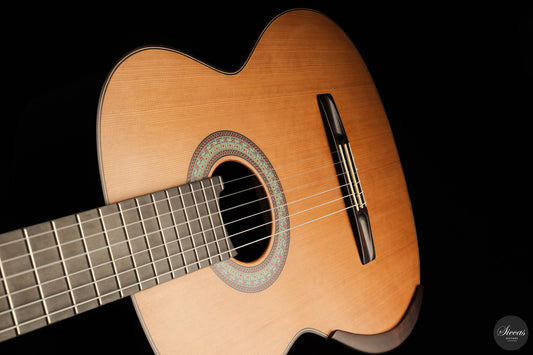
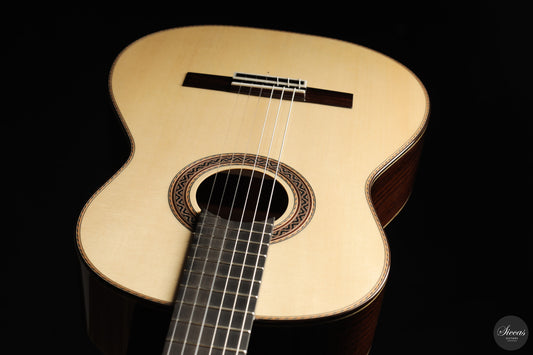
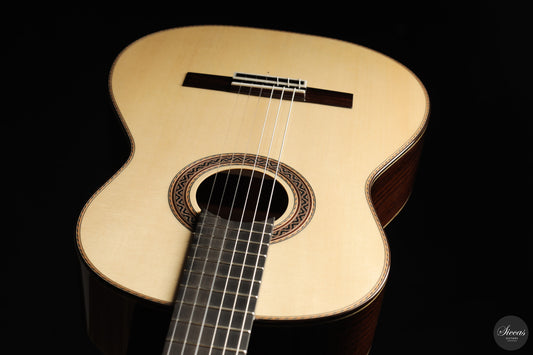
Here he plays the opening piece of a monumental cycle: Caprichos de Goya No. 1 by Mario Castelnuovo-Tedesco, on a Siccas Luthiers Continuum guitar.
About Caprichos de Goya No. 1
The 24 Caprichos de Goya, Op. 195 is the most ambitious guitar work Castelnuovo-Tedesco ever wrote — a cycle of musical portraits composed in 1961 after the etchings of Francisco Goya. The first piece bears the title of Goya's own opening plate, Francisco Goya y Lucientes, Pintor: the painter's self-portrait, the artist introducing himself before the satire begins.
That makes No. 1 something unusual for an opening movement. It is not an overture but a character study — a portrait of the man whose eyes will guide us through the following twenty-three images. Castelnuovo-Tedesco writes it with a certain proud reserve: a clearly drawn melodic profile, harmony that shades rather than illustrates, and the compositional economy of someone who knows he has a long journey ahead. For the performer the challenge is tone rather than velocity, which is exactly why it makes such a revealing showcase for an instrument.
We have looked at a later piece from the same cycle in our article on Capricho de Goya No. 18 — hearing the two side by side shows how widely Castelnuovo-Tedesco's palette ranges across the set.
About Mario Castelnuovo-Tedesco
Mario Castelnuovo-Tedesco (1895–1968), born in Florence like Santangelo, became one of the century's most important composers for the guitar after meeting Andrés Segovia in Venice in 1932. Driven from Italy by the racial laws in 1939, he built a second career in Los Angeles as a film composer and teacher. Read more in our portrait of the composer and our guide to his guitar works.
The Guitar: Siccas Luthiers Continuum
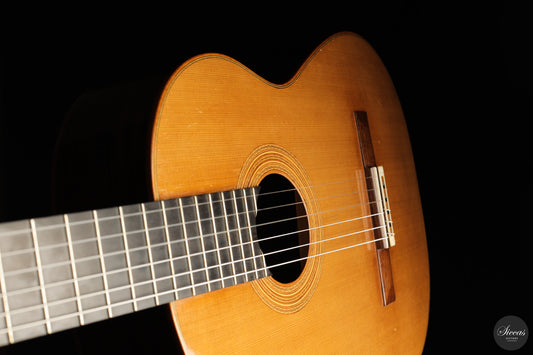
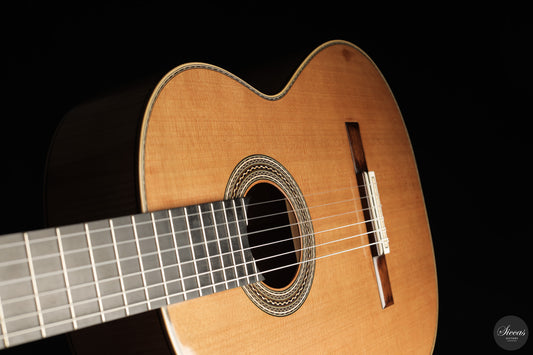
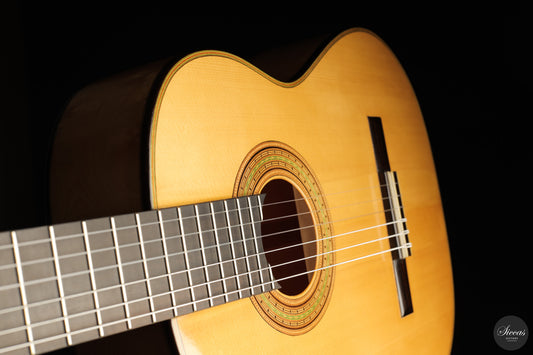
The Continuum is the newest model in our own Siccas Luthiers line, a lattice-braced concert guitar built for response and projection. You can hear our first impressions of it in our article on the Continuum Lattice, and explore the whole line in our Siccas Luthiers collection.
Watch the Performance
For more repertoire discoveries, browse our overview of famous classical guitar pieces.