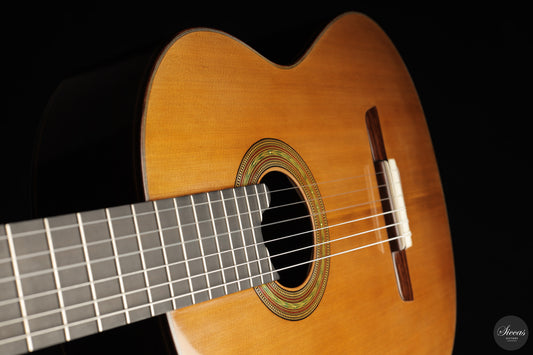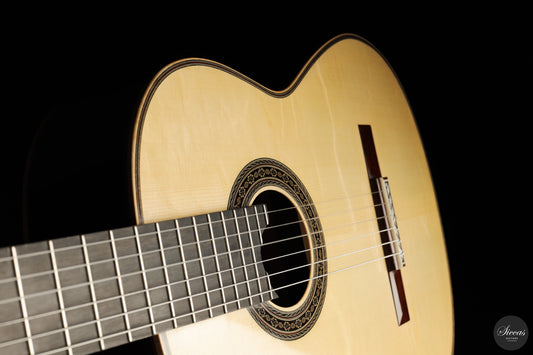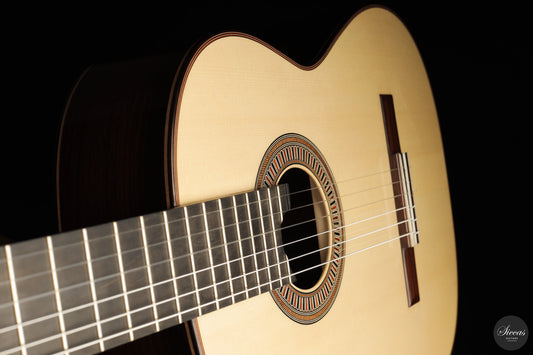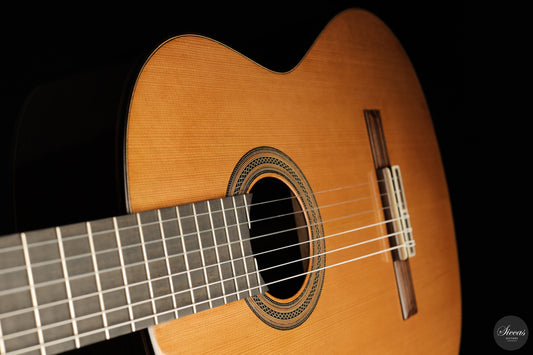

Kanahi Yamashita is a Japanese classical guitarist who has performed concert programmes at Siccas Guitars. Her recitals span repertoire from the Renaissance to the twentieth century, drawing on works by Johann Sebastian Bach, Francisco Tárrega, Fernando Sor, Hans Haug, and John Dowland. She has performed on historically significant instruments including a 1982 José Romanillos, a 1964 Manuel Reyes, and a Wolfgang Jellinghaus Torres 77 model — each guitar representing a distinct tradition in classical guitar lutherie.
Concerts at Siccas Guitars
Kanahi Yamashita has given concerts at Siccas Guitars, contributing to the ongoing series of artist performances hosted at the company. These concerts provide an opportunity to hear professional classical guitarists perform on the instruments available at Siccas Guitars, and to appreciate how different guitars respond to different repertoire and playing styles.
Her programmes demonstrate a considered approach to repertoire selection, combining Baroque counterpoint with Romantic character pieces and extending into twentieth-century writing for the guitar. The combination of Bach, Tárrega, Sor, Haug, and Dowland reflects a commitment to showing the breadth of the classical guitar's historical and expressive range.
Concert Programme
The following composers and works appear in Kanahi Yamashita's documented concert activity at Siccas Guitars:
Johann Sebastian Bach
Bach's music occupies a central place in the classical guitar repertoire. Originally composed for lute, keyboard, and other instruments, his works have been transcribed and performed by guitarists for well over a century. The counterpoint and structural logic of Bach's writing suits the guitar's capacity for independent voice leading, and his music remains a standard measure of technical and musical accomplishment for any classical guitarist. Kanahi Yamashita includes Bach in her recital programmes, placing his work alongside composers from very different periods and traditions.
Francisco Tárrega – Recuerdos de la Alhambra
Recuerdos de la Alhambra is one of the most recognisable works in the classical guitar repertoire. Composed by Francisco Tárrega in the late nineteenth century, it is built almost entirely on a tremolo technique — a rapid, repeating pattern on a single string that creates the impression of a sustained, singing melody above a slower-moving bass line. The piece takes its name from the Alhambra palace complex in Granada, and its texture is often described as evoking the sound of water or the Moorish architectural decoration of the palace. Performing Recuerdos de la Alhambra in concert requires sustained control of the tremolo across the full duration of the piece, and it is widely regarded as a test of both technical precision and musical sensitivity.
Fernando Sor
Fernando Sor was a Spanish composer and guitarist active in the late eighteenth and early nineteenth centuries. He is regarded as one of the foundational figures in the development of the classical guitar as a serious concert instrument, and his études, studies, and concert pieces remain in active use today both as teaching material and as concert repertoire. His writing for the guitar is characterised by clear classical form, balanced voice leading, and an understanding of the instrument's natural resonance and idiomatic possibilities. Kanahi Yamashita includes Sor in her programmes, situating his work within a wider historical survey of music composed for or adapted to the guitar.
Hans Haug
Hans Haug was a Swiss composer born in 1900 and active through the mid-twentieth century. His inclusion in Kanahi Yamashita's programme represents the less frequently performed area of the guitar's twentieth-century repertoire, and it reflects a willingness to move beyond the most well-known names in the concert canon. Haug's work for guitar is less widely documented than that of Sor or Tárrega, and encountering it in a live recital context is relatively uncommon. Including Haug in a programme alongside Bach and Tárrega places the guitar's mid-century repertoire in a broader context.
John Dowland
John Dowland was an English Renaissance composer and lutenist whose songs and lute works are among the most celebrated of the late sixteenth and early seventeenth centuries. His music is most naturally associated with the lute, the plucked string instrument for which it was originally written, but the classical guitar's tuning and technical possibilities make it a practical vehicle for Dowland's repertoire. Works such as his pavans, fantasias, and songs have been performed on the guitar for many decades, and Dowland's name appears regularly in programmes that aim to represent the full historical span of music available to the classical guitarist. Kanahi Yamashita's inclusion of Dowland places her programme in this tradition, connecting Renaissance lute music to the modern concert guitar.
Instruments
Kanahi Yamashita has performed on the following instruments in her concerts at Siccas Guitars:
1982 José Romanillos
José Romanillos is a Spanish luthier born in Madrid who later established himself in England, where he worked and taught for many decades. He is widely regarded as one of the most important classical guitar makers of the twentieth century, and his instruments are played by leading concert guitarists internationally. His relationship with Julian Bream, for whom he built a number of guitars over many years, helped bring his work to international attention. A 1982 Romanillos represents a mature example of his craft from a period when he had already established a clear and refined approach to construction and voicing. Romanillos instruments are known for their balance, clarity, and depth of tone.
If you are interested in historic and contemporary Spanish luthiery, you can explore instruments from related traditions in the classical guitars collection at Siccas Guitars.
1964 Manuel Reyes
Manuel Reyes was a Córdoba-based luthier whose instruments became particularly associated with flamenco guitar, though his classical guitars are also regarded with considerable respect. A 1964 instrument places this guitar in the early period of Reyes's mature output. His guitars are known for their responsiveness, clarity of attack, and tonal character. Encountering a 1964 Manuel Reyes in concert use is notable, as instruments of this age and maker are not commonly available.
Wolfgang Jellinghaus Torres 77
Wolfgang Jellinghaus is a German luthier known for building instruments inspired by historical models, including the designs of Antonio de Torres, the nineteenth-century Spanish luthier who is widely considered the foundational figure of the modern classical guitar. The Torres 77 model refers to a specific Torres guitar that Jellinghaus has studied and used as the basis for his own construction. Building in the Torres tradition involves specific choices about scale length, top thickness, bracing pattern, and overall geometry that are intended to reproduce or evoke the tonal qualities associated with Torres's own instruments. Performing on a Jellinghaus Torres model places the performer in direct dialogue with this historical tradition.
You can read more about the makers and traditions that shaped the classical guitar in the José Ramírez collection and the Hermann Hauser I collection at Siccas Guitars.
Watch: Kanahi Yamashita in Concert at Siccas Guitars
The video above documents Kanahi Yamashita's online concert recorded at Siccas Guitars. It presents her performing the programme described above, with commentary on the instruments used.
The Classical Guitar Repertoire in Context
The programme performed by Kanahi Yamashita at Siccas Guitars covers approximately four centuries of music, from Dowland's Renaissance lute works through Baroque counterpoint, classical-period writing, late Romantic character pieces, and twentieth-century composition. This range is characteristic of how the concert classical guitar has developed as an instrument capable of drawing on music from many different periods and traditions.
The guitar's capacity to perform this breadth of repertoire is one of its defining features as a concert instrument. Unlike instruments such as the violin or piano, which are more closely tied to specific periods of their technical development, the guitar has a history that allows performers to move between Renaissance, Baroque, Classical, Romantic, and modern music within a single recital. Kanahi Yamashita's programme at Siccas Guitars reflects this capacity directly.
For an overview of the repertoire most closely associated with the classical guitar, see the guide to famous classical guitar pieces on the Siccas Guitars blog.
Japanese Classical Guitarists
Japan has a strong tradition of classical guitar performance and education, and Japanese guitarists have been prominent in international concert life for several decades. The combination of rigorous musical training and a deep engagement with the European classical guitar repertoire has produced a number of significant performers. Kanahi Yamashita is part of this tradition, bringing Japanese musical training and sensibility to a repertoire that spans European musical history from the Renaissance to the twentieth century.
Learning the Classical Guitar
Watching a guitarist of Kanahi Yamashita's level perform a demanding programme that includes Tárrega's Recuerdos de la Alhambra, Bach, and Dowland can be both inspiring and useful for anyone interested in developing their own playing. The classical guitar requires sustained study and practice to master, and the repertoire she performs represents advanced-level material. If you are considering beginning or continuing classical guitar study, the article on how long it takes to learn classical guitar offers a realistic overview of the process.
For profiles of other guitarists who have performed at Siccas Guitars and beyond, see the full list of great classical guitarists on the Siccas Guitars blog. You can also read the profile of Julian Bream, one of the most significant British classical guitarists of the twentieth century, whose connection to the maker José Romanillos is one of the notable links between the luthiers and performers represented at Siccas Guitars.
Instruments at Siccas Guitars
Siccas Guitars holds and sells a range of classical guitars by significant makers, including historical instruments and contemporary luthier work. The guitars on which Kanahi Yamashita has performed — by Romanillos, Reyes, and Jellinghaus — represent different strands of the tradition of Spanish and European classical guitar making. The classical guitars collection at Siccas Guitars includes instruments from this tradition and from related schools of lutherie.
Visitors to the Siccas Guitars showroom and participants in the online concert series have the opportunity to hear these instruments in the hands of professional performers, providing a direct experience of how different guitars respond to demanding concert repertoire. Kanahi Yamashita's concerts at Siccas Guitars are an example of this approach: bringing a serious recital programme to a setting where the instruments themselves are as much a part of the event as the performance.
The concert programme and the instruments in detail. The biography is in Kanahi Yamashita.