
The first thing most listeners notice about Mariya Smirnova is the sound. A guitarist of Russian and German heritage, based in Cologne, she is admired for a tone of unusual warmth and clarity — at times so resonant and sustained that the guitar seems to take on the colour of a harp. It is a quality that turns even familiar repertoire into something to listen to afresh.
A wide-ranging repertoire
Smirnova's concert programmes move comfortably across styles and eras — from the Romantic guitar writing of Napoléon Coste, to the tango sensibility of Astor Piazzolla, to the music of the contemporary Spanish composer Nikita Koshkin and others such as Javier Alfonso. That breadth suggests a player guided less by a single specialism than by curiosity and by the search for music that lets her tone sing.
The art of the tremolo
She is particularly noted for her command of tremolo — the technique, central to pieces like Tárrega's Recuerdos de la Alhambra, in which a rapid repetition of a single note creates the illusion of a continuous, sustained melody. Done well, tremolo is one of the most beautiful effects the guitar can produce, and it is one of the hardest to make sound truly even. It is no accident that this demanding skill has become associated with her name.
A player to hear
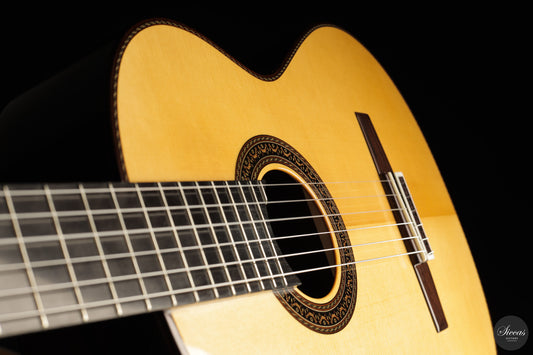
Smirnova performs on fine modern instruments — including a guitar by the contemporary Italian luthier Angelo Vailati — and her recordings have introduced her to a growing international audience. Hers is, above all, an art of sound and line: a reminder that on the classical guitar, beauty of tone is itself a form of expression.
FAQ
Where is Mariya Smirnova based?
In Cologne, Germany; she is of Russian and German heritage.
What is she known for?
A singing, harp-like tone and a fine command of tremolo technique.
What does she play?
A wide repertoire including Coste, Piazzolla and contemporary composers.
Browse our classical guitars →
Performing at Siccas Guitars
Every classical guitarist who performs at Siccas Guitars brings a distinct musical path to the instrument — shaped by years of study, competition experience, and the particular musical tradition they have chosen to inhabit. The classical guitar demands sustained technical commitment and a deep engagement with a repertoire that spans from the Renaissance through to works written for living performers. It is an instrument whose full possibilities only reveal themselves over time.