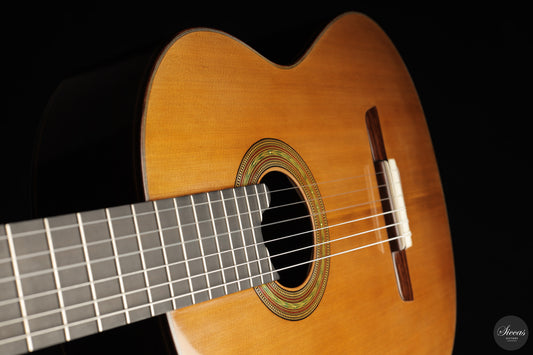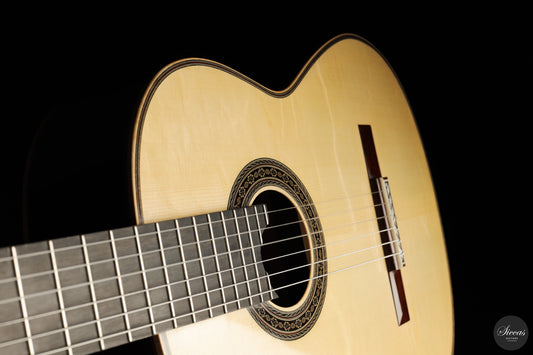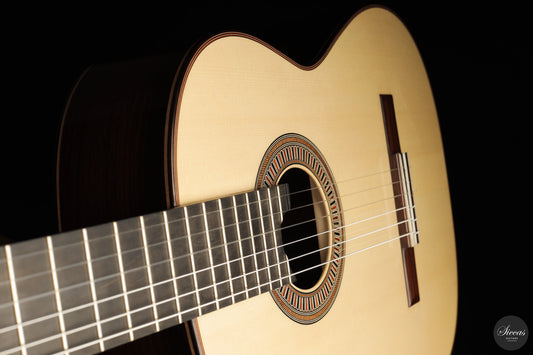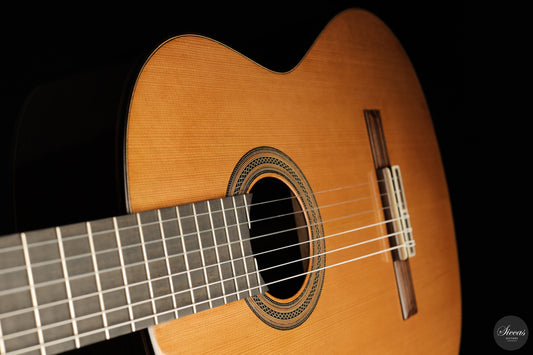

Among the generation of contemporary luthiers reshaping the concert guitar landscape, Andreas Madimenos stands out as one of the most compelling voices to emerge from southern Europe. Born in Athens in 1984, this Greek guitar maker has built a reputation for instruments that combine rigorous engineering thinking with a deep sensitivity to the needs of performing soloists. His guitars — characterised by a powerful, precise sound and exceptional playability — are today found in the hands of internationally recognised concert artists, a testament to how quickly a dedicated craftsman can earn the trust of the professional world.
Biography and Training
Madimenos began his relationship with music early, picking up the guitar at the age of seven. He pursued formal music studies alongside a parallel academic career, eventually earning both a Bachelor's and Master's degree in finance from the Athens University of Economics and Business. This analytical background may seem an unlikely companion to lutherie, but it speaks to a maker who brings systematic, structured thinking to every aspect of instrument design.
His path to guitar making crystallised in 2014, when he entered the workshop of Pavlos Gypas, one of Greece's most respected luthiers. Under Gypas's guidance, Madimenos absorbed the fundamentals of classical guitar construction — tone wood selection, bracing geometry, finish work and the subtle art of voicing a top. He quickly demonstrated an aptitude not just for replicating established methods but for interrogating them, asking why each design decision existed and whether it could be improved. Within a relatively short period he had established his own fully equipped workshop, described as one of the most sophisticated facilities for instrument building in Greece.
His influences extend across centuries of lutherie. He has studied the approaches of historical makers such as Vicente Arias and the early Romantic-era builder Johann Georg Stauffer, while also drawing deeply on the work of modern innovators — among them Greg Smallman, whose structurally engineered lattice guitars from Australia have reshaped expectations of what a classical guitar can project in a large concert hall. You can explore the broader context of these structural approaches in our guide to fan-braced, double-top and lattice classical guitars.
Construction Philosophy
The defining characteristic of Madimenos's approach is a willingness to combine the best of traditional lutherie thinking with contemporary engineering methods. He works from his own designs and patented structural solutions, adapting the topology of bracing and the architecture of the back and sides to the particular needs of each commission. Every guitar he builds is conceived in dialogue with the player who will perform on it: the soundboard design, the back-and-sides construction, and even the rosette are shaped according to individual preferences and physical playing characteristics.
His lattice-braced instruments draw significant inspiration from the Smallman school of Australian lutherie — notably the highly structured back and sides, the very thin and lightly mass-loaded soundboard, the internal frame, and the characteristic cross-lattice bracing pattern. Yet Madimenos does not simply replicate this template. He has developed proprietary structural elements that give his instruments a sonic identity distinct from their Australian antecedents: a clarity and focus in the upper register, combined with a warmth in the bass that players find particularly satisfying in chamber and recital settings. His fan-braced models, meanwhile, engage more directly with the Spanish tradition, offering guitarists who prefer a more organic tonal palette an alternative that still benefits from his precision craftsmanship.
This dual approach — lattice for those seeking maximum projection and modernity, fan-braced for those rooted in the classical tradition — reflects a maker who refuses to be constrained by a single philosophy. It also places him in interesting company among the contemporary builders who have pushed the instrument forward, such as the double-top pioneers Matthias Dammann and Bernd Clauss Wagner, who similarly sought structural innovation in the service of the concert player.
All components of a Madimenos guitar are handmade in his Athens workshop. He selects tonewoods with considerable care, favouring combinations that reinforce the sonic goals of each model, and his finishing work — from the pore-filling stages through to the final gloss — reflects the same attention to detail that runs through every other aspect of his process. The result is an instrument that not only sounds exceptional but holds up reliably under the physical and environmental demands of a touring professional's life.
Signature Models and Structural Innovations
Madimenos has developed a range of models that reflect different stages of his evolution as a builder. His lattice guitars, beginning with the instruments he built in the early 2020s, established his international reputation most directly. These guitars feature his patented back-and-sides reinforcement system and a soundboard thickness calibrated to maximise the energy transfer from string to body — an approach that yields the loud, responsive sound his clients seek for large concert halls.
His numbering system — instruments are assigned sequential build numbers — allows players and collectors to trace the development of his craft over time. By the mid-2020s he had passed number 70 in his catalogue, a significant output for a luthier who builds entirely by hand and refuses to compromise on the time each instrument requires. Examining the progression from his early guitars to his most recent work, one can observe a maker refining his voicing techniques and expanding the tonal range available within each model type.
The rosette work on his instruments has also attracted attention: he designs each rosette individually, treating it not as mere decoration but as a visual statement of the instrument's character, often reflecting the tonal and structural choices made throughout the build.
Notable Players
One of the clearest indicators of a luthier's standing in the professional world is the calibre of the players who choose their instruments. For Madimenos, the most prominent advocate is Rafael Aguirre, the multi-award-winning Spanish guitarist who regularly performs on a Madimenos lattice guitar. Aguirre's international profile — he is one of the most active concert soloists of his generation — has brought significant visibility to the Athenian maker, introducing his work to audiences and artists worldwide.
His instruments are also played within the British guitar quartet Aquarelle: Vasilis Bessas, one of the quartet's guitarists, performs on a Madimenos. This ensemble context is particularly interesting, as it places his guitars in direct comparison with instruments by other leading contemporary makers, and they hold their own in terms of both projection and blending.
Beyond these headline names, Madimenos has participated in major Greek guitar festivals, donating instruments as first prizes — a practice that has introduced his guitars to emerging players and competition circuits, building awareness of his work among the next generation of classical guitarists.
Legacy and Place in Contemporary Lutherie
Andreas Madimenos represents something genuinely encouraging about the current state of classical guitar making: the emergence of world-class luthiers from countries and traditions outside the historical centres of the craft. Where the story of the concert guitar has so often been written through the great Spanish makers — figures like Ignacio Fleta and José Luis Romanillos — or through the French school represented by masters like Daniel Friederich, the contemporary scene is far more geographically diverse.
Greece has no historic tradition of classical guitar making comparable to Spain or France, yet Madimenos has built a workshop and a body of work that stand comparison with the best contemporary makers anywhere in the world. He has done so through a combination of thorough self-education, a willingness to apprentice seriously, an engineering mindset, and — above all — an obsessive commitment to the quality of every instrument that leaves his bench. In the broader ecosystem of classical guitar makers working today, his is a name that is already well established and likely to carry increasing weight in the years ahead.
Browse available Andreas Madimenos guitars → in the Siccas Guitars collection.