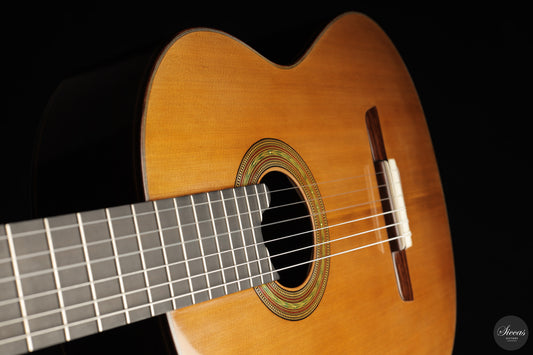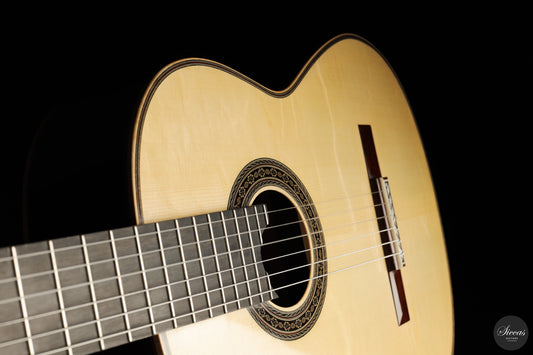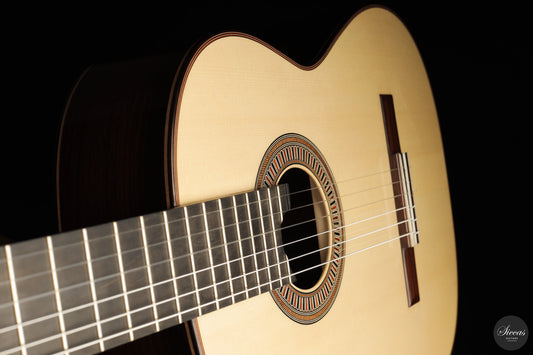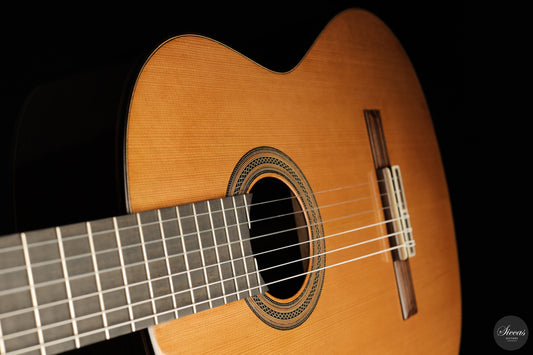

Few living guitar makers can claim a lineage as deeply woven into the history of the Spanish classical guitar as Antonio Raya Ferrer. Born in Granada in 1980, he stands at the confluence of two of the most celebrated guitar-making dynasties the city has ever produced: the Raya Pardo family on his father's side, and the Ferrer dynasty on his mother's. Where other luthiers must construct a legacy from scratch, Antonio Raya Ferrer inherited one stretching back more than a century — and has spent his career proving himself worthy of it on his own terms.
Biography & Training
Antonio Raya Ferrer grew up in an environment saturated with the craft. His father, master luthier Antonio Raya Pardo, is one of Granada's most respected contemporary guitar makers, and the young Antonio was already present in the workshop by the age of fourteen. Sawdust, exotic tonewoods, and the smell of French polish were as familiar to him as the sounds of the city itself. By the time he was seventeen, in 1997, he had progressed far enough to begin building instruments under his own name — a significant step that marked his transition from apprentice to independent craftsman.
His maternal heritage adds another dimension of extraordinary depth. Through his mother, Pilar Ferrer, Antonio descends from Eduardo Ferrer, who in turn inherited and continued the workshop of his uncle Benito Ferrer (1845–1925). Benito Ferrer is widely regarded as the founding figure of the Granada school of guitar making, a tradition that shaped the sound of the classical guitar throughout the twentieth century. It was Benito who gifted a guitar to the young Andrés Segovia around 1904, recognising in the impoverished student a talent that deserved an instrument — a gesture that played a small but meaningful part in the trajectory of the greatest classical guitarist of the modern era. That guitar remained Segovia's primary concert instrument for nearly a decade, until the famous Manuel Ramírez guitar entered his hands.
Eduardo Ferrer, Benito's nephew and successor, continued the workshop's work through the upheaval of the Spanish Civil War and went on to train a generation of Granada luthiers, shaping the city's guitar-making community in ways that parallel the influence of José Ramírez in Madrid. Antonio Raya Ferrer thus carries five generations of accumulated knowledge in his hands whenever he picks up a chisel or planes a top.
Construction Philosophy
Antonio Raya Ferrer works within the traditional Granada school framework, an approach that places a premium on clarity, balance, and a tonal character that is immediately identifiable as Southern Spanish in origin. Granada guitars are typically distinguished from their Madrid counterparts by a slightly lighter construction, a more intimate resonance chamber, and a tonal character that leans toward clarity and singing sustain rather than brute projection. Antonio's instruments embody these qualities while reflecting his own evolution as a craftsman.
His guitars are built entirely by hand, one at a time, in the Granada workshop he shares with his father. He selects his tonewoods with great care, favouring European and cedar tops paired with traditional back and side materials including Indian rosewood and, in some instruments, Madagascar rosewood — a wood prized for its warmth and complexity. The combination of inherited technique and personal refinement produces instruments that players describe as possessing power, elegance, and tonal clarity in equal measure. The guitars project well without sacrificing the intimacy and nuance that concert performers demand in quieter passages.
In keeping with traditional fan-bracing principles passed down through the Granada school, Antonio uses time-tested bracing patterns refined over generations. He does not pursue novelty for its own sake; instead, his aim is the consistent production of instruments that serve the musician fully across the entire dynamic and tonal range of the classical repertoire.
Signature Models
Antonio Raya Ferrer builds both classical and flamenco guitars, a versatility that reflects the dual heritage of Granada — a city where the two traditions have always coexisted and cross-pollinated. His classical guitars typically feature spruce or cedar tops over bodies of Indian or Madagascar rosewood, with a traditional Spanish heel-neck joint and a French-polished finish that preserves the natural resonance of the timber. His flamenco models follow the lighter construction and lower action that the style demands, often using cypress for the back and sides to produce the characteristic bright, percussive response that flamenco players prize.
Each guitar is numbered sequentially, giving buyers a precise record of where their instrument falls within Antonio's body of work. By the mid-2020s, his numbered series had passed 248 instruments — a modest output that speaks to the care and time he dedicates to each piece. This limited production also means that his guitars are sought after by players and collectors who understand that genuine hand-craftsmanship at this level cannot be rushed.
Notable Players & Reception
While Antonio Raya Ferrer does not publicise an extensive roster of high-profile endorsees in the manner of some larger workshops, his guitars have found their way into the hands of serious concert guitarists and discerning collectors across Europe and North America. Dealers specialising in fine classical guitars — including Siccas Guitars — have consistently included his instruments in their offerings, a reliable indicator of quality in a market where reputation is everything. Players who have spent time with his guitars frequently comment on the immediacy of the response: the guitar speaks quickly under the fingers, rewarding both the student who is developing technique and the professional who needs an instrument that will not hold them back on stage.
His dual heritage — the Granada school's clarity and the Raya Pardo family's refined craftsmanship — gives his instruments a character that sits comfortably alongside the great historical makers associated with the city, including figures studied in depth by guitar historians and enthusiasts. Understanding where his work stands in the broader narrative of Spanish luthiery helps to contextualise just how rare it is to find a maker of this generation with such an unbroken chain of transmission from the founders of a whole school of building.
Legacy
Antonio Raya Ferrer represents something increasingly rare in contemporary guitar making: a living craftsman who is both the product and the custodian of a tradition. The Granada school that Benito Ferrer helped establish has shaped luthiers across the world, from those who trained directly in the city's workshops to those who absorbed its principles through the instruments and writings that filtered outward across the twentieth century. Masters such as Robert Bouchet and Daniel Friederich in France were themselves influenced by the Spanish tradition that Granada embodied.
For Antonio, that tradition is not a museum piece. It is a living practice, something he engages with daily in the workshop alongside his father, refining his touch with every instrument he completes. His numbered series, which grows slowly and deliberately year by year, stands as an ongoing testament to what patient, informed, generationally-rooted craftsmanship can produce. Each guitar that leaves his bench carries not only his own skill but the accumulated knowledge of five generations of makers, beginning with a man who once handed a guitar to a young Segovia on a street in Granada.