
Anže Lopatič – Slovenian Luthier Bridging Science and Sound
Among the new generation of classical guitar makers emerging across Europe, Anže Lopatič stands out for the clarity of his thinking as much as the quality of his instruments. Born in Ljubljana, Slovenia, in 1998, he brings a trained engineer's eye to the ancient craft of guitar making — studying wood at a structural and acoustic level before a single shaving is taken from the top. In just a few years of dedicated work, his instruments have attracted attention for their sustain, balance, and the quiet authority with which they speak under a player's hands.
From Wood Engineering to Guitar Making
Lopatič came to instrument making through wood rather than through an inherited lutherie tradition. From an early age he worked with timber on a practical level, developing an instinctive understanding of how the material behaves, responds to stress, and changes over time. That hands-on familiarity became the foundation for something more rigorous: he went on to study Wood Engineering at the Biotechnical Faculty of the University of Ljubljana, where he deepened his knowledge of wood properties, construction logic, and acoustic performance in a formal academic setting.
The musical dimension arrived through his sister, the professional guitarist Neža Lopatič, whose commitment to the classical guitar brought the instrument into close personal reach. Watching her relationship with the instrument over many years gave Lopatič a clear understanding of what a guitarist actually needs — not merely a well-constructed object, but one that responds with ease, sustains with warmth, and rewards musical intention. In 2021, he completed his first classical guitar, and since that point the instrument has become the exclusive focus of his workshop.
A Scientific Approach to the Classical Guitar
What distinguishes Lopatič among his contemporaries is not simply technical precision — it is the deliberate integration of scientific methodology into the making process. Rather than approaching the guitar only through inherited models and received wisdom, he brings an engineering-based way of thinking to questions of resonance, material selection, and structural efficiency. Each decision about bracing geometry, top thickness, or back stiffness is informed by an understanding of acoustic physics, and that understanding is continually tested against the musical result.
This does not make his guitars clinical or cold. On the contrary, the application of structural thinking produces instruments that feel alive under the fingers — transparent in the trebles, grounded in the bass, and coherent across the full range of the neck. His philosophy, in his own words, is to combine craftsmanship, science, and artistic expression: three elements that in lesser hands might pull in different directions, but in his workshop form a productive unity.
The tonal character of a Lopatič guitar is defined by long sustain, clear brightness, and a note that carries real substance after the attack. The voice stays open and colourful, with a strong tonal core and a comfortable, natural feel in the hands. These are not passive qualities — they reflect active choices made at every stage of construction, from the selection of the raw top to the final adjustment of action and nut.
Guitar Models and Construction Lines
Lopatič's workshop produces four distinct lines of instruments, each designed to serve a different level of player and a different set of musical priorities. The Basic Line offers a point of entry into his workshop's approach, while the Prestige Line represents a more refined expression of his tonal and aesthetic ideals. For players drawn to contemporary construction techniques, he also builds a Double Top Line and a Lattice Groove Top Line — the latter an inventive variation on the lattice-braced architecture that has reshaped the upper end of the concert guitar market in recent decades.
These are not merely product categories but genuine expressions of different acoustic philosophies. The fan-braced, double top, and lattice construction methods each produce a fundamentally different relationship between the player and the sound, and Lopatič's decision to work across all of them reflects both his engineering curiosity and his commitment to offering players instruments that match their specific musical needs. Where earlier innovators in the double-top tradition, such as the pioneers Matthias Dammann and Gernot Wagner, established the foundational vocabulary of the form, Lopatič builds from those precedents with his own structural logic and tonal intentions.
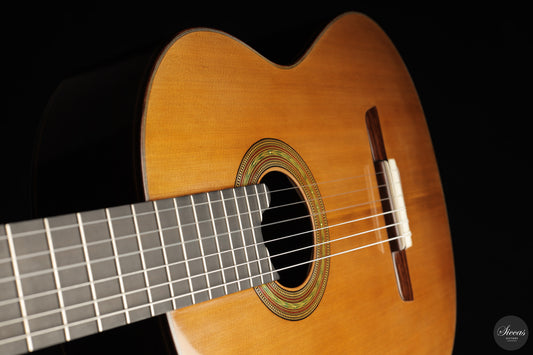
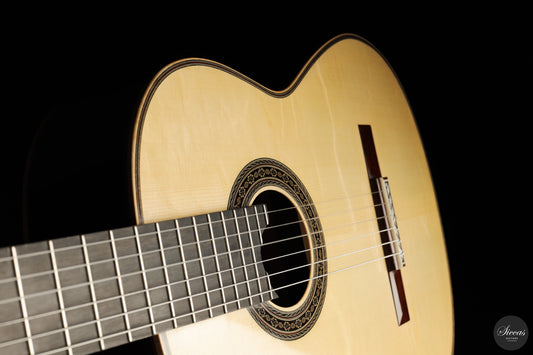
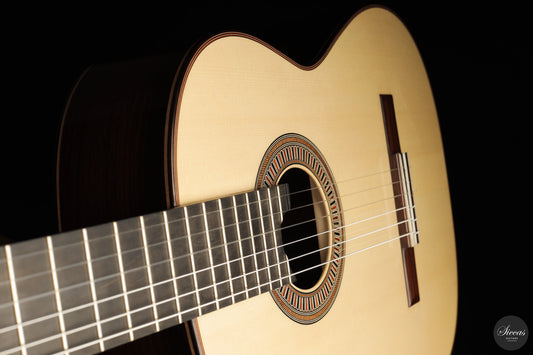
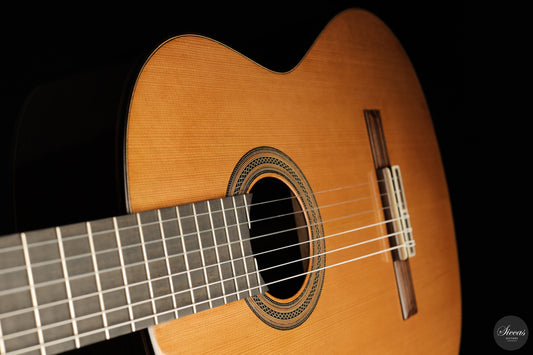
His 2026 traditional model in spruce and Indian rosewood exemplifies the qualities his instruments are known for: the sound is built not around extreme projection speed, but around continuity, tonal weight, and a presence that remains after the attack has passed. It is a guitar made for music that requires sustained thought and sustained tone in equal measure.
Recognition and the International Stage
Although his career as a maker is still in its early chapter, Lopatič has already drawn notice beyond Slovenia. His instruments have been exhibited at international events including the International Guitar Festival Styria, where makers from across Europe present their work to players, educators, and collectors. That presence on the international circuit matters not only as a measure of recognition but as an ongoing dialogue: hearing how different players respond to the same instrument is, for a maker of Lopatič's disposition, a form of data as useful as any acoustic measurement.
The guitarist and composer Yorgos Nousis, who has played his instruments, described them as "a delight both aesthetically and acoustically," singling out their maximum sustain and clarity, as well as the perfect playing comfort they offer. That combination of qualities — tonal performance and physical ease — is precisely what Lopatič aims for: a guitar that does not ask the player to fight against it, but instead extends what the player is already capable of doing.
A New Voice in European Lutherie
The history of classical guitar making is rich with makers who arrived at the craft through unexpected routes — Robert Bouchet was a painter before he was a luthier, and Daniel Friederich brought a cabinetmaker's discipline to bear on the concert guitar. Lopatič fits within this tradition of makers who come to the instrument from an adjacent domain and bring with them a set of tools and habits of mind that the established craft tradition does not already possess. His engineering background is not an ornament to his biography — it is the engine of his making.
Based in Dob, Slovenia, with his workshop at the centre of his daily work, Lopatič represents something genuinely interesting in contemporary European lutherie: a young maker who takes scientific rigour seriously without losing sight of the fact that the guitar's ultimate purpose is musical. That combination of intellectual seriousness and practical musical awareness, still developing and still being tested, is the quality that makes his trajectory worth following closely.
Browse available Anže Lopatič guitars → in the Siccas Guitars collection.