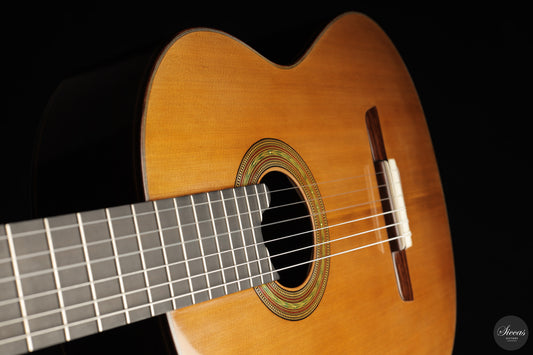
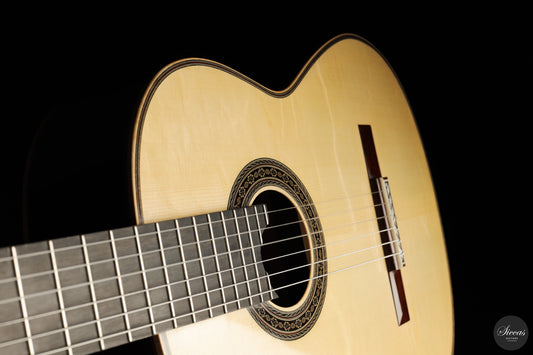
Bogusław Teryks occupies a singular position in the world of contemporary classical guitar making. A Polish luthier who has worked from Mainz, Germany since the mid-1980s, he is one of the very first builders in the world to have mastered the double-top construction technique — an achievement that places him alongside the small group of visionaries who have shaped the sound of the modern concert guitar. His instruments are distinguished by their wide dynamic range, exceptional tonal clarity, and a responsiveness that has attracted some of the finest players of the current era.
Biography & Training
Teryks was born in Wrocław (Breslau), Poland, and his passion for the guitar was ignited early. As a teenager, he watched a concert broadcast on Polish television in 1975 featuring the Venezuelan virtuoso Alirio Díaz, and the experience left a lasting impression. Guitar — its sound, its construction, its mysteries — became a lifelong pursuit. He began building instruments as far back as the early 1980s, reportedly following a friendly wager in secondary school that set him on the path from player to maker.
When Teryks relocated to Mainz in 1984, he found himself at the heart of a flourishing German luthiery scene. He worked under the mentorship of Manfred Pletz, with whom he built his first four instruments, and was later introduced to Gernot Wagner, one of Germany's most celebrated guitar makers and a central figure in the development of the double-top guitar. Wagner's guidance proved transformative. Under his influence, Teryks produced around 63 instruments grounded in traditional construction methods, absorbing a rigorous understanding of bracing geometry, tonewoods, and acoustic physics before embarking on his own path.
Construction Philosophy
What sets Teryks apart is his mastery of three distinct construction approaches: traditional fan-braced guitars, lattice-braced instruments, and — above all — the Nomex double-top. The double-top guitar uses a sandwich construction in which two ultra-thin spruce or cedar skins are bonded around a lightweight Nomex honeycomb core, dramatically reducing soundboard mass while preserving rigidity. The result is a guitar capable of producing great volume and projection with a subtlety and nuance that earlier high-output designs sometimes sacrificed.
When Gernot Wagner shared the principles of this advanced technique with Teryks, he became only the third luthier in the world — after Wagner himself and his colleague Matthias Dammann — to build guitars using this innovation. That lineage is significant: it connects Teryks directly to the founding moment of a construction revolution that has since been adopted by makers worldwide. His double-top model, which he has named Grand Concert – Nada Brahma, represents his most refined expression of the form, and is the guitar to which he now dedicates most of his workshop time. The name draws on Sanskrit philosophy — "Nada Brahma" translates roughly as "the world is sound" — reflecting the meditative seriousness with which Teryks approaches the act of building.
His lattice guitars, meanwhile, are carefully distinguished from the stiff, high-tension Australian lattice tradition. Teryks's lattice instruments retain a warmth and singing quality more characteristic of the European tonal ideal, while still offering the enhanced projection that lattice bracing makes possible. Across all his construction styles, the commitment is the same: to break what he sees as unnecessary limitations on the expressive range of the classical guitar, and to give players instruments capable of meeting the full demands of the modern concert stage.
Signature Models & Craftsmanship
Teryks numbers each guitar he produces, and his serial numbers now extend well into the 280s and beyond, documenting a career spanning more than four decades. His instruments are built entirely by hand in his Mainz workshop, and each guitar is the product of meticulous selection of tonewoods — European spruce and cedar tops, Indian rosewood or maple back and sides — chosen not only for visual quality but for the acoustic properties Teryks has learned to identify through long experience. His Grand Concert – Nada Brahma double-tops are the instruments most frequently sought by professional players, combining a broad dynamic palette with a singing treble register and a bass response that is both powerful and well-defined.
For players and collectors interested in the breadth of classical guitar making traditions, a Teryks guitar offers something rare: the chance to own an instrument built by a luthier who was present at the very birth of a major constructional innovation, and who has spent forty years refining his interpretation of it.
Notable Players
The roster of guitarists who have chosen a Teryks instrument is a testament to the quality and versatility of his work. Polish virtuoso Marcin Dylla — one of the most acclaimed classical guitarists of his generation and a First Prize winner at the most prestigious international competitions — has played Teryks guitars, lending considerable prestige to the maker's reputation. Łukasz Kuropaczewski, another leading Polish guitarist with an extensive international career, is also among his customers. Further afield, the Japanese guitarist Yoshimasa Yoshida and musicians of the Niibori Guitar Orchestra have played his instruments, as have rising talents such as Vera Danilina and Jakob Bangsø. The Amaral Duo and Pavel Kukhta round out a customer list that spans continents and playing styles.
This diversity of players speaks to a fundamental quality of the Teryks guitar: it does not impose a particular sound on the player, but responds openly to different touch and technique, making it a genuine tool for musical expression rather than a demonstration of the maker's ego.
Legacy & Recognition
Beyond the testimony of the players who own his instruments, Teryks has received formal recognition for his craft. He has won first place at international guitar-making competitions in Gdańsk, and took the Grand Prix at two separate editions — in 1999 and 2003 — confirming his standing among the finest makers working in Europe. His place in the history of the instrument is assured not only by those prizes, but by his unique position as one of the founding generation of double-top builders.
In the wider context of contemporary lutherie, Teryks is a figure who bridges traditions: rooted in the classical European craft lineage that runs from Daniel Friederich to José Luis Romanillos, yet also a pioneer of the acoustic engineering approach that has defined guitar making in the twenty-first century. His guitars embody that balance — instruments that feel organically alive under the fingers, yet are built with the precision and intentionality of a craftsman who has spent a lifetime listening to what wood can do.
For those seeking a concert-level instrument that carries real historical significance and a proven track record at the highest level of performance, the guitars of Bogusław Teryks represent one of the most compelling choices available today.
Browse available Boguslaw Teryks guitars → in the Siccas Guitars collection.