Chai Di – Beijing Luthier and Lattice Guitar Innovator
Chai Di is one of the most intriguing voices to emerge from contemporary classical guitar making in China. Based in Beijing, he has spent nearly two decades refining a personal approach to lattice-braced construction that draws on the legacy of Greg Smallman and the European precision associated with makers such as Matthias Dammann — synthesising both into an instrument language that is distinctly his own. His guitars have attracted growing international attention, and their appearance at Siccas Guitars marks a significant moment for a maker who has built his reputation almost entirely through the quality of his work rather than institutional recognition.
A Self-Directed Path Into Guitar Making
Chai Di began making classical guitars in 2007, approaching the craft as a deeply personal pursuit rather than a formal vocation. Working outside the established networks of European conservatory-linked ateliers, he taught himself the fundamentals of instrument construction through study, experimentation, and an unusually methodical willingness to rebuild assumptions from the ground up. By 2010 his focus had shifted decisively toward lattice bracing — the structurally radical approach pioneered in Australia by Greg Smallman, which replaces the traditional fan-braced soundboard with a lightweight grid of struts that allows the top to vibrate more freely across its entire surface. This was not a casual stylistic choice but the beginning of a long technical investigation. Chai Di spent the following years exploring what lattice construction could become in his own hands, studying the physics of the soundboard with the same rigour that he applied to every other aspect of the instrument. He works today as a part-time maker alongside a career as a respiratory therapist — a detail that speaks to a certain kind of dedication, the kind that produces guitars because making them is necessary rather than merely professional.
Construction Philosophy and Materials
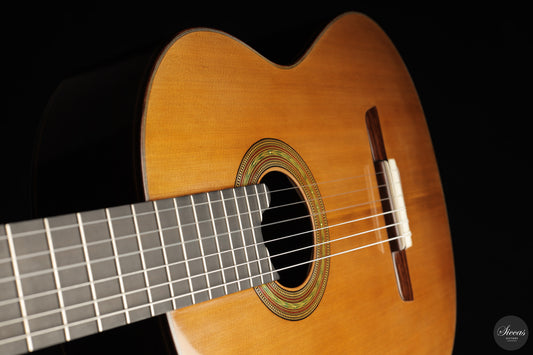
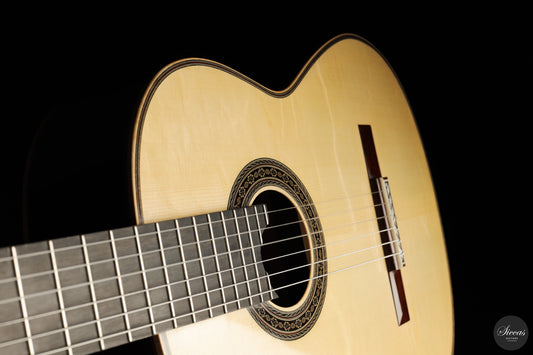
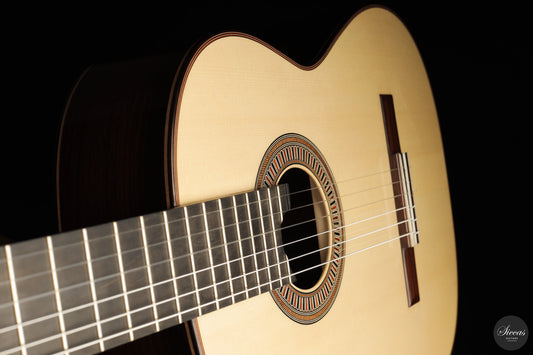
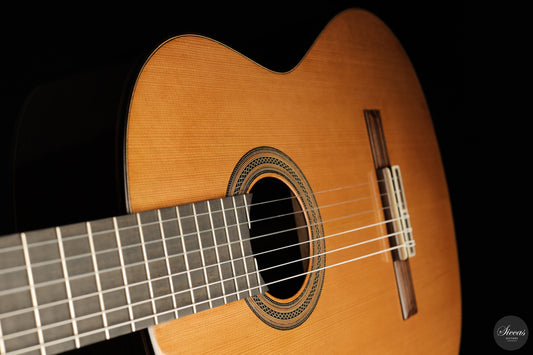
What distinguishes Chai Di's approach within the broader world of fan-braced, double-top and lattice guitars is his commitment to developing a synthesis rather than simply working within a received tradition. His lattice structures use balsa wood for the struts — an ultra-light material that maximises the mass-to-stiffness ratio of the bracing system — reinforced with carbon fibre to provide rigidity without adding weight. Cedar tops, kept deliberately thin, complete a soundboard designed to move with exceptional freedom. The resulting instruments are capable of considerable projection and sustain while retaining a warmth of tone that purely mechanical lattice designs can sometimes sacrifice. Chai Di has described his influences as both Smallman and the work of Matthias Dammann, one of the central figures profiled among the double-top guitar pioneers whose innovations redefined what a modern concert guitar could sound like. Rather than aligning himself with one camp, Chai Di has worked to understand the underlying principles of each approach and to find the intersection that best serves the musical instrument. His finishing choices — combining wax and polyurethane — reflect the same pragmatic experimentalism: each decision is made in service of the final sound, not tradition for its own sake.
Chai Di in the Context of Contemporary Guitar Making
To appreciate what Chai Di represents, it helps to situate him within the longer history of the classical guitar's evolution. The instrument as we know it today was shaped by a sequence of makers — from the Viennese and Spanish schools of the nineteenth century through the towering figures of the twentieth century such as Robert Bouchet, Ignacio Fleta, and Daniel Friederich — each of whom advanced the instrument's potential through individual vision and technical mastery. The lattice revolution of the late twentieth century introduced a new paradigm, one in which structural engineering became as important as tonal intuition. Chai Di belongs to the generation of makers who have grown up with that paradigm as a given, and whose task is therefore not to discover it but to deepen and personalise it. Working from Beijing, far from the geographic centres of classical guitar culture in Europe and Australia, he has done so without the advantages of a famous workshop lineage or a renowned teacher's endorsement. That independence, while presenting its own challenges, has also allowed him a freedom to experiment that more tradition-bound ateliers might not permit. Among the broader community of classical guitar makers working today, Chai Di occupies an increasingly notable position: a maker whose instruments speak for themselves on the international stage.
Legacy and Recognition
Chai Di's guitars have been offered as prizes in classical guitar competitions, a mark of recognition that places them in the company of instruments by established workshop names. His 2025 Lattice model, available through Siccas Guitars, represents the current state of his thinking: an instrument in which more than fifteen years of sustained inquiry into lattice construction has been distilled into a coherent and playable whole. The guitar offers the power and projection that professional soloists require alongside a tonal warmth and complexity that reward close listening. For players seeking an instrument that sits outside the mainstream of European workshop production while maintaining concert-level quality, a Chai Di guitar represents a compelling and genuinely individual choice. His story also reflects a broader shift taking place in classical guitar making — as the tradition becomes genuinely global, voices from China, Japan, South America, and beyond are contributing to a conversation that enriches the instrument for everyone.
Browse available Chai Di guitars → in the Siccas Guitars collection.