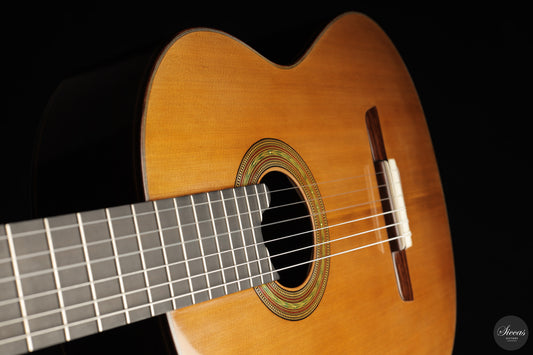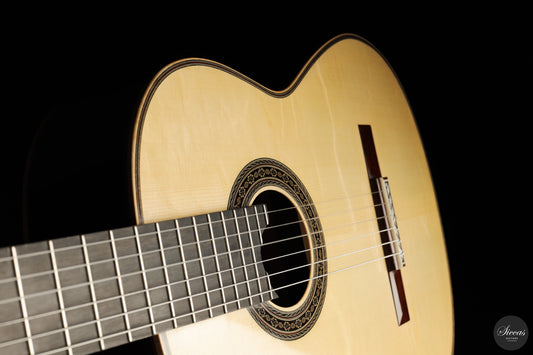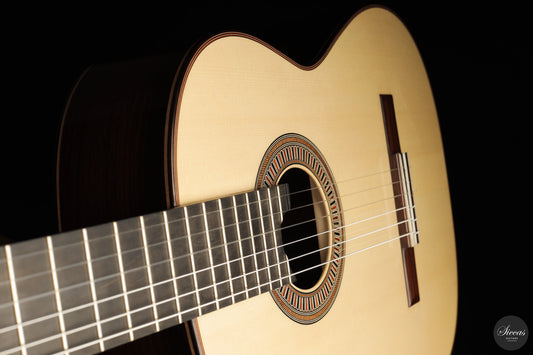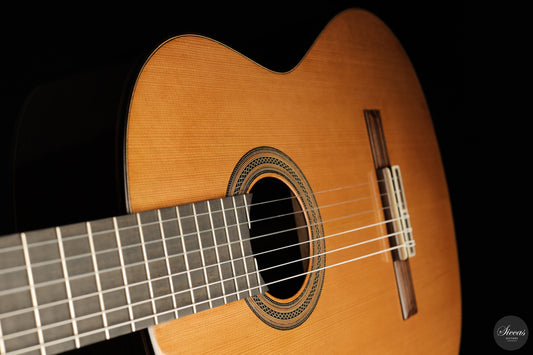

Enrique García (1868–1922) stands among the most consequential figures in the entire history of classical guitar making. Born in Madrid, trained under the most influential workshop of his era, and eventually transplanted to Barcelona, García spent the last three decades of his life quietly redefining what a concert guitar could be. His instruments shaped the sound of the early twentieth century, were played by luminaries including Francisco Tárrega and Domingo Prat, and gave rise to a regional tradition — the so-called Barcelona School — whose influence can still be heard in workshops and concert halls today. With a total output of only around 300 to 400 instruments, García's surviving guitars are among the rarest and most valuable historical classical guitars in the world.
Biography & Training
García was born into a musical-instrument-making family: his father, Juan García, was himself a guitar maker. Despite that heritage, the decisive step in Enrique's formation came in 1883, when at fifteen years of age he entered the workshop of José Ramírez I in Madrid. The Ramírez atelier was the dominant centre of Spanish lutherie at the time, and it was there that García absorbed the foundational disciplines of the craft — wood selection, voicing, the physics of bracing — while working alongside some of the most skilled hands in the trade. He remained in Madrid for over a decade, deepening his technique and earning a reputation for exceptional workmanship.
The turning point came in 1893, when guitars bearing García's label won first prize at the Chicago World's Fair. The award was an international statement: García was no longer simply a fine Madrid craftsman but a maker of world standing. He commemorated the honour on every subsequent label he printed, and the recognition opened doors to clients across Europe and South America. Two years later, in 1895, he left the Ramírez orbit and Madrid entirely, relocating to Barcelona and opening an independent workshop at Calle Aragón 309. He moved to larger premises at Calle Aragón 455 in 1899, and in 1902 settled at his final address, Paseo de San Juan 110, where he worked until his death in 1922.
Construction Philosophy
García's guitars are immediately recognisable to scholars and players familiar with the history of classical guitar making. While firmly rooted in the Torres tradition — Antonio de Torres had established the structural and aesthetic grammar that all serious Spanish makers inherited — García introduced a set of refinements that gave his instruments a distinctive character. The most technically significant was his adoption of an eight-fan bracing pattern in place of the more conventional seven fans. The additional brace, asymmetrically placed, increased the stiffness of the soundboard in a controlled way, contributing to the clarity and projection that players consistently describe in García instruments.
His typical material choices reinforced this tonal direction: a spruce top combined with rosewood back and sides, a 650 mm scale length, and a nut width of approximately 51 mm. These specifications placed his guitars firmly in the concert register — instruments built not for domestic parlour use but for the demands of professional performance. The overall aesthetic was refined and restrained, with elegant binding work and meticulous interior finishing that reflected a craftsman unwilling to compromise on any detail, visible or hidden. Those interested in how different bracing systems shape sound across eras will find useful context in the guide to fan-braced, double-top, and lattice guitars.
García also produced a small number of instruments in a Torres model with a tornavoz — a cylindrical internal resonator first used by Torres himself — demonstrating both his respect for the founding tradition and his willingness to experiment within it. Each guitar was numbered and dated, and García's labels, with their proud reference to the 1893 Chicago prize, have become reliable documents for authenticating and dating surviving instruments.
Notable Players
The finest testament to any luthier's work is the players who choose their instruments, and García's clientele was extraordinary. Francisco Tárrega, the towering figure of the classical guitar at the turn of the twentieth century, owned two García guitars: number 43, made in 1904, and number 74, made in 1906. That Tárrega — the composer of Recuerdos de la Alhambra and the man who more than any other defined the modern classical guitar repertoire — selected García instruments for his concert work speaks directly to the tonal quality and responsiveness García achieved.
Domingo Prat, one of Tárrega's most distinguished students and a guitarist who performed across South America and Europe, owned at least three García guitars at the time of his death in 1944. Prat was also a guitar scholar — his Diccionario de Guitarristas remains an essential reference — and his sustained commitment to García instruments over decades suggests an affinity that went beyond fashion. These associations with the leading guitarists of the era established García's reputation on the international concert circuit and ensured that his work was heard in the most prestigious halls of the early twentieth century.
Legacy and the Barcelona School
García's move to Barcelona in 1895 had consequences far beyond his own workshop. By establishing a centre of excellence in the Catalan capital, he attracted students and apprentices who would carry his approach forward into the mid-twentieth century and beyond. The most significant of these was Francisco Simplicio, who worked closely with García and became one of the defining figures of the next generation of Barcelona makers. Miguel Simplicio and Enrique Sanfeliu also emerged from the same tradition, as, indirectly, did Ignacio Fleta — the maker whose instruments became synonymous with the golden age of concert guitar in the 1960s and 1970s.
This lineage, running from García through Simplicio and onward to Fleta and others, constitutes what is now recognised as the Barcelona School: a tradition characterised by refined tonal balance, meticulous craft, and a particular brightness and clarity of voice that distinguishes these instruments from the drier, more austere sound sometimes associated with the Madrid tradition. The contrast with the Madrid lineage — represented above all by the Ramírez dynasty from which García himself had emerged — has shaped guitar making and guitar playing for over a century.
García died in 1922, leaving behind a body of work that is simultaneously small in number and immense in influence. His surviving instruments, carefully preserved in private collections, museums, and the holdings of specialist dealers, are studied not only as historical artefacts but as living models of acoustical achievement. Makers working today — whether in the Spanish tradition or in the broader international field of classical guitar making — continue to learn from the principles García embedded in spruce and rosewood over a century ago. The eight-fan brace, the precise voicing, the uncompromising attention to detail: these are not period curiosities but enduring solutions to the problem of making a small wooden instrument sing with power, clarity, and warmth across a full concert hall.
For those who encounter a genuine García guitar today — whether as a player fortunate enough to put one in their hands, or as a listener hearing one in performance — the experience carries a particular weight. These are instruments that Tárrega played, that crossed the Atlantic, that helped define what classical guitar music could sound like. They are, in every sense, irreplaceable.
Browse available Enrique García guitars → in the Siccas Guitars collection.