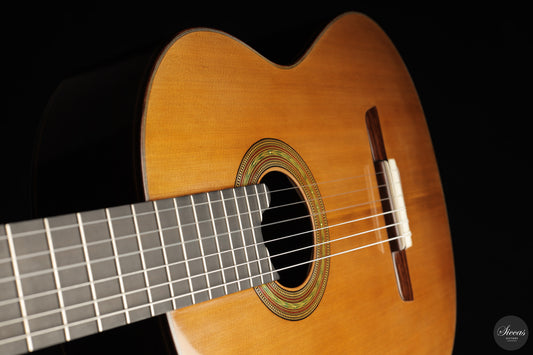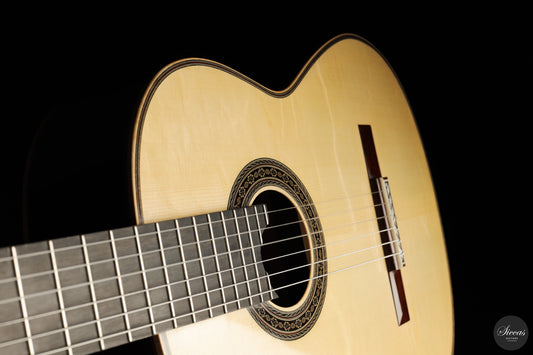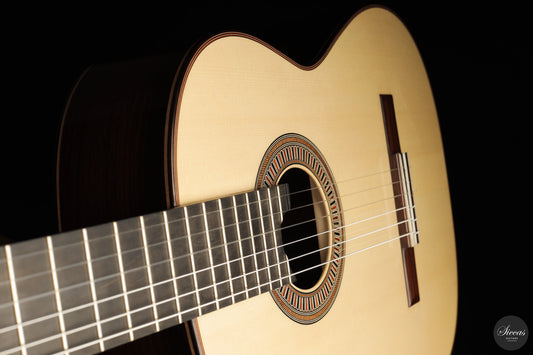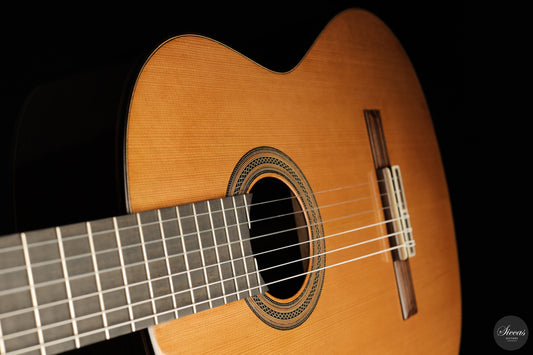

Felix Müller is one of the most promising young classical guitar makers working in Germany today. Based in Aarbergen in the Hesse region, he carries forward a distinguished family tradition rooted in some of the most innovative lutherie of the past three decades. Growing up in the workshop of his father, Antonius Müller — himself a student of master luthier Dieter Hopf and co-founder of the celebrated Albert & Müller atelier — Felix absorbed the principles of refined guitar construction from an early age. Where many luthiers spend years searching for a coherent voice, Felix Müller entered the craft with a rare clarity of purpose, and the guitars he produces already command long waiting lists among players across Europe and beyond.
Biography & Training
Felix Müller grew up immersed in the world of classical lutherie. His father, Antonius Müller, built a reputation over decades for instruments that combined structural innovation with outstanding tonal results — guitars played by internationally acclaimed artists including Sharon Isbin and Marko Topchii. From around 2013, Felix began working alongside his father in the Aarbergen workshop, learning not only the technical foundations of the craft but also the deeper sensibility that distinguishes a concert instrument from a merely competent one. His early guitars were built in the traditional Spanish method, and the fourth instrument to leave his bench already showed, in the assessment of specialist dealers, the clear predispositions of an outstanding concert guitar. As his confidence and skill grew, Felix moved progressively toward the double-top construction that would become his signature.
He participated in the Koblenz International Guitar Festival luthier exhibition in 2021, where he was introduced to a wider audience as a young and committed maker whose instruments generate a wonderful timbre, fantastic sonority, and long-lasting sustain. That kind of recognition, coming early in a career, is a marker of genuine quality. Among the broader landscape of classical guitar makers, Felix Müller stands out for the seriousness with which he has approached both the heritage and the forward-looking possibilities of the form.
Construction Philosophy
Felix Müller's approach to building is grounded in a deep respect for tonal balance. His instruments are designed to give the player access to both warmth and clarity, with the precise character of the sound shaped by the player's own attack rather than fixed by the instrument's construction alone. This flexibility — a guitar that can sound round and intimate or bright and projecting depending on how it is played — is one of the hallmarks of a truly great concert instrument.
His double-top guitars use a sandwich construction in which a core of balsa wood is bonded between two thin outer layers of tonewoods, a method that reduces the overall mass of the soundboard dramatically while preserving stiffness. This is distinct from approaches that use Nomex honeycomb as the core material, and the choice of balsa is said to contribute to the particular warmth and resonance that characterises Müller guitars. The result is a soundboard that vibrates more freely than a standard solid top, producing greater volume and a longer, richer sustain. For players and readers interested in the technical context of these approaches, a detailed overview can be found in the double-top guitar guide and in the broader history of double-top guitar pioneers.
Beyond the top construction, Müller pays close attention to the overall ergonomics of his instruments. An elevated fingerboard — raising the string plane slightly above the body — is a feature he offers, improving both right-hand access to the strings near the soundhole and the overall comfort of extended playing. The inclusion of an optional extra C note further extends the instrument's tonal range, a detail that reflects the thoughtfulness of his approach to the needs of the contemporary concert guitarist.
Signature Models & Materials
Felix Müller works with a focused palette of tonewoods selected for their acoustic and aesthetic qualities. His soundboards are offered in either European spruce or Canadian cedar, each giving a distinct tonal character: spruce tends toward brightness and clarity with a long tonal development over the life of the instrument, while cedar responds quickly and warmly, particularly attractive for players who prefer a more immediate, rounded sound. Back and sides are typically crafted from solid Indian rosewood, whose density and reflective properties contribute to strong projection and good voice separation across the registers.
The fingerboard is ebony, chosen for its hardness and smooth playing feel, and the guitars are finished in French polish — the traditional shellac-based finish that adds almost no mass to the soundboard and allows it to vibrate as freely as possible. Tuning machines are by Gotoh, combining reliability with a refined appearance. A standard scale length of 650 mm provides comfortable access for most players while maintaining the full tonal response expected of a concert instrument.
His earlier instruments, built in the Spanish tradition before the move to double-top construction, already demonstrated strong manual skills and a nuanced understanding of tonal balance. Reviewers noted soft and responsive trebles combined with a robust bass response — characteristics that have carried through into his mature work.
The Müller Legacy
To understand Felix Müller fully, it helps to appreciate the workshop from which he emerged. Antonius Müller's contribution to modern lutherie has been significant: by developing double-top instruments using balsa cores, and by building guitars of exceptional quality that reached the highest concert stages worldwide, he established a standard that very few makers anywhere have matched. That Felix was trained directly in this environment, and that he has absorbed its values so thoroughly, gives his work an unusual depth for a maker still early in his career.
The family connection is not merely biographical. It represents a direct transmission of knowledge — the kind of hands-on, workshop-based learning that has always been at the heart of the great lutherie traditions, from the masters of the Spanish school such as Ignacio Fleta to the French innovators like Robert Bouchet and Daniel Friederich. Felix Müller is part of a living chain of craft knowledge, and the instruments he makes carry that weight without being burdened by it.
Why Felix Müller Matters
In a field where the greatest makers often only achieve full recognition late in their careers or posthumously, Felix Müller has arrived with unusual speed. The combination of a rigorous family training, a clear construction philosophy centred on double-top techniques with balsa cores, and an evident sensitivity to the needs of the performing guitarist has produced instruments that are already difficult to obtain. Long waiting lists are both a practical inconvenience and a reliable signal of genuine demand from serious musicians.
His guitars offer something that remains rare even among the finest instruments: a tonal flexibility that places the expressive resources squarely in the hands of the player. Whether the music calls for a whispered pianissimo or a full orchestral fortissimo, a Müller guitar responds with clarity and warmth in equal measure. For any guitarist seeking an instrument that will grow with them over decades of playing, the work of Felix Müller deserves serious consideration.
Browse available Felix Müller guitars → in the Siccas Guitars collection.