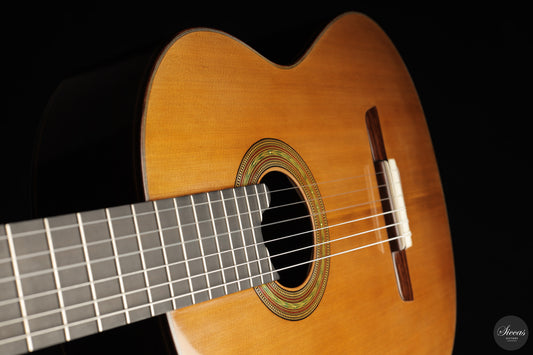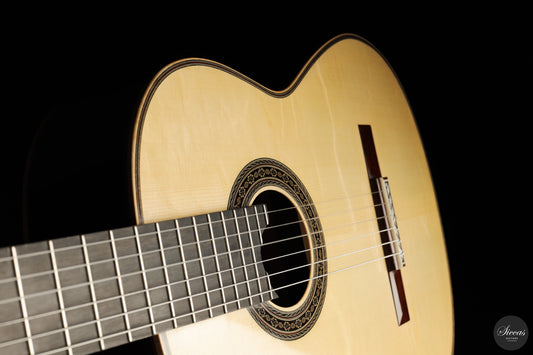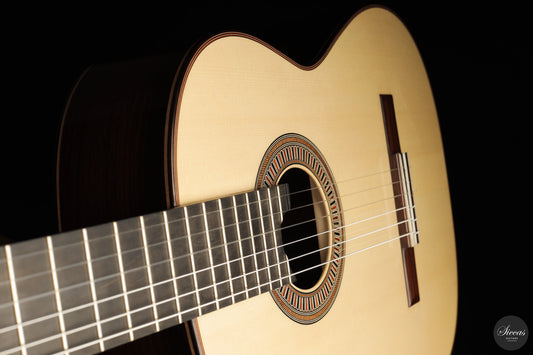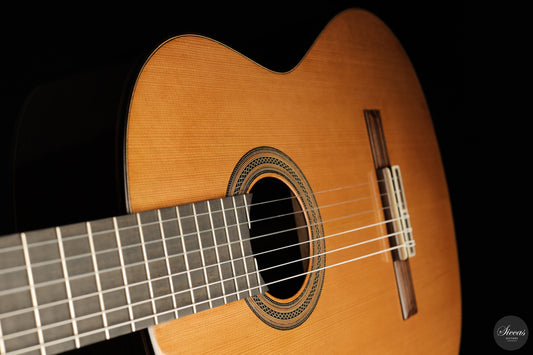

Among the contemporary Italian luthiers who have quietly earned a place on the international concert stage, Ivan Bruna stands apart for the clarity of his vision and the rigour of his craft. Working from his workshop in Rosignano Marittimo, a few kilometres from the Tuscan port city of Livorno, Bruna builds classical guitars entirely by hand — instruments conceived, above all, as working tools for the serious musician. His approach combines an unwavering respect for classical lutherie tradition with a deeply analytical ear, and the resulting instruments are prized for their tonal balance, structural reliability, and a responsiveness that serves players across the full breadth of the concert repertoire.
Biography & Training
Ivan Bruna's path to lutherie began early, shaped by a dual passion for classical music and precise manual work. As a young man he enrolled at the Civica Scuola di Liuteria in Milan — one of Italy's most respected institutions for the training of instrument makers — where he developed both the technical foundation and the aesthetic sensibility that would define his career. After completing his studies, he deepened his practical formation through an internship with master luthier Enrico Bottelli, whose influence helped sharpen Bruna's understanding of sound construction and tonal shaping at the bench.
Following his training in Milan, Bruna established his own atelier in Rosignano Marittimo, a coastal town in the province of Livorno, where he continues to work by appointment. The workshop setting — intimate, methodical, unhurried — reflects the way Bruna thinks about instrument making: each guitar receives his full attention from the selection of tonewoods to the final setup. Italy has a rich tradition of classical guitar making, with celebrated names such as Andrea and Giovanni Tacchi and contributions to collaborative projects like the Italica guitar built by twenty Italian master luthiers, and Bruna occupies a respected position within this living tradition.
Construction Philosophy
At the heart of Ivan Bruna's lutherie is a conviction that the guitar must function, first and foremost, as a reliable tool in the hands of a performing musician. He articulates his making philosophy around three interconnected principles: ease of playability, structural reliability, and tonal versatility. These are not abstract ideals but concrete criteria that guide every decision at the workbench, from the graduation of the soundboard to the shaping of the neck profile and the calibration of string action.
Playability, for Bruna, means reducing the physical demands placed on the player's hand without sacrificing control or expressive range. His structural approach results in an instrument whose strings respond with a suppleness that lessens fatigue during extended playing, particularly at higher positions on the fretboard. Reliability, meanwhile, refers to the evenness of the instrument across its entire register — the careful balancing of bass and treble frequencies through the architecture of both the body and the soundboard, so that the guitar responds predictably and proportionately whether playing softly or at full concert volume.
Tonal versatility is perhaps the most consequential of Bruna's aims. His instruments are conceived to serve a wide repertoire — from the intimate polyphony of Renaissance transcriptions to the orchestral demands of twentieth-century works — and this breadth of application is built into the guitar rather than left to chance. Rather than pursuing novelty in construction for its own sake, Bruna refines and deepens the traditional methods he inherited from his teachers. His guitars adhere to the classical lutherie lineage descending from the great Spanish and European masters, a tradition also explored in the work of figures such as José Luis Romanillos and Ignacio Fleta, while bearing the unmistakable personal signature of a maker who listens with exceptional precision.
Signature Models & Materials
Bruna's primary model — which he describes with characteristic directness as a "work tool" conceived around the player's needs — represents a synthesis of his training and his years of accumulated listening at the bench. The guitar is distinguished by a homogeneous treble register that maintains a consistent timbre across all positions, a wide dynamic range that responds honestly to gradations of touch, and an action-reaction relationship between the strings and the soundboard that experienced players consistently describe as immediate and communicative.
While Bruna does not publicly catalogue his tonewoods or bracing specifications in the manner of larger workshops, his instruments consistently demonstrate the structural refinement and tonal coherence that characterise makers who work within the Spanish-tradition fan-braced approach — a system whose acoustic properties are discussed at length in the guide to fan-braced, double-top, and lattice guitars. Each guitar is built to order and reflects a close dialogue between maker and musician, with Bruna's attention to individual requirements influencing both the voice and the physical dimensions of the finished instrument.
Teaching & Legacy
Beyond the workshop, Ivan Bruna gives back to the institution that formed him. He teaches at the Civica Scuola di Liuteria in Milan — the same school where he first learned the craft — carrying forward a tradition of pedagogical transmission that has long been central to Italian lutherie. In this respect, Bruna embodies a continuity of knowledge that connects the workshops of the past with the makers of the future, a thread that runs through the broader history of classical guitar making from its nineteenth-century origins to the present.
His instruments have found players internationally, and Siccas Guitars has worked with Bruna over a number of years to bring his concert guitars to musicians worldwide. The relationship reflects a shared commitment to instruments that perform at the highest level — guitars built not to impress in the showroom but to sustain a professional musician through years of concert work and daily practice. For players who seek an Italian voice rooted in tradition but refined through a rigorous modern sensibility, Bruna's instruments represent a compelling and deeply considered choice.
Browse available Ivan Bruna guitars → in the Siccas Guitars collection.